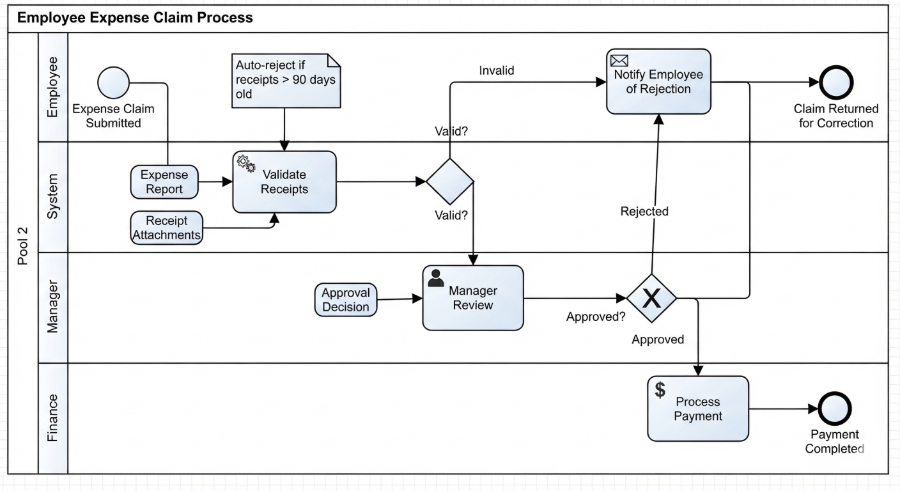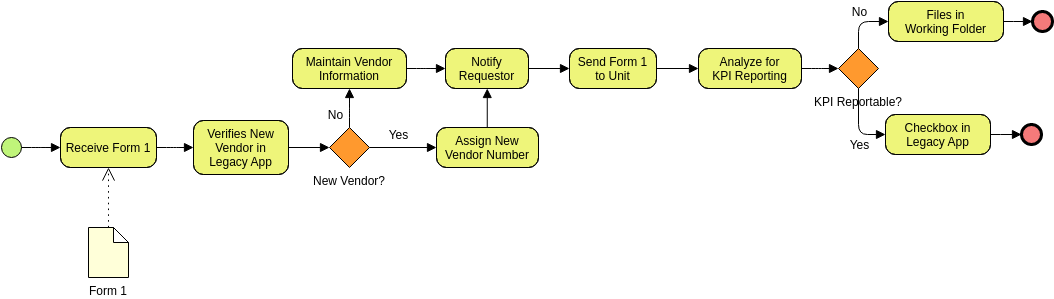
Welcome to the essential world of Business Process Model and Notation (BPMN). In the modern business landscape, understanding how an organization operates is the first and most critical step toward improvement. BPMN serves as the universal visual language for this purpose. It is a graphical representation of workflows that bridges the communication gap between business stakeholders, analysts, and technical developers. Whether you are documenting an “As-is” process or designing a future state, mastering BPMN is essential for operational excellence.
The Foundation: Standards and Governance
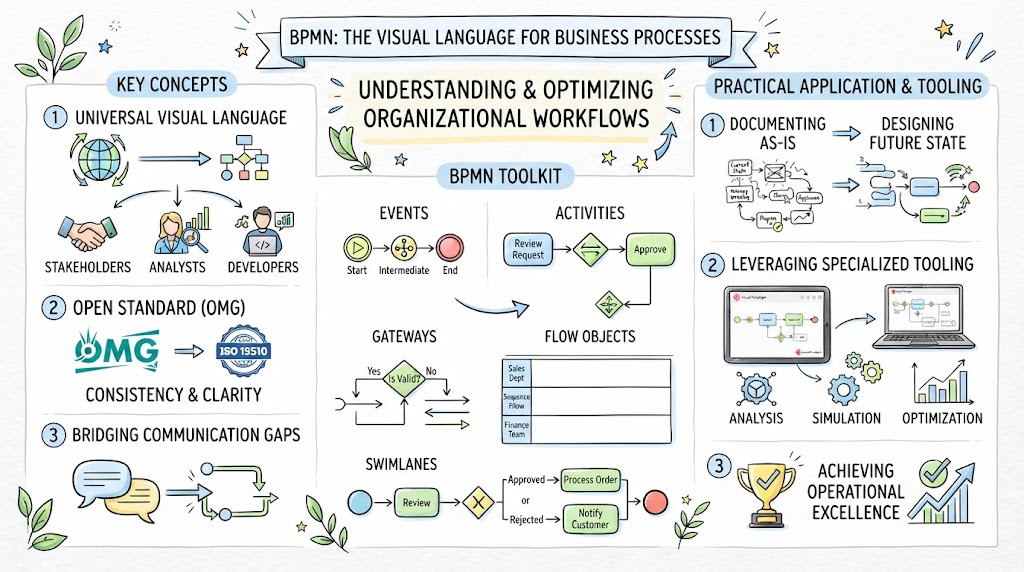
To truly appreciate the power of this notation, we must look at its roots. BPMN is not just a random set of drawings; it is an open standard maintained by the Object Management Group (OMG) and formalized as ISO/IEC 19510. This standardization ensures consistency and clarity across different industries and organizations. By adhering to these guidelines, we ensure that a process diagram created by one team can be perfectly understood by another, regardless of their location or technical background.
The BPMN Toolkit: Understanding Core Elements
Think of BPMN as a toolkit filled with specific symbols, each carrying a distinct meaning. To design effective workflows, you must be fluent in the vocabulary of these elements. Let’s break down the core components you will encounter:
- Flow Objects: These are the primary building blocks.
- Events: Represented by circles, these denote something that happens during the process. You have Start events (green circle), Intermediate events (yellow circle), and End events (red circle).
- Activities: Represented by rounded rectangles, these are the actual work being performed, such as “Review Request” or “Approve.”
- Gateways: Represented by diamonds, these control the flow of the process. They are used for decision points, like asking “Is Valid?” to determine if a process continues or branches off.
- Swimlanes: These partition the diagram to show who is responsible for what. A swimlane might be labeled “Sales Dept,” “Sequence Flow,” or “Finance Team,” ensuring clear accountability.
- Connecting Objects: These arrows link the flow objects together, guiding the reader through the sequence of events.
Practical Application: From Documentation to Design
Why do we create these models? The application is twofold. First, we document the current reality, known as the “As-is” process. This allows organizations to see exactly how work flows today, identifying bottlenecks and inefficiencies. Second, we use this knowledge to design the “Future State” or “To-be” process. This is where optimization happens—redesigning the workflow to be faster, cheaper, or higher quality.
This journey from As-is to Future state is where specialized tooling becomes indispensable. While you can draw BPMN on a whiteboard, digital tools offer much more power. This is where platforms like Visual Paradigm shine. Visual Paradigm facilitates designing, modeling, and implementing these concepts effectively by providing a robust environment for creating these diagrams.
Leveraging Visual Paradigm for Process Excellence
Transitioning from static diagrams to dynamic assets is crucial for modern analysis. When you use Visual Paradigm, you are not just drawing boxes and lines; you are building a model that can be analyzed and simulated. Here is how the tool enhances the workflow:
- Analysis: Visual Paradigm allows you to visualize complex processes clearly. You can instantly see dependencies and potential issues in the flow of information between stakeholders, analysts, and developers.
- Simulation: You can run simulations on your BPMN diagrams to predict how a process will behave under different conditions. This helps in testing the “Future State” before you commit resources to it.
- Optimization: By analyzing the simulation results, you can refine your process to achieve true operational excellence. Visual Paradigm supports the entire lifecycle, ensuring that your design translates seamlessly into implementation.
In conclusion, BPMN is more than just a standard; it is a strategic asset. By combining a deep understanding of the core elements—Events, Activities, and Gateways—with powerful tools like Visual Paradigm, you can transform your organizational workflows from chaotic messes into streamlined engines of efficiency.