Welcome to the Future of Technical Documentation
Welcome, everyone. As we dive into the modern landscape of software architecture and technical documentation, it is crucial to acknowledge a significant shift in how we work. For years, tools like PlantUML and Mermaid have been the gold standard for “Diagram-as-Code,” offering the unbeatable benefits of version control and reproducibility. However, let’s be honest about the barrier to entry: the steep learning curve of syntax memorization. If you have ever struggled to remember exactly how to code a specific relationship or layout in a raw text file, you know the frustration.
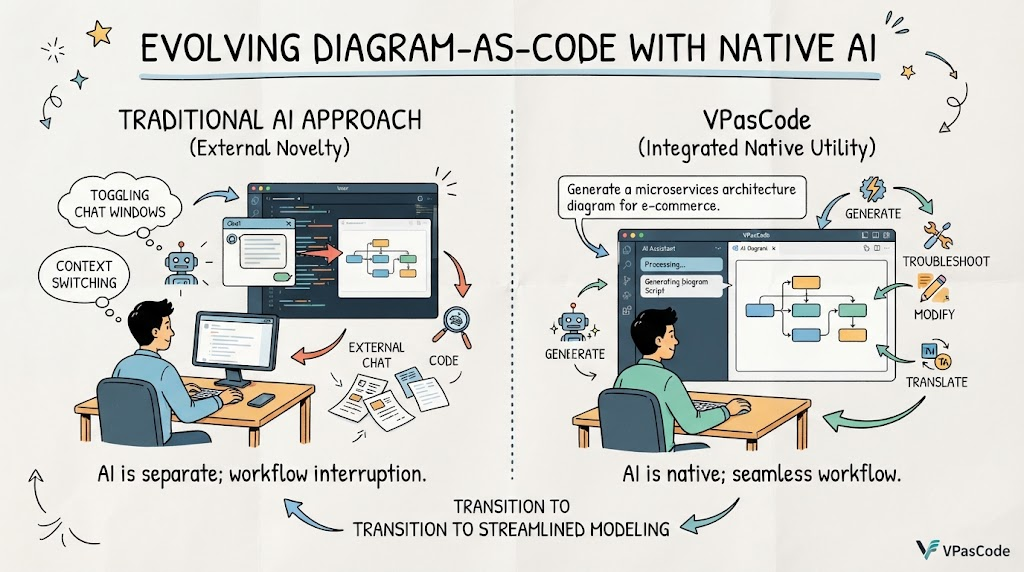
Today, we are looking at a major evolution in this space with the latest update to Visual Paradigm’s VPasCode platform. This update fundamentally changes the dynamic by introducing native AI capabilities. We are moving away from a strict text editor environment toward an automated, conversational design environment. This guide will walk you through how to leverage these new generative AI features to bridge the gap between your abstract ideas and concrete visual models.
1. The Embedded AI Mini Chatbot: From Syntax to Semantics
The most immediate change you will notice is the introduction of the Embedded AI Mini Chatbot. This feature transforms the way you initiate diagram creation. Instead of starting with a blank slate and worrying about the correct command structure, you can now simply converse with the platform.
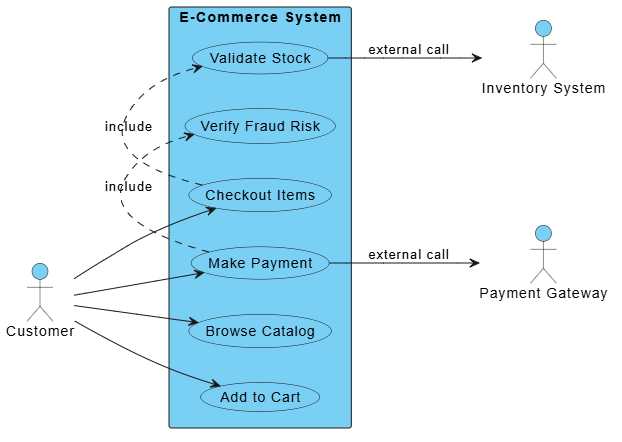
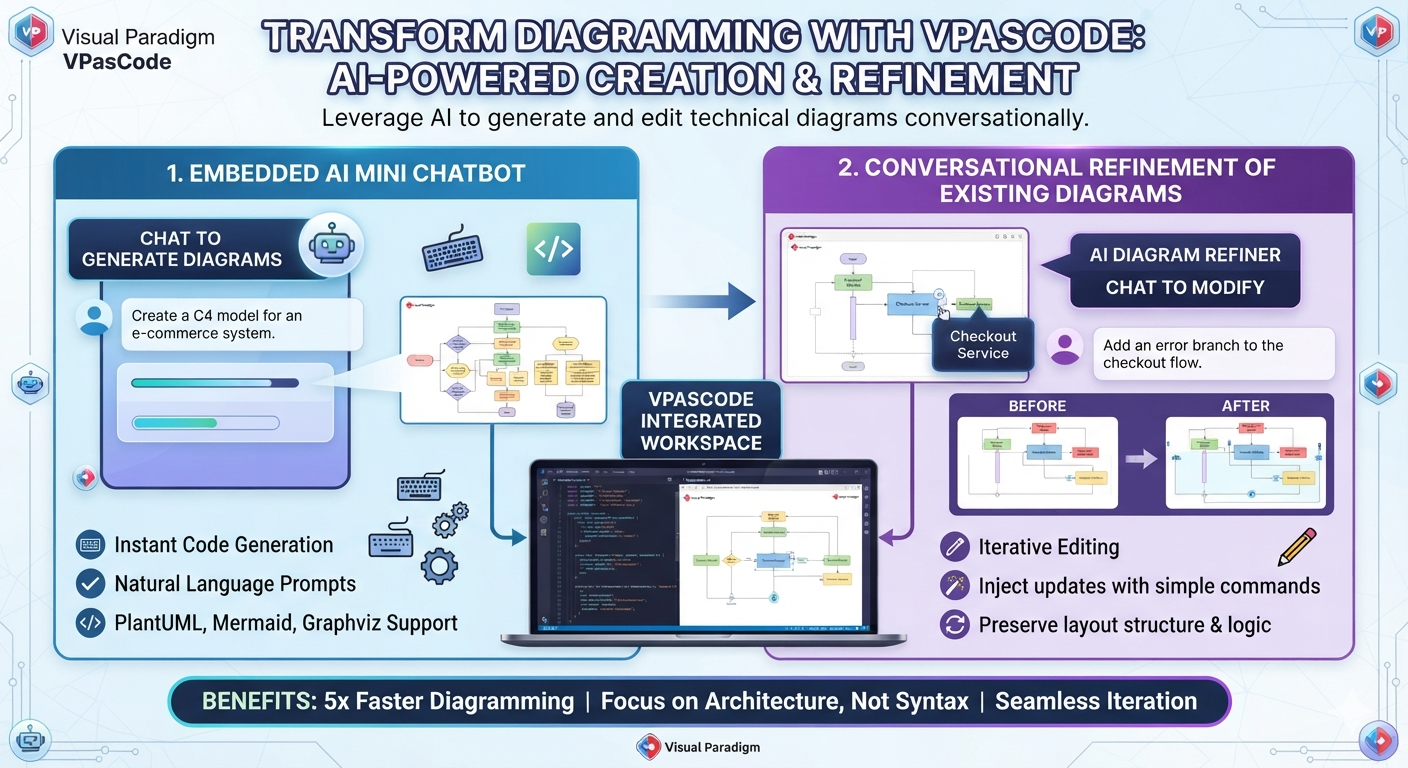
Imagine you are a software architect tasked with mapping out a complex microservices ecosystem. In the past, you might have spent hours defining the containers and components. With VPasCode, you can simply type a natural language prompt. For instance, as illustrated in our workflow, you can instruct the system: “Create a C4 model for an e-commerce system.”
Within moments, the AI handles the heavy lifting of generating the code. This feature is incredibly powerful because it supports multiple diagramming languages, ensuring you aren’t locked into a single ecosystem. VPasCode now provides:
- Instant Code Generation: Transform your text prompts into executable code immediately.
- Natural Language Prompts: Speak your requirements rather than coding them.
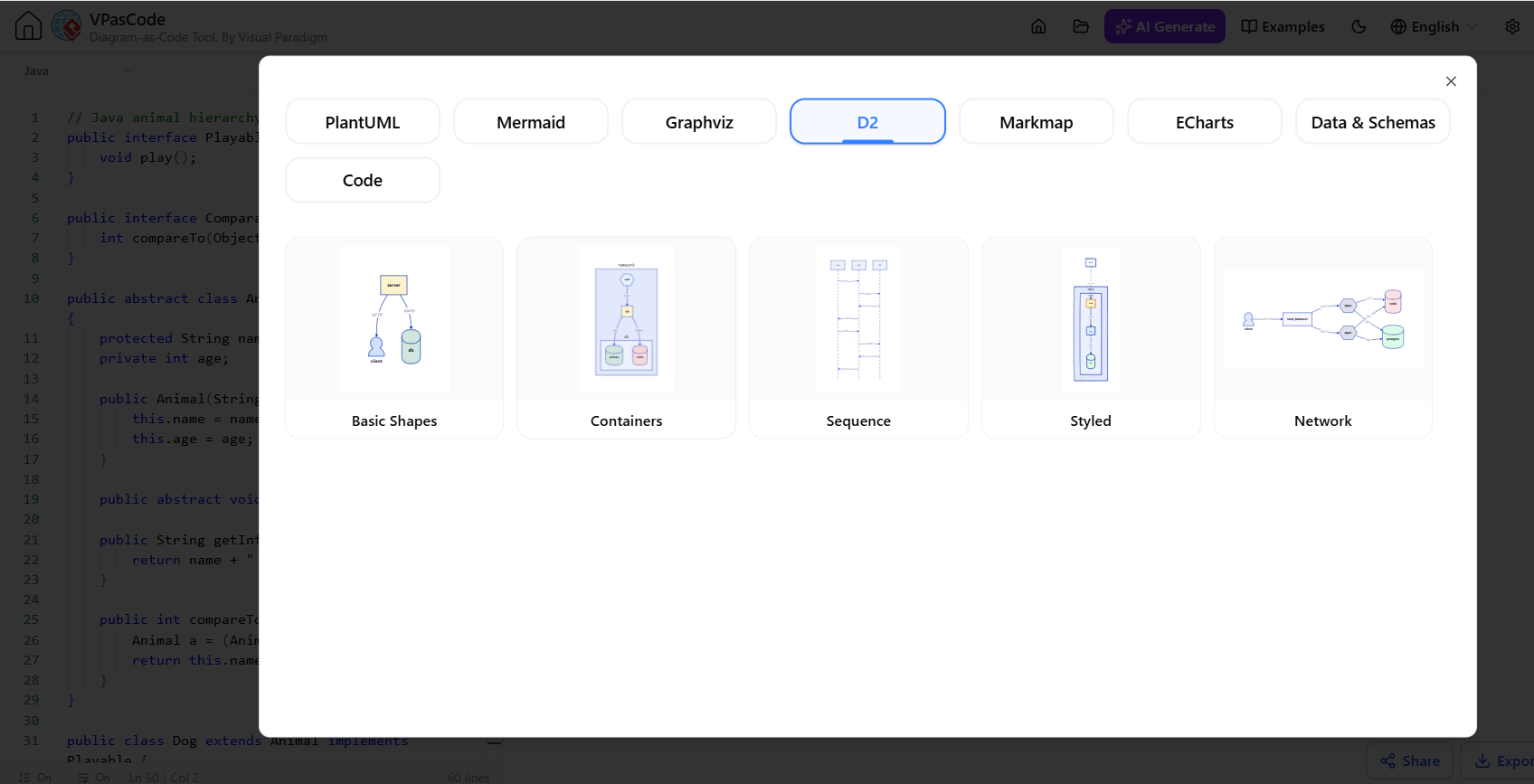
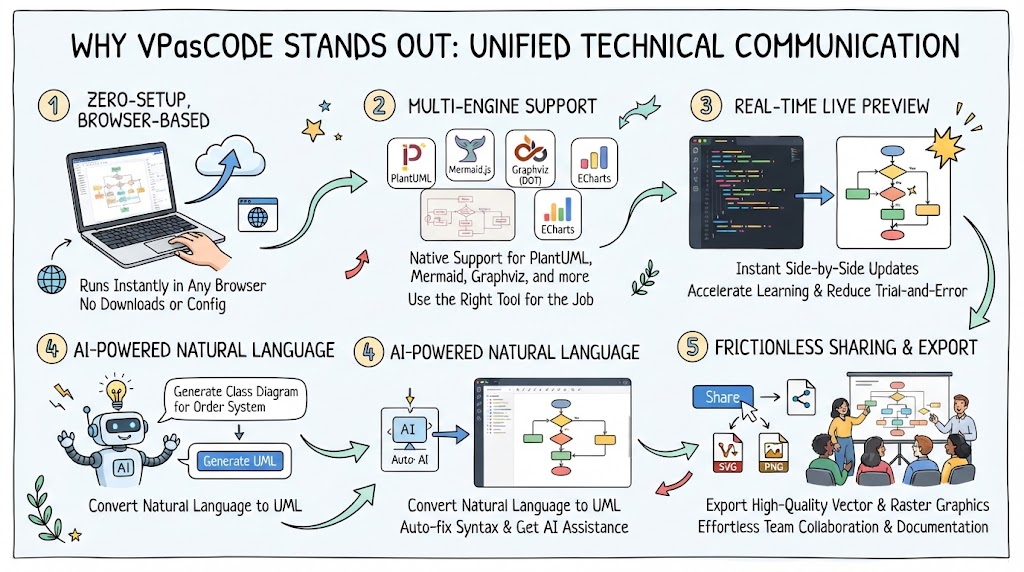
- Multi-Language Support: Native support for PlantUML, Mermaid, and Graphviz allows you to work in the syntax you are most comfortable with.
2. Conversational Refinement of Existing Diagrams
One of the most common challenges in diagramming is iteration. You create a diagram, realize a component is missing, or a flow needs adjustment, and suddenly you are back to the drawing board. Visual Paradigm addresses this with the AI Diagram Refiner, a feature dedicated to the conversational modification of existing diagrams.
This functionality allows you to treat your diagram as a living document that can be edited through simple commands. Let’s look at a practical example involving a Checkout Service. Suppose you have a flowchart representing a user’s journey. You realize that if a payment fails, the system needs a specific error handling branch.
Instead of manually dragging and dropping nodes and reconnecting arrows, you can instruct the AI to “Add an error branch to the checkout flow.” The system intelligently understands your intent, modifies the underlying code, and updates the visual representation. The result is a seamless “Before” and “After” transition where the layout structure and logic are preserved, but the complexity of the task is reduced to a simple chat message.
This iterative editing capability offers three distinct advantages:
- Iterative Editing: Refine your models in real-time as your requirements evolve.
- Simple Commands: Inject updates without needing to know the specific syntax for every node type.
- Preserved Logic: The AI maintains the integrity of your existing diagram structure while applying changes.
3. The Benefits: Focus on Architecture, Not Syntax
The ultimate goal of these updates is to liberate you from the mechanics of drawing and allow you to focus on the mechanics of thinking. By offloading the syntax management to the AI, Visual Paradigm enables a 5x faster diagramming process.
Whether you are a product manager defining user flows or a developer implementing system architecture, VPasCode acts as a bridge. It facilitates designing, modeling, and implementing concepts effectively by ensuring that your time is spent on the logic of the system, rather than the syntax of the tool.
As we move forward, platforms like VPasCode are redefining what it means to be a technical writer or an architect. By embracing these AI-powered tools, we can achieve a level of documentation quality and speed that was previously unattainable. Welcome to the era of conversational diagramming.