Demystifying Complex Codebases with Multi-Language Class Diagrams
In the modern software development landscape, we often find ourselves navigating projects that span multiple programming languages. Whether you are maintaining a legacy monolith or building a microservices architecture, understanding the underlying structure of your code is paramount. However, staring at raw source code can be overwhelming when trying to grasp the high-level architecture, relationships, and inheritance hierarchies. This is where the power of reverse engineering comes into play, transforming opaque text into clear, visual models.
Today, we are exploring a transformative capability within the Visual Paradigm ecosystem: the ability to generate UML Class Diagrams from source code across a vast array of programming languages using VPasCode. As we dive into this tutorial, you will discover how this tool bridges the gap between code and design, allowing you to visualize your application’s structure instantly.
The Challenge of Polyglot Development
Software projects rarely stick to a single language anymore. A typical enterprise application might utilize Java for backend services, TypeScript for the frontend, and perhaps Go or Rust for high-performance microservices. When you need to document these systems or onboard a new developer, describing the class relationships and dependencies purely through text documentation is inefficient and prone to becoming outdated.
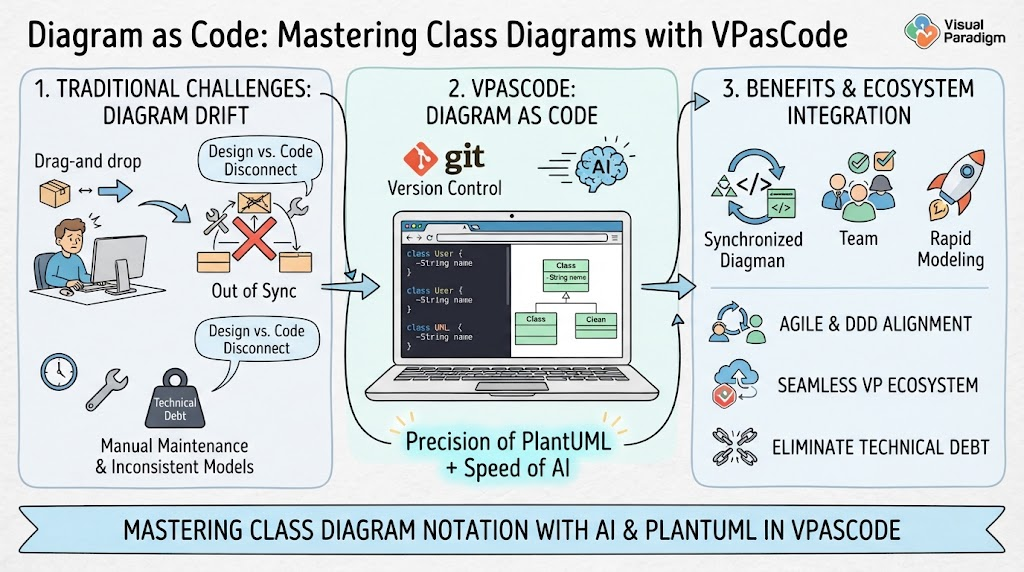
Visual Paradigm addresses this challenge by offering a robust engine that parses application code to visualize relationships, inheritance, and dependencies automatically. Instead of manually drawing diagrams that might quickly become stale, you can let the tool read your code and generate the diagram for you. This ensures that your documentation is always in sync with your actual implementation.
Universal Support: A Language-Agnostic Approach
One of the most impressive features of this technology is its extensive support for multi-language environments. VPasCode does not limit you to a single syntax; it understands the nuances of the industry’s most popular languages. This allows you to treat your entire codebase as a unified model, regardless of the underlying syntax.
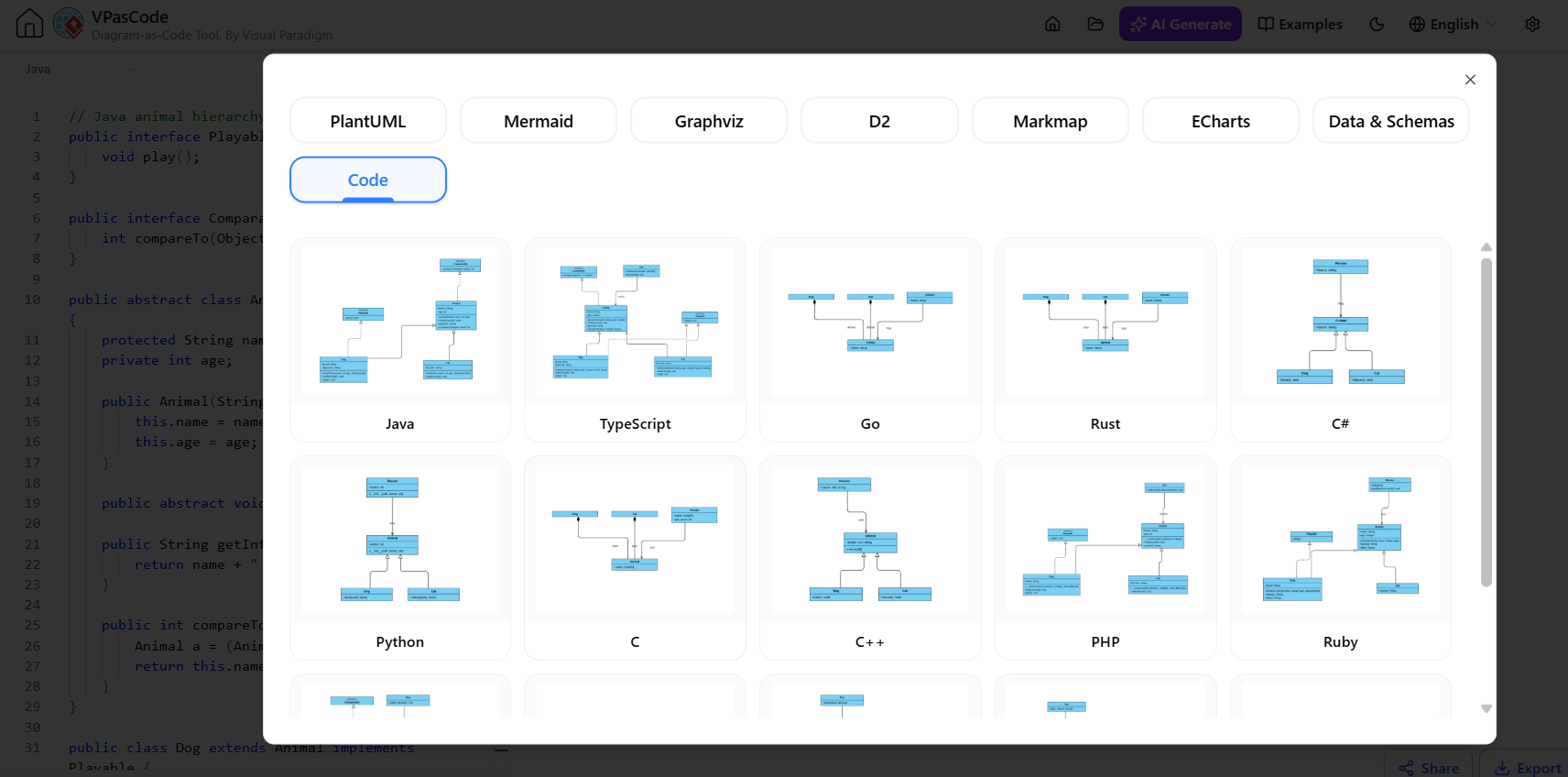
The engine currently supports the following languages, ensuring comprehensive coverage for most development stacks:
- Core Backend & Web: Java, TypeScript, C#, Python, C++, C, PHP, Ruby, Scala, Kotlin, Swift.
- Systems & Performance: Go, Rust, Elixir.
This breadth of support means that whether your project is written in the statically typed rigor of Rust or the dynamic flexibility of Python, you can generate a consistent UML Class Diagram to understand the flow of data and logic.
How VPasCode Facilitates Modeling
Imagine you are working on a complex inheritance hierarchy, perhaps an animal simulation system involving interfaces like Playable or Comparable. In a traditional workflow, you might spend hours manually creating boxes and arrows in a modeling tool. With VPasCode, the process is reversed.
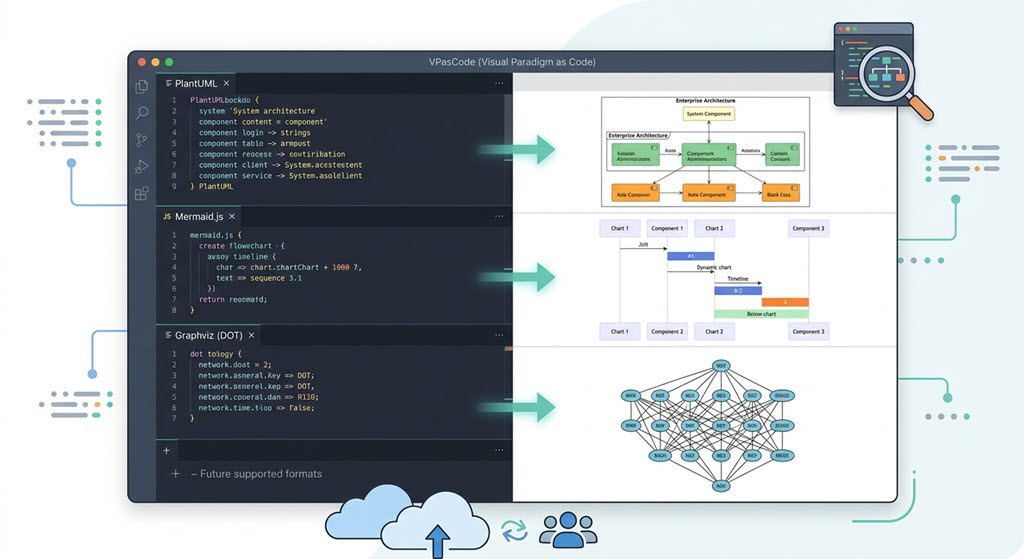
By feeding your source code into the engine, you get an immediate visualization. For instance, if you have a public class Dog extends Animal in Java, or a similar struct inheritance in Rust, the tool parses these definitions and renders the class boxes and inheritance arrows automatically. It highlights:
- Inheritance: Clearly showing parent-child relationships between classes.
- Interfaces: Visualizing how classes implement specific contracts (like the
Playableinterface mentioned in common examples). - Dependencies: Mapping out how different components rely on one another.
This capability is particularly useful for reverse engineering existing projects. If you have inherited a codebase without documentation, you can instantly generate a diagram to understand the architecture before making any changes. This reduces the risk of breaking dependencies and speeds up the learning curve significantly.
Integrating with the Visual Paradigm Ecosystem
VPasCode is not an isolated tool; it is a powerful component of the broader Visual Paradigm suite. By integrating code-to-diagram generation with Visual Paradigm’s robust modeling features, you create a seamless workflow. You can generate a diagram from your code, then refine it manually if needed, or even use the diagram to generate new code scaffolding.
This bidirectional flow—moving from Code to Diagram and back again—is essential for modern agile development. It allows teams to maintain a single source of truth. When the code changes, the diagram updates. When the model is refined, the code can be regenerated. This synergy ensures that your design and implementation remain perfectly aligned.
Conclusion
In an era where code complexity is constantly increasing, tools that simplify visualization are not just a luxury; they are a necessity. By leveraging VPasCode and Visual Paradigm, developers can instantly gain clarity on their projects, regardless of the language used. Whether you are a Java veteran, a Rust enthusiast, or a Python developer, the ability to reverse engineer your code into a clear UML Class Diagram empowers you to design better, document faster, and maintain your software with confidence.