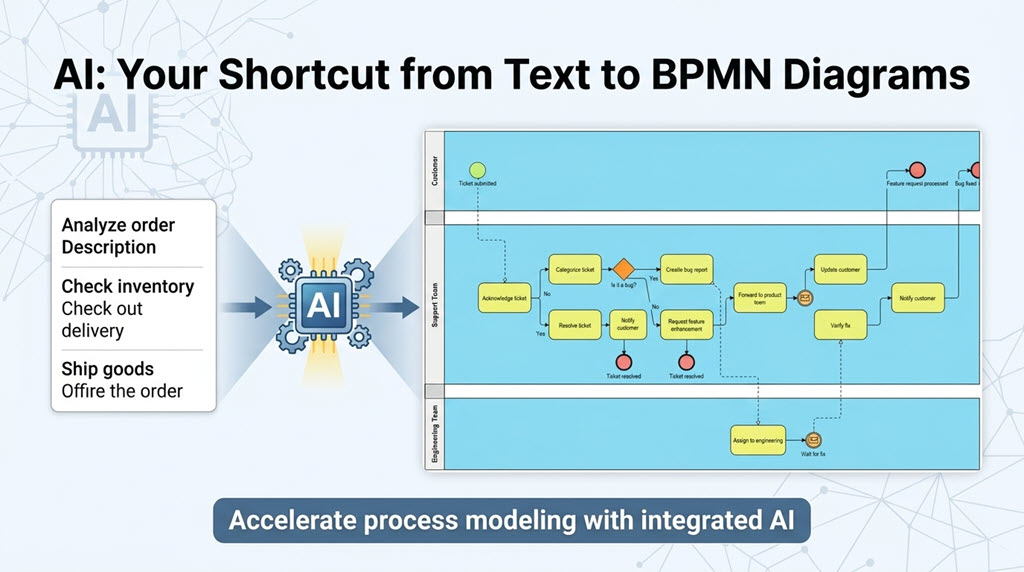
In the world of Business Process Management (BPM), the gap between an idea and a documented process has traditionally been bridged by hours of manual diagramming. However, with the integration of Artificial Intelligence into tools like Visual Paradigm, the paradigm is shifting. This tutorial explores how to leverage AI to transform simple text descriptions into complex, compliant BPMN 2.0 diagrams, specifically analyzing the workflow shown in the “Support Ticket” example.
1. The Input: Analyzing the Text Prompt
The process begins with a textual input. In the image provided, the system is fed a set of high-level directives. These are not just random words; they represent the core triggers and outcomes of a business process.
- Analyze order Description: This acts as the trigger event. In BPMN terms, this is often an Intermediate Event or a Start Event that initiates the flow.
- Check inventory / Check out delivery: These represent standard operational tasks. The AI identifies these as User Tasks that need to be assigned to a specific actor.
- Ship goods / Offere the order: These are terminal or outcome-based actions. The AI recognizes these as steps leading toward the end of the process.
Key Concept: The AI engine parses these sentences to identify the Subject (who is doing it), the Verb (the action), and the Object (what is being acted upon). This semantic analysis allows the AI to map natural language into structured process logic.
2. The Architecture: Swimlanes and Actors
Once the AI processes the input, it generates a visual representation. A critical aspect of BPMN is the use of Swimlanes (or Pools) to separate responsibilities. In the generated diagram, we see a clear separation of duties:
- Customer Pool: The external actor initiating the request (“Ticket submitted”).
- Support Team Pool: The internal team handling the initial triage, categorization, and customer communication.
- Engineering Team Pool: The specialized technical team responsible for the actual fix or enhancement.
This structure ensures that the diagram clearly communicates who is responsible for what, a fundamental requirement for effective business analysis.
3. Decoding the Logic: Gateways and Decision Points
The most sophisticated part of the generated diagram is the logic flow. The AI has correctly identified a decision point within the workflow.
The Exclusive Gateway
In the center of the Support Team lane, there is a diamond shape labeled Is it a bug?. In BPMN terminology, this is an Exclusive Gateway.
This logic dictates that the process cannot proceed in parallel; it must choose exactly one path based on the condition:
- The “Yes” Path (Bug Detected): If the ticket is a bug, the flow moves to Create bug report. This task connects to the Engineering Team, indicating a hand-off of work.
- The “No” Path (Feature/Other): If it is not a bug, the flow moves to Resolve ticket. This indicates a self-contained task handled entirely by the Support Team.
4. The Flow: From Start to End
Let’s walk through the specific lifecycle of a ticket as modeled by the AI:
- Initiation: The process starts when the Customer submits a ticket. This is represented by a green circle (Start Event).
- Triage: The Support Team acknowledges the ticket and categorizes it.
- Decision: The team asks, “Is it a bug?”
- Branch A (Bug Fix):
- A bug report is created.
- The task Request feature enhancement (or bug fix) is forwarded to the Engineering Team.
- The Engineering Team waits for the fix.
- The Support Team updates the customer.
- The process concludes with the Red Circle (End Event): Bug fixed.
- Branch B (Ticket Resolved):
- The ticket is resolved directly.
- The customer is notified.
- The process concludes with the Red Circle (End Event): Ticket resolved.
5. Why AI-Generated BPMN Matters
As demonstrated by this “Ticket Resolution” model, AI-driven modeling tools like Visual Paradigm offer three distinct advantages:
- Speed: What might take a business analyst 30 minutes to draw (dragging shapes, connecting lines, formatting swimlanes) is generated in seconds.
- Standardization: The AI enforces BPMN 2.0 standards. You don’t have to worry about whether a diamond represents an XOR or an AND gateway; the AI applies the correct notation based on the context of the text.
- Focus on Logic: Instead of spending time on the aesthetics of the diagram, business analysts can focus on the logic of the business rules themselves.
By using AI as a starting point, you can rapidly prototype complex workflows, validate them with stakeholders, and then refine them manually if necessary. This “Text-to-Diagram” capability is the future of process documentation.