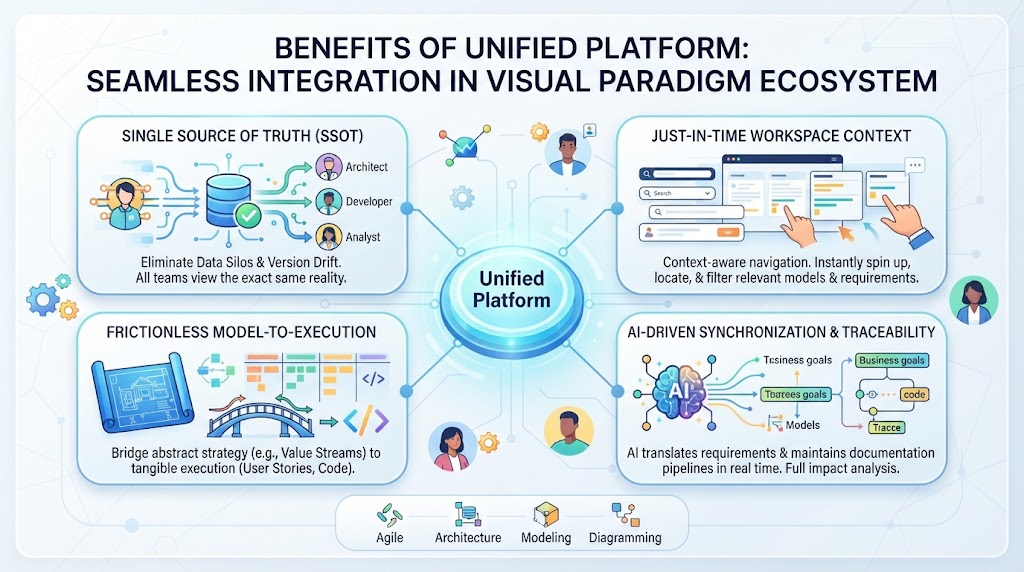
In modern software development and enterprise architecture, the biggest bottleneck is often not the lack of tools, but the fragmentation between them. Traditional workflows often treat modeling, agile planning, and architecture frameworks as isolated islands. However, as illustrated in the Visual Paradigm Unified Platform ecosystem, the future of efficient development lies in connecting these pillars into a single, living knowledge base.
This tutorial will guide you through the four critical operational advantages of this unified approach: Single Source of Truth (SSOT), Just-in-Time Context, Frictionless Model-to-Execution, and AI-Driven Synchronization.
1. Establishing a Single Source of Truth (SSOT)
The foundation of any robust technical ecosystem is data integrity. In a fragmented environment, “version drift” occurs—where the architecture diagram does not match the database schema, which in turn does not match the agile backlog. This leads to costly errors and miscommunication.
How SSOT Works
When you operate within a unified platform, you eliminate data silos. The system ensures that changes made in one area instantly propagate to others. Consider the following workflow:
- Architecture Changes: When an architect modifies a class diagram or a capability map, the change is immediately reflected in the system’s data dictionary.
- Agile Alignment: Because the data is centralized, these changes instantly update the associated agile backlogs and user stories.
- Process Consistency: Process maps are updated in real-time, ensuring that business analysts, developers, and architects are always looking at the exact same reality.
Key Takeaway: By centralizing your data, you ensure that cross-functional teams never work from outdated or conflicting information.
2. Implementing Just-in-Time Workspace Context
One of the most common productivity killers in software engineering is “search fatigue.” Developers and architects often spend hours hunting for specific requirements, use cases, or relevant diagrams across disconnected repositories.
Dynamic Navigation
A unified platform solves this through context-aware navigation. Instead of manually opening multiple applications, the workspace dynamically adapts to the user’s needs.
- Spin Up: Instantly launch the specific view or model relevant to your current task.
- Locate: Use intelligent filtering to find specific models or requirements without sifting through irrelevant files.
- Filter: The system presents only the data you need right now, whether you are a Product Manager reviewing high-level strategy or a Developer looking at low-level code.
3. Creating Frictionless Model-to-Execution Pipelines
The gap between abstract strategy and tangible execution is where many projects fail. High-level goals often get lost when translated into technical requirements, leading to “scope creep” or misaligned deliverables.
Bridging the Gap
Visual Paradigm’s integrated approach creates a seamless pipeline that bridges this gap without manual re-entry. This process typically flows as follows:
- Abstract Strategy: Start with high-level
Value Stream MappingandCapability Mappingto define business goals. - Tangible Execution: Automatically link these strategies to
User StoriesandScrum Backlogs. - Technical Implementation: Further refine these into technical artifacts like
Class Diagramsand database schemas.
This ensures that every line of code written can be traced back to a specific business value, and every business goal has a concrete technical implementation.
4. Leveraging AI-Driven Synchronization
The final pillar of this ecosystem is the integration of Artificial Intelligence to maintain the health of the platform. AI is not just a feature; it is the glue that keeps the ecosystem synchronized.
Real-Time Intelligence
By leveraging AI across the unified ecosystem, you can achieve:
- Requirement Translation: Automatically translate natural language requirements into structured models.
- Design Standards: Cross-reference designs against established enterprise standards to ensure compliance.
- Documentation Pipelines: Maintain documentation automatically in real-time, ensuring that what is built matches what is documented.
Conclusion: End-to-End Traceability
By integrating these four pillars, organizations achieve End-to-End Traceability. You can instantly perform impact analysis from high-level business goals down to specific database schemas, code snippets, or test cases. Whether you are preparing for a compliance audit or executing a strategic pivot, a unified platform provides the clarity and speed necessary to succeed.