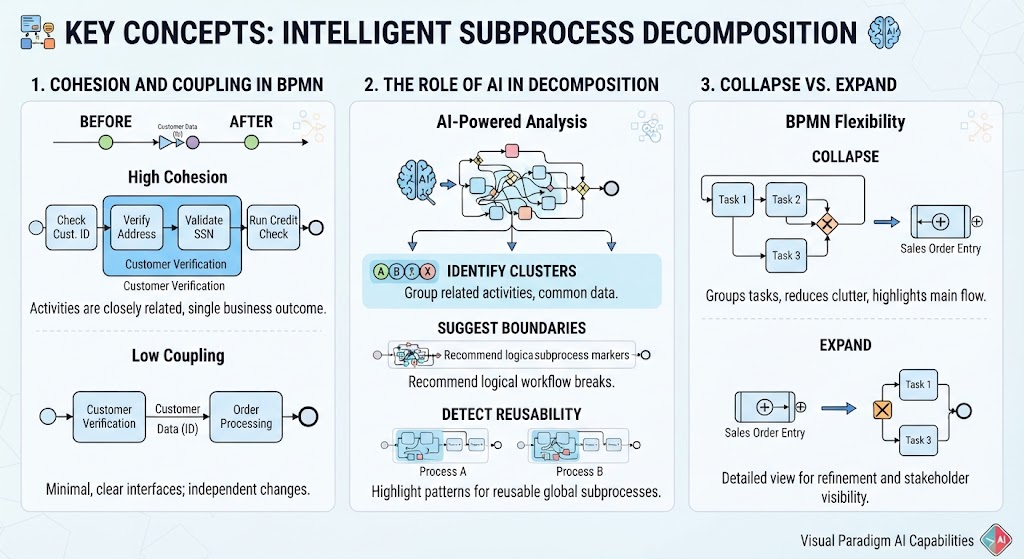
In the complex world of Business Process Management, clarity is king. When diagrams become cluttered with dozens of tasks, stakeholders lose the forest for the trees. This tutorial explores Intelligent Subprocess Decomposition, a strategy that combines fundamental architectural principles with modern AI capabilities to create clean, maintainable, and scalable BPMN models.
We will break down the three pillars of this methodology: the architectural rules of Cohesion and Coupling, the analytical power of AI, and the practical flexibility of the Collapse vs. Expand workflow.
1. The Architectural Foundation: Cohesion and Coupling
Just as software architecture relies on these principles, effective process design requires a balance between Cohesion and Coupling. Visual Paradigm’s approach to decomposition is rooted in these concepts.
High Cohesion: The Power of Grouping
High Cohesion dictates that activities within a subprocess should be closely related and contribute to a single, well-defined business outcome. When a group of tasks shares a common purpose, they belong together.
- Before: You might see a sequence of unconnected tasks like “Check Cust. ID,” “Verify Address,” “Validate SSN,” and “Run Credit Check” scattered across a diagram.
- After: These are logically grouped into a single Customer Verification subprocess. This encapsulates the logic, making the high-level process cleaner and the specific logic easier to find.
Low Coupling: The Art of Independence
Low Coupling ensures that subprocesses interact through clear, minimal interfaces. They should be independent enough that a change in one does not necessitate widespread changes in others.
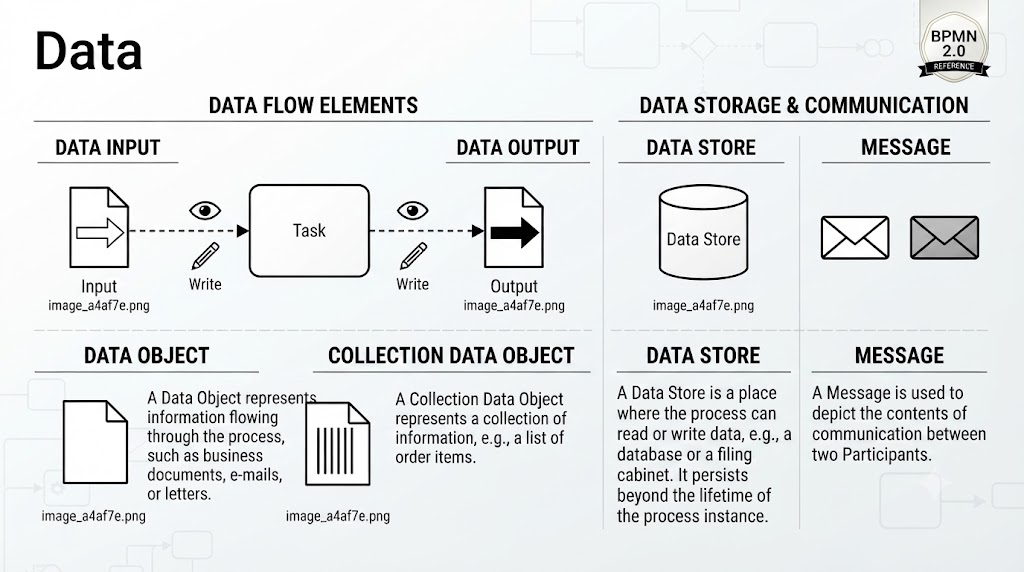
- Imagine a Customer Verification subprocess that passes a Customer Data (ID) object to an Order Processing subprocess.
- Because the interface is defined clearly (just the ID), you can improve the verification logic inside the first subprocess without ever touching the second one. This modularity is key to scalable process management.
2. The Role of AI in Decomposition
Traditionally, deciding where to draw the lines for a subprocess was a manual, subjective task. However, AI algorithms are changing this by analyzing semantic relationships between activities, data flows, and decision points.
Identify Clusters
AI tools can analyze a process to find groups of activities that frequently occur together or share common data inputs. Instead of guessing which tasks belong together, the system highlights clusters based on actual data flow patterns, ensuring that your grouping is logical rather than arbitrary.
Suggest Boundaries
Once clusters are identified, the system recommends where to insert subprocess markers. It looks for logical breaks in the workflow—places where the process naturally pauses or transitions—to suggest the most effective boundaries for your subprocesses.
Detect Reusability
One of the most powerful features of AI analysis is the ability to detect patterns. If the system notices a specific sequence of tasks (a pattern) appearing in multiple different processes (e.g., “Process A” and “Process B”), it will highlight this for reusability. This suggests collapsing these patterns into a single, reusable global subprocess, reducing redundancy and maintenance efforts.
3. The Art of Collapse vs. Expand
Finally, BPMN modeling is not a “one-time” setting; it is a dynamic view. The ability to Collapse and Expand allows you to control the level of detail presented to your audience.
Collapse: Reducing Visual Clutter
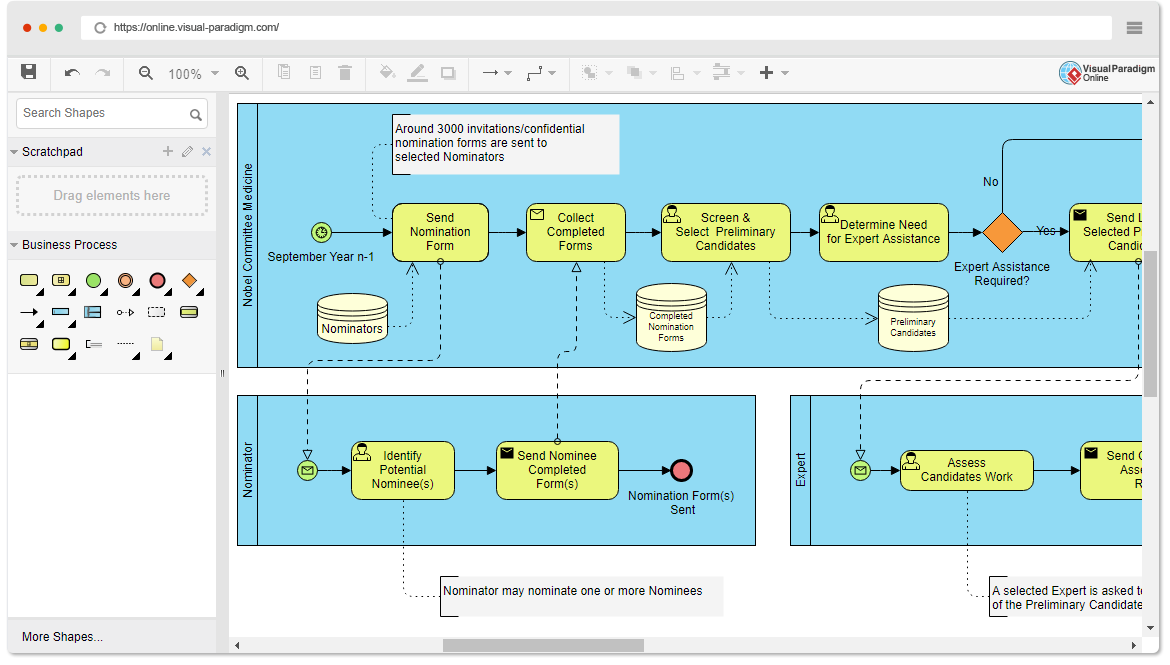
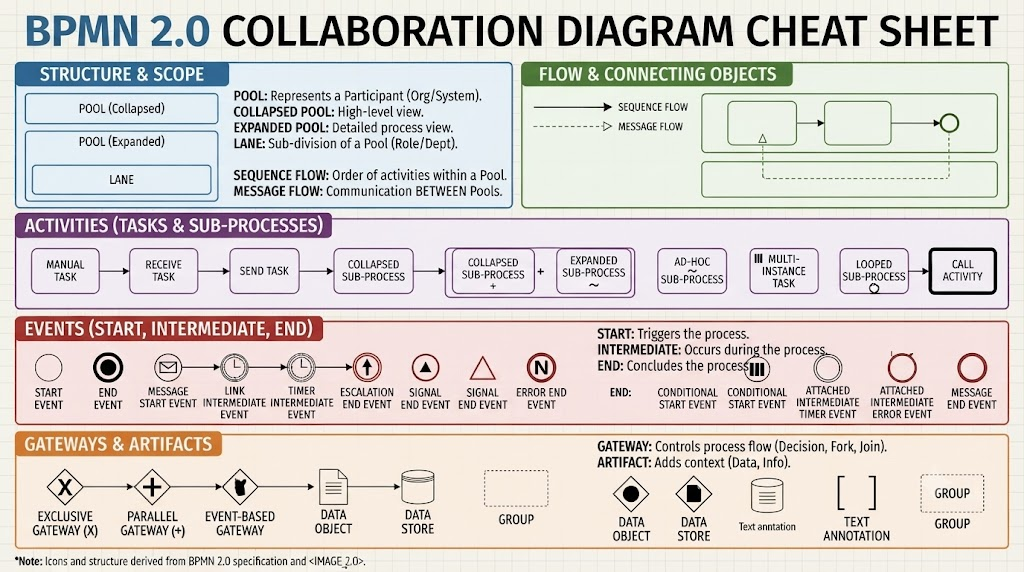
When a sequence of tasks forms a self-contained unit with a clear start and end, it should be Collapsed into a subprocess. This transforms a complex web of tasks into a single, neat icon (often marked with a plus sign). This reduces visual clutter and highlights the main flow of the business, allowing executives to see the “big picture” without getting bogged down in details.
Expand: Detailed Refinement
Conversely, if a subprocess becomes too complex or if specific stakeholders need visibility into the details, it can be Expanded back into its constituent tasks. This is crucial for the refinement phase, where analysts need to verify logic, adjust decision points, or troubleshoot specific errors within the subprocess.
Summary of Benefits
- Collapse: Groups tasks, reduces clutter, and highlights the main business flow.
- Expand: Provides a detailed view for refinement and ensures stakeholder visibility where needed.
By combining these architectural principles with AI-driven analysis, you can build BPMN models that are not just diagrams, but intelligent, maintainable representations of your business logic.