


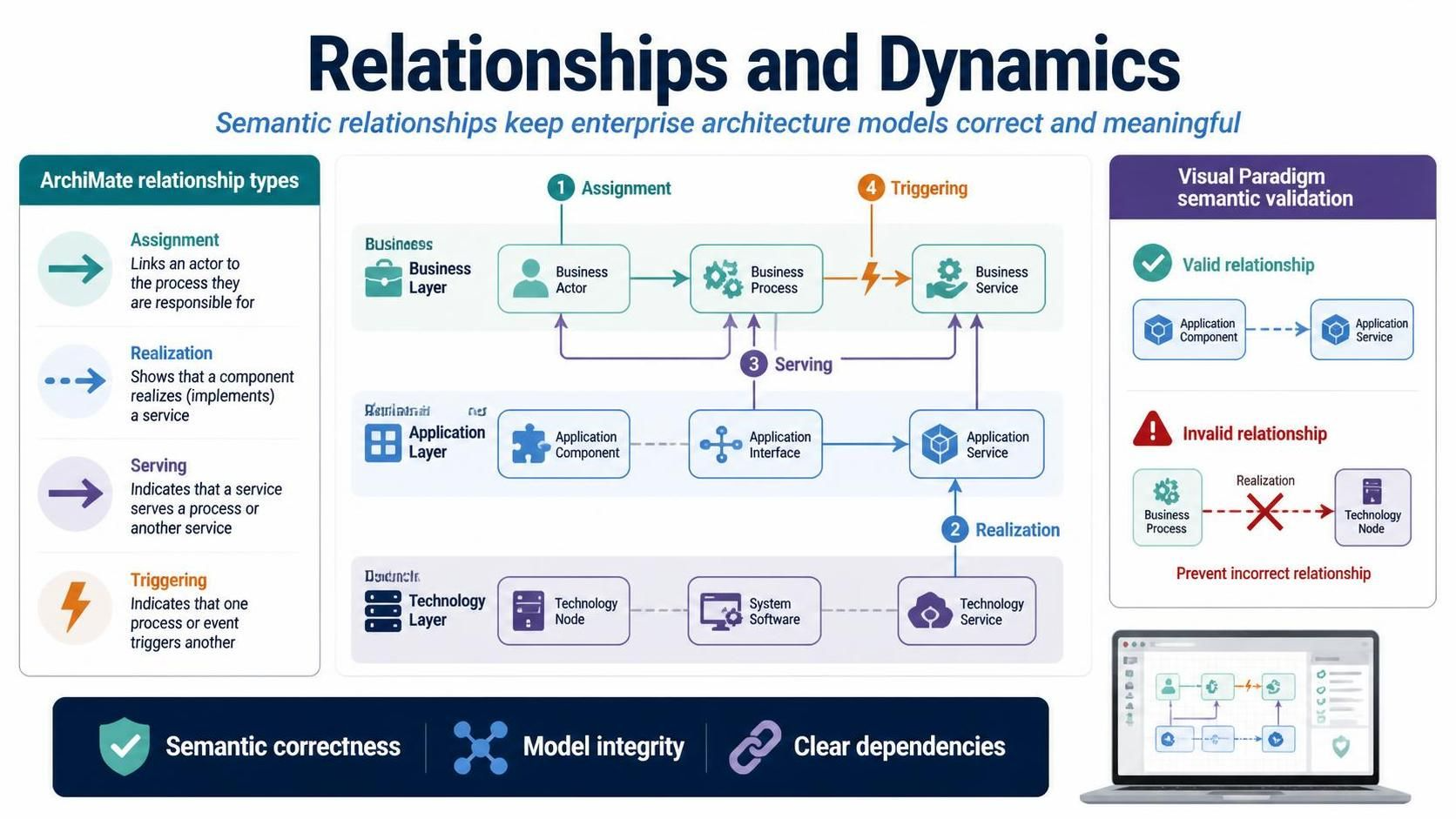
Enterprise architecture is often compared to building a house; it requires a solid foundation, a clear structural plan, and a strict adherence to building codes to ensure safety and stability. In the world of model-driven architecture, the “building codes” are the semantic rules defined by standards like ArchiMate. Visual Paradigm acts as the vigilant construction manager, enforcing these rules to ensure that your models are not just visually appealing, but logically sound.
This tutorial explores the critical Relationships and Dynamics within the ArchiMate framework. We will break down how specific relationship types define interactions between layers and how Visual Paradigm’s semantic validation engine prevents logical errors, ensuring your model maintains absolute integrity.
Understanding the Core ArchiMate Relationship Types
The power of ArchiMate lies in its ability to describe not just static structures, but the dynamic interactions between them. The framework defines four primary relationship types that dictate how elements in different layers (Business, Application, and Technology) interact. Understanding these is the first step toward creating a valid model.
1. Assignment
The Assignment relationship links an actor (a person or a role) to the process or function they are responsible for. It answers the question: “Who does this work?”
- Direction: Actor → Process
- Use Case: Assigning a Business Actor to a Business Process.
2. Realization
Realization is the bridge between the “what” and the “how.” It shows that a component (the implementation) realizes or implements a service (the functionality). It is the primary mechanism for linking layers, such as connecting an Application Component to an Application Service.
- Direction: Component → Service
- Use Case: An Application Component realizing an Application Service.
3. Serving
The Serving relationship indicates that a service is provided to a process or another service. It represents the flow of value or data between layers. For example, a Business Process might serve a Business Service, or an Application Service might serve a Business Process.
- Direction: Service → Process
- Use Case: An Application Service serving a Business Process.
4. Triggering
Triggering indicates causality. It shows that one process or event initiates or triggers another. This is crucial for mapping the flow of business activities.
- Direction: Process → Process (or Event)
- Use Case: A specific Business Process triggering another Business Process.
Visual Paradigm’s Semantic Validation Engine
While the ArchiMate standard provides the theory, Visual Paradigm provides the practical enforcement. In complex enterprise models, it is easy to accidentally draw a line between two incompatible elements. Visual Paradigm’s Semantic Validation feature acts as a gatekeeper, ensuring that your diagram strictly adheres to the logical rules of the framework.
Valid vs. Invalid Relationships
Visual Paradigm distinguishes between valid and invalid relationships based on the element types involved. This prevents the “Category Error” common in poorly constructed models.
Consider the scenario where a Business Process attempts to Realize a Technology Node. Logically, a business process (a “what”) cannot implement a technology node (a “how” or “where”). A process is abstract; a technology node is physical.
Visual Paradigm detects this mismatch immediately. It highlights the relationship with a red “X” or an error icon, indicating that the Realization relationship is semantically incorrect for these specific element types.
Ensuring Model Integrity
This validation extends across the entire stack:
- Business Layer: Ensures that Actors only Assign to Processes and Services.
- Application Layer: Ensures that Components only Realize Services.
- Technology Layer: Ensures that Nodes only Realize System Software or Services.
By preventing incorrect relationships, Visual Paradigm maintains Model Integrity. This ensures that when you export your model or use it for gap analysis, the data is trustworthy.
Conclusion
Building a robust enterprise architecture model requires more than just placing boxes on a canvas. It requires a deep understanding of the relationships that bind them. By mastering the four core ArchiMate relationships—Assignment, Realization, Serving, and Triggering—and leveraging Visual Paradigm’s semantic validation, you ensure that your models are not only correct but also actionable insights into your organization’s structure.