Understanding the Bridge to Operational Agility
In today’s rapidly evolving business landscape, operational agility is not just an advantage—it is a necessity. Organizations often find themselves trapped in legacy workflows that rely on manual handoffs, siloed data, and outdated decision-making frameworks. The bridge between these inefficient current states and a streamlined future lies in Business Process Model and Notation (BPMN) Gap Analysis.
While many organizations document their processes, few effectively leverage those diagrams as diagnostic tools. A true Gap Analysis goes beyond simple documentation; it systematically compares the “AS-IS” reality against a “TO-BE” vision to expose bottlenecks, technology deficits, and compliance risks. This guide will walk you through the methodology to transform static diagrams into dynamic roadmaps for digital transformation.
Core Concepts: AS-IS, TO-BE, and The Gap
Before diving into the mechanics, it is essential to understand the three pillars of this analysis. Think of this as a diagnostic journey where you identify where you are, where you want to be, and exactly what is stopping you from getting there.
The AS-IS State
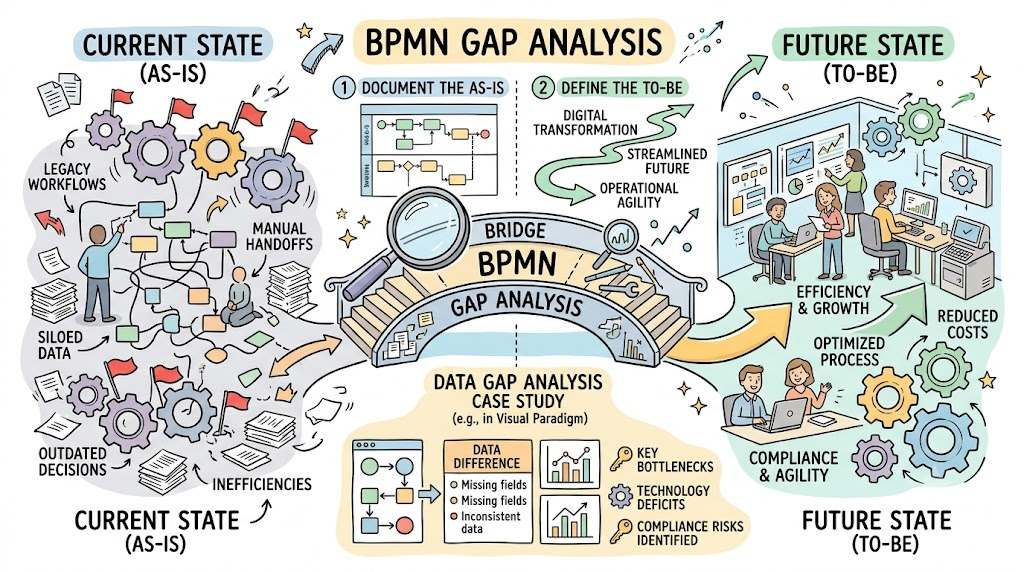
The AS-IS state represents the current reality of your organization. In a BPMN diagram, this is where you map out the actual workflows, including the inefficiencies. As seen in the context of legacy systems, this state is often characterized by:
- Manual Handoffs: Reliance on human intervention for data transfer.
- Siloed Data: Information trapped in disconnected systems.
- Outdated Decisions: Processes driven by intuition rather than real-time data.
The TO-BE State
The TO-BE state is the vision. This is the optimized process design that incorporates digital transformation goals. It represents a streamlined future where:
- Efficiency & Growth: Automated workflows reduce cycle times.
- Reduced Costs: Elimination of redundant manual steps.
- Compliance & Agility: Processes that are adaptable and audit-ready.
The Gap
The Gap is the delta between these two states. It is not just a distance; it is a collection of specific obstacles. In our analysis, we look for:
- Key Bottlenecks: Where does the process slow down?
- Technology Deficits: What tools are missing to automate the flow?
- Compliance Risks: Where are we exposing the organization to liability?
Case Study: The Data Gap Analysis
To illustrate this, let us look at a Data Gap Analysis case study. Imagine a scenario where a company is struggling with order processing. By modeling the AS-IS state, you discover a significant discrepancy in data handling.
In the analysis phase, you might identify specific Data Differences such as:
- Missing Fields: Critical customer data points are not being captured.
- Inconsistent Data: Formats vary across different departments.
These data differences directly translate to Key Bottlenecks in the workflow. For instance, if a field is missing, a manual review is required, creating a delay. By identifying these gaps, you move from merely describing work to actively engineering efficiency. You can now design a TO-BE state where data validation happens automatically at the entry point, eliminating the bottleneck entirely.
Implementing the Analysis with Visual Paradigm
How do you execute this efficiently? This is where modern tooling comes into play. Visual Paradigm offers a robust suite of features specifically designed to facilitate BPMN Gap Analysis.
Designing and Modeling
Visual Paradigm allows you to model both AS-IS and TO-BE processes within the same environment. You can use the BPMN editor to create clear, standard-compliant diagrams. The platform supports side-by-side comparison, allowing stakeholders to visually trace the journey from the chaotic legacy workflow to the streamlined future state.
Leveraging AI-Assisted Features
The landscape of process modeling is changing with the introduction of AI. Visual Paradigm’s new AI-assisted features can revolutionize how you conduct a gap analysis.
- Automated Modeling: Instead of drawing every box manually, you can use AI to generate initial process drafts based on natural language descriptions of your business rules.
- Intelligent Suggestions: The AI can analyze your AS-IS diagram and suggest optimizations, effectively acting as a consultant that points out potential bottlenecks you might have missed.
- Data Gap Detection: By integrating with your data repositories, AI tools can highlight where your process models do not align with actual data availability, speeding up the identification of those “missing fields” mentioned in our case study.
Conclusion: From Description to Engineering
Mastering BPMN Gap Analysis allows process architects and analysts to move from merely describing work to actively engineering efficiency. By utilizing tools like Visual Paradigm and embracing AI-assisted modeling, you can transform static diagrams into dynamic roadmaps. The result is a clear path from the “AS-IS” reality to the “TO-BE” vision, ensuring your organization remains agile in a competitive market.