Hello and welcome. Today, we are diving into a critical challenge that plagues almost every organization attempting digital transformation or process improvement. You might have heard the saying that business initiatives often fail not because of a lack of ambition, but because of a lack of clarity. It is a harsh truth: many companies set lofty strategic objectives but struggle to articulate the precise distance between their current operational reality and where they want to be.
This distance is what we call the process divide. It is the gap where potential is lost to confusion, inefficiency, and misalignment. This is where rigorous Gap Analysis lives, and this is where Business Process Model and Notation (BPMN) tooling, specifically Visual Paradigm, becomes indispensable. In this session, we will explore how to bridge that divide, transforming vague improvement goals into actionable, modeled process changes.
Step 1: Mapping the “As-Is” Chaos
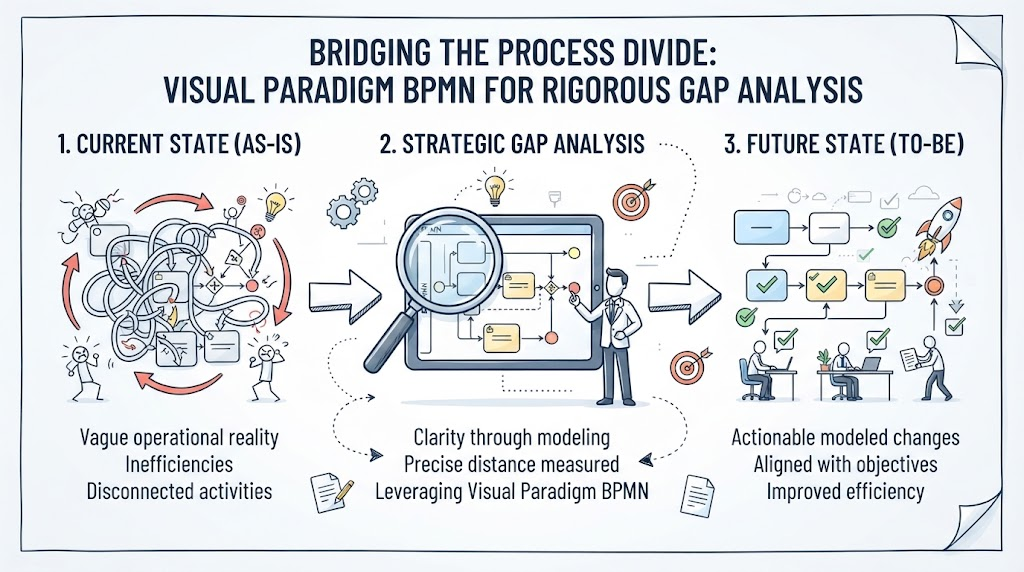
Every journey begins with understanding where you currently stand. In our case study, the first phase is capturing the Current State, or the “As-Is” process. If you look at the left side of our conceptual framework, you see a tangled web of arrows, disconnected activities, and frustrated stakeholders. This represents the “vague operational reality.”
Often, when we try to document a current process, we rely on text documents or whiteboard sketches that are open to interpretation. This leads to the “mess” shown in the diagram. Using Visual Paradigm, you can rigorously document this state using BPMN 2.0 standards. By forcing the process into a structured model, you strip away the ambiguity. You identify bottlenecks, redundant loops, and disconnected activities that are invisible in a text-based description.
Tutor’s Note: Don’t try to fix the process yet. The goal here is purely visibility. Visual Paradigm allows you to collaborate with stakeholders to ensure the “As-Is” model accurately reflects the messy reality before you try to clean it up.
Step 2: The Strategic Gap Analysis
Once the current reality is modeled, we move to the core of the exercise: the Strategic Gap Analysis. In the center of our framework, we see a magnifying glass examining a model. This represents the act of measuring the precise distance between the “As-Is” state and the strategic goal.
This is where the power of BPMN shines. You are not just guessing what is missing; you are modeling the difference. Visual Paradigm facilitates this by allowing you to compare the “As-Is” model against the desired “To-Be” model. You can identify exactly which steps need to be removed, which need to be automated, and which new decision points need to be introduced.
By leveraging Visual Paradigm’s simulation and analysis features, you can quantify this gap. You move from qualitative statements like “this process is too slow” to quantitative data like “this specific approval loop adds 4 hours to the cycle time.” This clarity is what turns a strategic objective into a concrete engineering task.
Step 3: Designing the “To-Be” Future
The final destination is the Future State or “To-Be” process. Looking at the right side of the framework, we see a streamlined flow, clear objectives, and a sense of forward momentum (symbolized by the rocket). This represents “actionable modeled changes.”
Because you have already rigorously defined the gap, the “To-Be” model is not a wish list; it is a blueprint for execution. In Visual Paradigm, you can design this future state using the same rigorous BPMN notation. This ensures that the future process is not only efficient but also compliant with industry standards. The model becomes the single source of truth for your development teams or operations staff, ensuring that the implementation aligns perfectly with the strategic objectives.
Action Plan: How to Execute with Visual Paradigm
To take this knowledge and apply it to your organization, follow this structured action plan using Visual Paradigm:
- Define the Scope and Objective: Clearly state the strategic goal. What is the “North Star” you are trying to reach?
- Model the As-Is State: Gather your team and use Visual Paradigm to map the current process. Be honest about the inefficiencies. Use swimlanes to clarify responsibilities.
- Conduct the Gap Analysis: Identify the missing links. Use Visual Paradigm’s collaboration features to highlight areas where the current process fails to meet the strategic objective.
- Design the To-Be State: Create the ideal process model. Ensure every step in the “To-Be” model directly addresses a gap identified in the previous step.
- Implement and Monitor: Use the model to guide your implementation. Visual Paradigm’s execution capabilities can even help you pilot the new process.
Tips & Tricks for Success
- Standardize your Notation: Ensure everyone in your organization speaks the same language. Use the standard BPMN 2.0 symbols provided by Visual Paradigm to avoid confusion.
- Iterate Rapidly: Don’t aim for perfection in the first draft. Use Visual Paradigm’s ease of editing to quickly pivot your models as you discover new information during the gap analysis.
- Focus on Value: When modeling the “To-Be” state, constantly ask, “Does this specific step add value to the customer or the business?” If not, remove it.
By following this approach, you transform the abstract concept of “improvement” into a tangible, modeled reality. You bridge the process divide and ensure that your ambition is matched by the clarity to execute.