


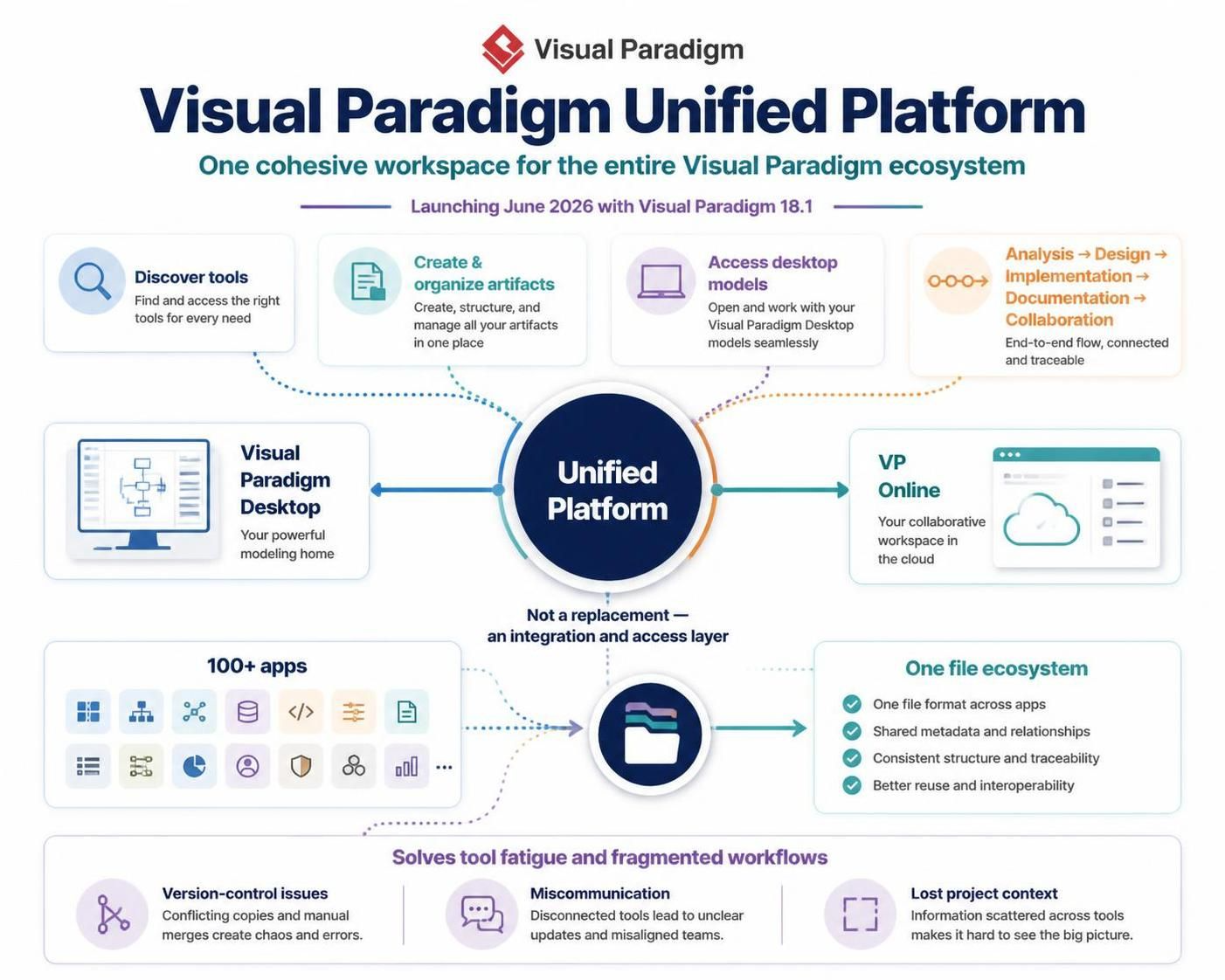
In the rapidly evolving landscape of enterprise architecture and software development, professionals often face a critical challenge known as “tool fatigue.” This phenomenon occurs when teams must juggle multiple disconnected applications—using one tool for modeling, another for cloud collaboration, and a third for documentation. The result is a fragmented workflow plagued by version-control issues, miscommunication, and a constant loss of project context.
The Visual Paradigm Unified Platform, launching with Visual Paradigm 18.1 in June 2026, is the strategic solution to this systemic issue. It is not a standalone application to replace your desktop or online tools; rather, it acts as the central orchestration hub and integration layer for the entire Visual Paradigm ecosystem. This tutorial explores the architectural concepts, the “One File Ecosystem” philosophy, and how the platform unifies the user experience.
Understanding the Core Architecture
The Unified Platform is designed to be the “single, cohesive home” for the ecosystem, which includes over 100 distinct applications. Its architecture functions on three primary pillars: discovery, organization, and seamless connectivity.
1. The Integration and Access Layer
The platform sits centrally between Visual Paradigm Desktop and VP Online. It does not replace either; instead, it serves as the bridge that allows them to communicate and share data seamlessly.
- Desktop Connection: It acts as a gateway to open, work with, and manage local desktop models without losing the robust processing power of the desktop environment.
- Cloud Integration: It provides a unified entry point to VP Online, ensuring that your collaborative workspace is always in sync with your local data.
2. The Workflow Lifecycle
A key architectural goal is to support the end-to-end flow of a project. The platform structures the user journey through a linear yet flexible progression:
- Analysis: Understanding requirements and business needs.
- Design: Creating the visual models and system architecture.
- Implementation: Generating code or detailed specifications.
- Documentation: Auto-generating reports and user guides.
- Collaboration: Sharing artifacts with stakeholders.
The “One File Ecosystem” Concept
The most revolutionary aspect of the Unified Platform is its approach to data management. Historically, different tools within the VP ecosystem might have used disparate file formats, leading to interoperability issues. The Unified Platform establishes a One File Ecosystem.
This concept ensures that a single file format is used across all applications. By standardizing the underlying structure, the platform achieves several technical advantages:
- Shared Metadata: Relationships and attributes defined in one app are instantly recognized in another.
- Consistent Traceability: You can trace a requirement from a high-level analysis model all the way down to the implementation code without breaking the link.
- Better Reuse: Artifacts created in one context can be easily reused in another, reducing redundant work.
AI and the New Interaction Model
With the integration of the AI Ecosystem, the Unified Platform transforms into a proactive workspace. Instead of navigating through complex menus to find tools, users can interact with the platform to “find apps” and “perform actions.”
This shifts the paradigm from manual tool selection to context-aware assistance. The AI helps users create and organize artifacts directly within the workspace, sending them to the appropriate destination (Desktop or Online) automatically. This reduces the cognitive load on the user, allowing them to focus on the architectural logic rather than the mechanics of the software.
Conclusion
As we move toward the June 2026 release, the Visual Paradigm Unified Platform represents a significant evolution in modeling tools. By unifying local desktop data and cloud app data into a single file ecosystem, it provides a true hub for professionals to discover tools, create artifacts, and maintain a clear project context from analysis to collaboration.