Welcome to this tutorial on one of the most critical tools in business process management: Gap Analysis. Whether you are a project manager, a business analyst, or a student of process improvement, understanding the distinction between your As-Is state and your To-Be state is fundamental to driving organizational success. Today, we will dissect the mechanics of this analysis, exploring how to identify inefficiencies and map out a clear path to optimization.
The As-Is State: Documenting the Current Reality
Every journey of improvement begins with a clear understanding of where you currently stand. The “As-Is” process is a documentation of your existing workflow. It is not about blaming current methods, but rather objectively observing how work gets done today.
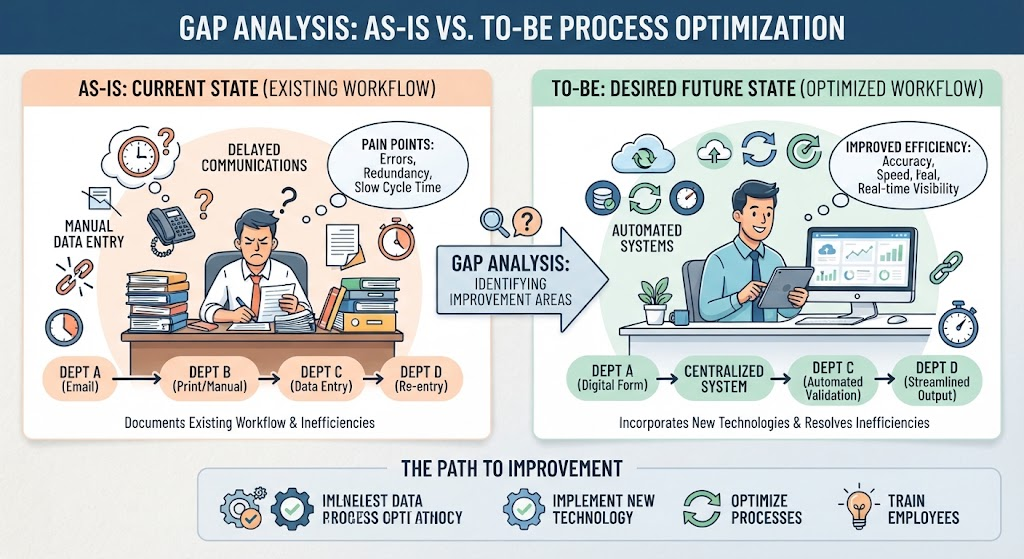
In the scenario depicted in our analysis, we see a traditional, fragmented workflow. Department A sends data via email, Department B handles it manually, Department C performs data entry, and Department D performs a re-entry. This linear, siloed approach is rife with potential pain points:
- Manual Data Entry: This is a classic source of human error. When humans transcribe information repeatedly, typos and inconsistencies inevitably creep in.
- Delayed Communications: The reliance on emails and physical documents often creates bottlenecks. As shown in the illustration, confusion arises when information is lost or delayed between departments.
- Redundancy: Seeing the same data pass through multiple hands (Dept C and Dept D) wastes valuable time and resources.
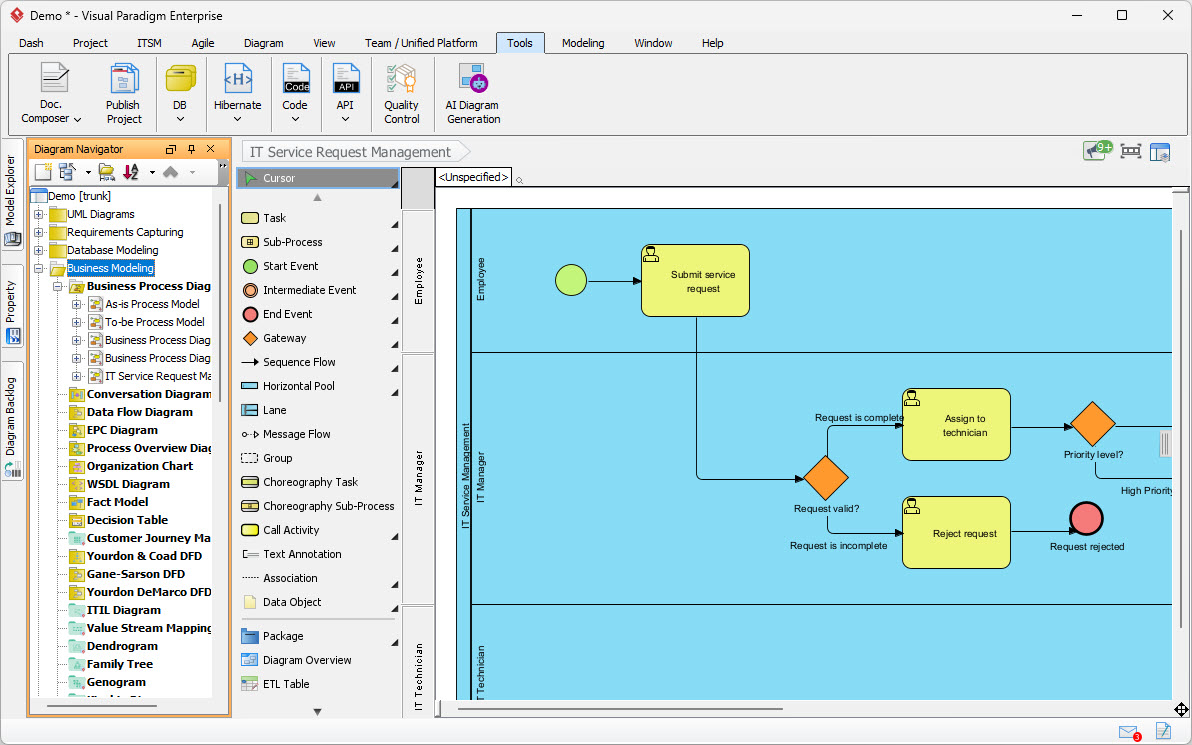
When using a tool like Visual Paradigm, you can capture this messy reality effectively. By utilizing process modeling features, you can map out these siloed interactions. Visual Paradigm allows you to visualize the “pain points” directly on the diagram, such as highlighting manual hand-offs that cause delays. This visual clarity is the first step toward change; you cannot fix what you cannot see.
The To-Be State: Designing the Optimized Future
Once the As-Is state is understood, the focus shifts to the “To-Be” process. This is your vision of the optimized workflow. It represents the future state where inefficiencies are resolved through new technologies or methodologies.
Looking at the “To-Be” side of our analysis, the transformation is striking. The workflow has moved from a fragmented chain to a centralized, automated ecosystem:
- Centralized System: Instead of emails bouncing between departments, a central system is introduced. This ensures a single source of truth.
- Automated Validation: By replacing manual data entry with digital forms and automated validation, the risk of errors is significantly reduced.
- Real-time Visibility: The manager is no longer guessing about progress; they have dashboards and real-time data, leading to improved accuracy and speed.
This is where Visual Paradigm truly shines as a strategic partner. It allows you to design this “To-Be” state with precision. You can model the new automated flows, ensuring that the logic holds up before you ever spend a dollar on software. You can simulate the new process to predict performance metrics, such as reduced cycle time, ensuring your “To-Be” design is not just a dream, but a viable reality.
Bridging the Gap: The Path to Improvement
The core of Gap Analysis lies in the space between the As-Is and To-Be states. This is the “Gap” itself. Identifying this gap allows you to pinpoint exactly what needs to change. It isn’t just about buying new software; it involves a holistic approach to improvement.
As illustrated in the “Path to Improvement” section, successful implementation requires a multi-faceted strategy:
- Implement New Technology: This is the enabler. Moving from manual entry to a centralized digital system is the technological leap required to bridge the gap.
- Optimize Processes: Technology alone is not a magic wand. You must streamline the underlying logic. For instance, removing the redundant step in Department D is a process optimization, not just a software fix.
- Train Employees: This is often the most overlooked aspect. When you shift from manual emails to automated dashboards, your team needs training. Visual Paradigm can help generate user documentation and training manuals based on your process models, ensuring your team understands the new workflow.
Conclusion
Gap Analysis is more than just a comparison; it is a roadmap for transformation. By rigorously documenting the As-Is state to understand your current pain points, and creatively designing the To-Be state to envision your future potential, you create a powerful strategy for growth. Tools like Visual Paradigm facilitate this entire lifecycle, allowing you to model, analyze, and communicate these changes effectively, turning complex business challenges into streamlined, optimized workflows.