In the world of Business Process Model and Notation (BPMN), clarity is king. While sequence flows dictate the “how” and “when” of a process, they often leave the “what” and “why” ambiguous. This is where the Association comes into play. It is the unsung hero of process modeling, allowing architects to attach rich, supplementary information to specific elements without cluttering the execution logic.
This tutorial explores the concept of Associations, analyzing their behavior, visual representation, and strategic usage in complex system architectures.
Understanding the Core Concept
An Association is a specific type of connector used to link supplementary information—such as text annotations, comments, or groups—to process elements. Unlike Sequence Flows (solid arrows) which control the order of operations, an Association is purely informational.
Think of an Association as a sticky note attached to a specific step in a workflow. It provides context, constraints, or data details without altering the path the process takes.
Key Behavioral Characteristics
- Non-Intrusive: The most critical rule of an Association is that it has no impact on the process engine’s behavior. It is read-only documentation for humans and external systems.
- Flexible Directionality: Associations can be undirected (a line with no arrowhead) or directed (with an arrowhead). The arrowhead simply indicates the direction of the relationship, but never the direction of the process flow.
- Visual Linking: It connects a text object or group to a task, event, or gateway.
Deep Dive: The “Nobel Committee” Scenario
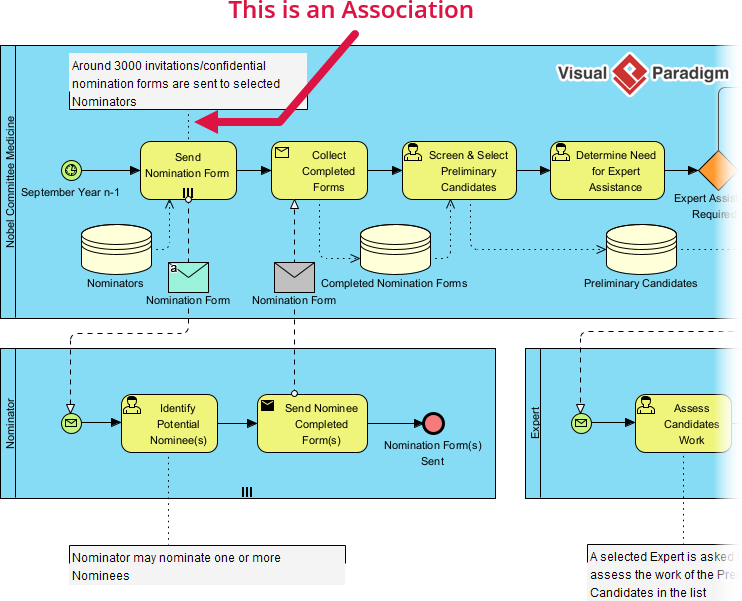
To truly understand how Associations function in a real-world architecture, let us analyze the diagram provided in our context. This diagram models the nomination process for the Nobel Committee in Medicine.
The Visual Breakdown
In the upper section of the diagram, we see a pool labeled “Nobel Committee Medicine”. Within this pool, a specific task is highlighted: Send Nomination Form.
Attached to this task is a text box containing the following note:
Note: “Around 3000 invitations/confidential nomination forms are sent to selected Nominators”
The line connecting this text box to the task is the Association. It serves a vital architectural purpose:
- Quantification: It informs the reader that this isn’t a one-off action. It specifies volume (3000 invitations).
- Constraint Definition: It clarifies that the “Nomination Form” is confidential, adding a security context to the task.
- Scope: It identifies the recipients (“selected Nominators”), defining the boundary of the interaction.
When to Use Associations
Associations are essential for bridging the gap between high-level process logic and granular business rules. You should utilize them in the following scenarios:
- Clarifying Data Objects: Use an undirected association to show which data object a task produces or consumes without implying a flow dependency.
- Adding Business Rules: If a task has specific conditions (e.g., “Only if budget > $10,000”), place this logic in a text box and associate it with the task.
- Grouping Related Elements: You can associate a group boundary with specific tasks to visually categorize them as part of a specific functional area.
Conclusion
By mastering Associations, you transform a sterile flowchart into a comprehensive documentation tool. As seen in the Nobel Committee example, these simple lines allow complex datasets and constraints to coexist with the process flow, ensuring that anyone reviewing the architecture understands not just what happens, but the context in which it happens.