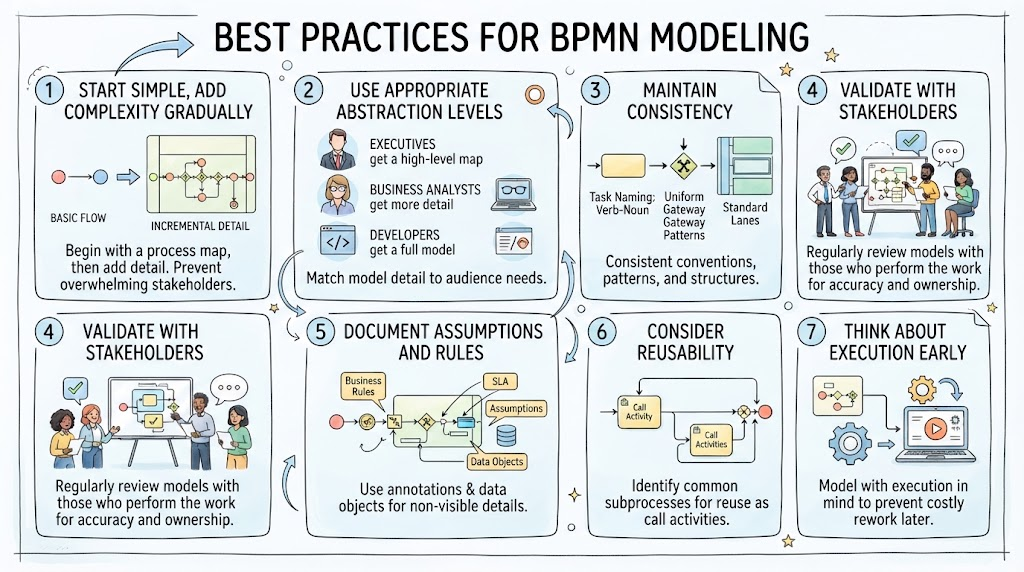
Welcome to this comprehensive tutorial on Business Process Model and Notation (BPMN) best practices. Whether you are a business analyst, a developer, or a stakeholder looking to optimize organizational workflows, understanding the core principles of BPMN is essential. This guide breaks down the seven fundamental pillars of successful modeling, explains the critical pitfalls to avoid, and walks you through a practical application framework to take your skills from novice to expert.
1. The Foundation: Starting Simple and Adding Complexity
The most common mistake in process modeling is attempting to create a “perfect” model in the first draft. The first rule of BPMN is to Start Simple, Add Complexity Gradually.
- Establish the Backbone: Begin with a high-level process map. Focus solely on the “happy path”—the ideal sequence of events where everything goes right.
- Incremental Detail: Once the fundamental flow is agreed upon, incrementally add details. This prevents overwhelming stakeholders who may not understand complex notations like gateways or complex event triggers immediately.
2. Tailoring to Your Audience: Appropriate Abstraction Levels
A single process model rarely serves everyone. To communicate effectively, you must match the model detail to your audience’s needs:
- Executives: They need high-level process maps to understand strategic flow and bottlenecks. They do not need to see every decision point.
- Business Analysts: They require process descriptions that clarify roles, responsibilities, and the logic of the workflow.
- Developers & BPMS Administrators: They need the full process model, including detailed data flows, exception handling, and executable logic.
3. The Art of Consistency
Consistency is key to maintainability. If a process model looks different from one department to another, it becomes a nightmare to maintain. You must adhere to three main consistency standards:
- Naming Conventions: Use a consistent format for tasks (e.g., Verb-Noun, such as “Approve Invoice” or “Validate User”).
- Gateway Patterns: Apply uniform patterns for decision points. For example, always use the same shape for “Yes/No” decisions or “Parallel Splits.”
- Pool and Lane Structures: Standardize how you group processes. If you use Pools to represent organizations, keep that structure consistent across your entire portfolio.
4. Validation and Stakeholder Engagement
A model is useless if it does not reflect reality. Validate with Stakeholders by regularly reviewing the models with the people who actually perform the work. Their feedback ensures accuracy. Furthermore, involving them in the review process builds ownership of the documented process, making future adoption much easier.
5. Documentation: Assumptions and Rules
Not everything can be represented by a shape on a diagram. You must Document Assumptions and Rules using annotations and data objects. This includes:
- Business Rules: Specific logic (e.g., “If amount > $5000, require manager approval”).
- SLAs (Service Level Agreements): Time constraints associated with tasks.
- Assumptions: Conditions assumed to be true for the process to run (e.g., “System is online”).
6. Reusability and Execution
To keep your models clean and maintainable, Consider Reusability. Identify common subprocesses that appear in multiple flows. Instead of redrawing them every time, model them once and reference them using Call Activities.
Additionally, Think About Execution Early. Even if you are not automating the process immediately, model with execution in mind. Ask yourself: “Can a computer read this?” This prevents costly rework later when you decide to implement the process in a Business Process Management System (BPMS).
Common Pitfalls to Avoid
Even experienced modelers can fall into traps. Be vigilant against these common errors:
- Over-modeling: Adding unnecessary detail that obscures the main flow.
- Under-modeling: Missing critical decision points or exception paths.
- Ignoring Exceptions: Only modeling the “happy path” without error handling.
- Mixing Levels: Combining high-level strategic elements with low-level technical details inconsistently.
- Poor Naming: Using vague labels (e.g., “Do something”) instead of clear descriptions.
Practical Application Framework
To apply these concepts, follow this five-step framework:
Step 1: Discovery
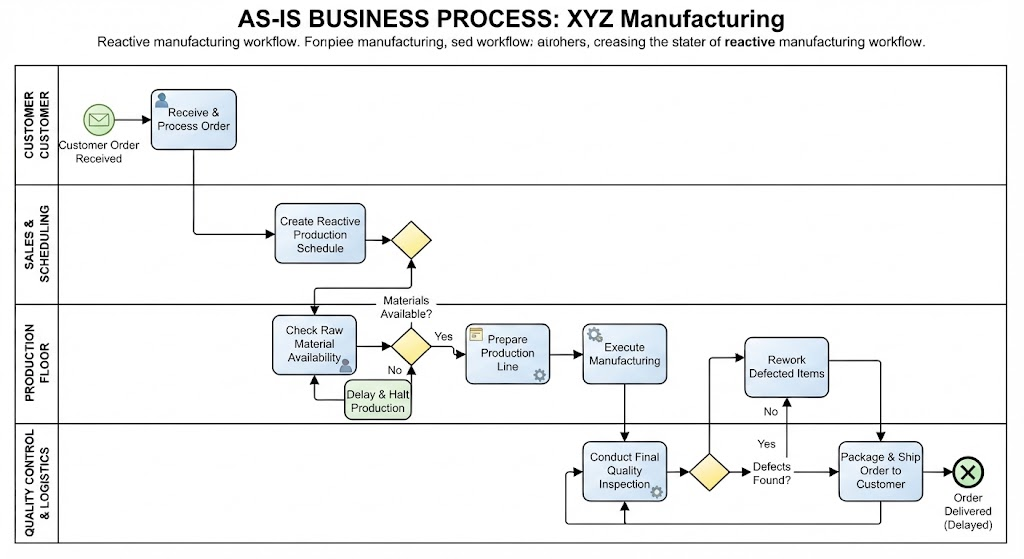
Identify the process boundaries (start and end points). Interview stakeholders to understand the current state and create an initial process map.
Step 2: Elaboration
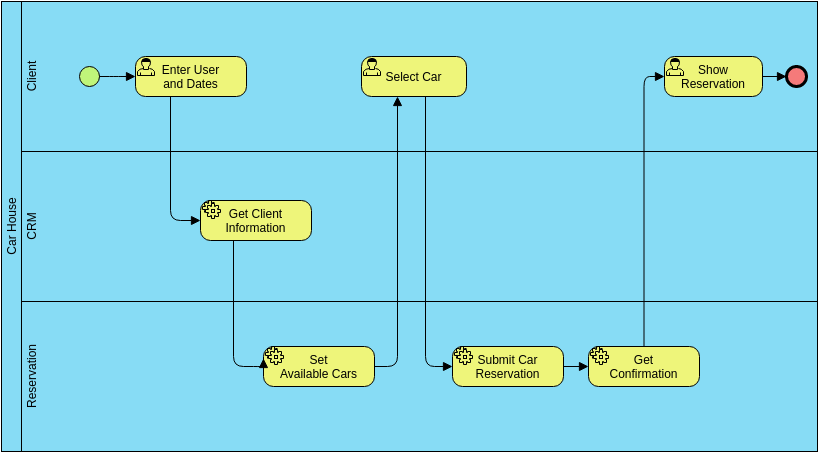
Add participants (pools/lanes) to clarify who is doing what. Include key data objects and documents. Map out decision points using gateways and develop a detailed process description.
Step 3: Refinement
Add specific events (timers, messages, errors). Define the exact conditions on gateways. Model exception and compensation paths (what happens when things go wrong) and incorporate performance metrics.
Step 4: Validation
Walk through scenarios with stakeholders. Verify completeness and accuracy. Check for bottlenecks and inefficiencies, then finalize the process model.
Step 5: Implementation & Maintenance
Deploy the model to a BPMS if applicable. Monitor actual performance against the model and update the model as processes evolve. Ensure version control changes are tracked.
Conclusion
BPMN’s strength lies in its flexibility to support all three levels of process modeling. Whether you are creating a simple process map for stakeholder alignment, a detailed process description for cross-functional understanding, or a fully executable process model for automation, BPMN provides the notation and semantics to communicate effectively. Remember: The best process model is not the most complex one—it’s the one that serves its intended purpose and audience while remaining maintainable and accurate.
In the modern era of process engineering, tools must evolve to keep pace with the complexity of business operations. Visual Paradigm stands out as a premier platform that bridges the gap between traditional modeling and artificial intelligence. This section explores how to leverage Visual Paradigm’s AI-assisted capabilities to streamline the modeling lifecycle.
Why Visual Paradigm?
Visual Paradigm is more than just a drawing tool; it is a comprehensive enterprise modeling solution. It supports the full spectrum of BPMN standards, from basic diagrams to executable process definitions. Its integration of AI allows users to move from concept to model at unprecedented speeds.
Key AI-Assisted Features
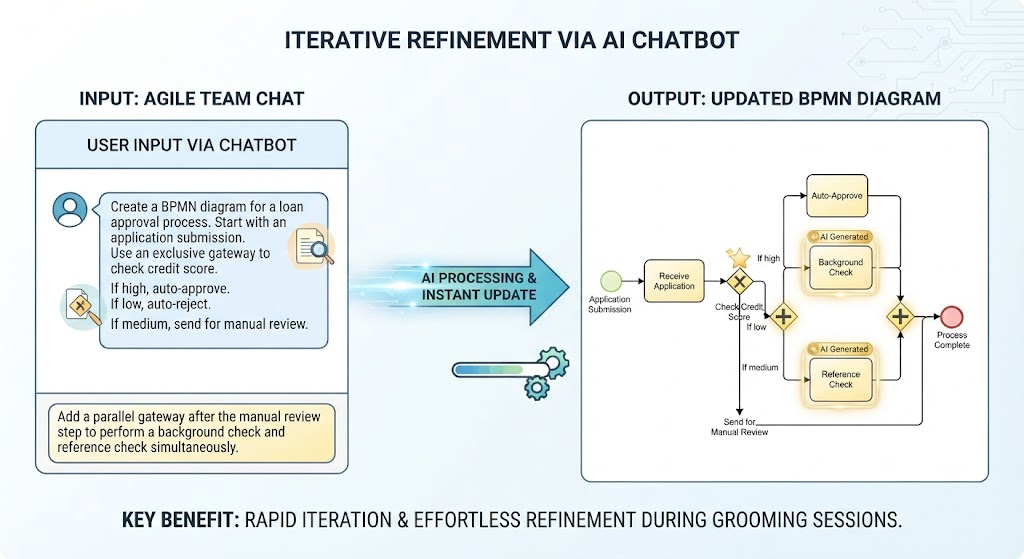
- AI Text-to-Process: Instead of dragging and dropping shapes, users can input natural language descriptions of a process (e.g., “Create a process where a customer places an order, which is then validated and shipped”). The AI engine interprets this text and automatically generates the corresponding BPMN diagram.
- Smart Validation: The AI analyzes the model for consistency and adherence to best practices. It can flag potential issues, such as unreachable tasks, infinite loops, or inconsistent gateway logic, before the model is finalized.
- Automated Documentation: Generating the “Process Description” mentioned in Step 2 of the framework can be time-consuming. Visual Paradigm’s AI can auto-generate descriptive text based on the diagram elements, saving analysts hours of documentation work.
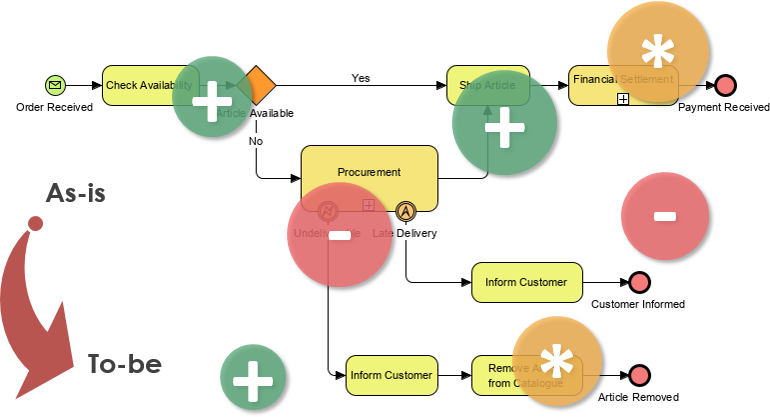
- Reverse Engineering: For legacy systems, Visual Paradigm can reverse engineer existing code or database structures into visual process models, helping organizations understand their current state (As-Is) without manual reconstruction.
Integrating AI into the Workflow
When applying the Practical Application Framework using Visual Paradigm:
- During Discovery: Use the AI chat interface to brainstorm process steps and boundaries based on your interview notes.
- During Elaboration: Use the AI to suggest appropriate gateways and event types based on the task descriptions you’ve entered.
- During Refinement: Run the AI validation checks to ensure your exception paths and data flows are logically sound.
By combining the disciplined approach outlined in the best practices section with the efficiency of Visual Paradigm’s AI tools, organizations can achieve higher process transparency and enable continuous improvement much faster than ever before.