Introduction to the Language of Business
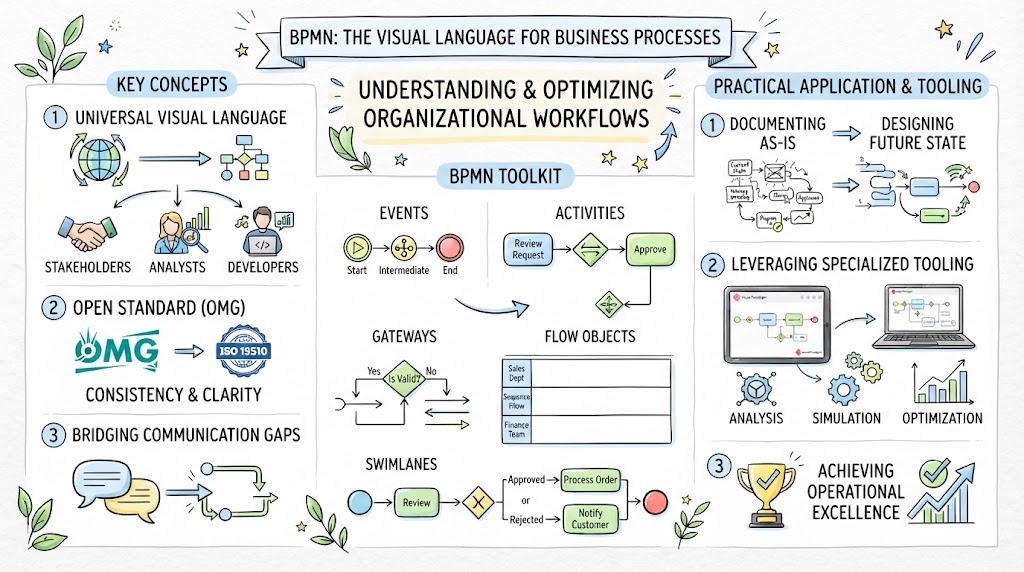
Welcome to today’s session on process improvement. If you have ever struggled to explain a complex workflow to a developer, or tried to map out a department’s daily tasks without confusion, you are likely familiar with the need for a universal standard. That standard is BPMN, or Business Process Model and Notation. Think of BPMN as the “English language” of business processes—a way to bridge the gap between high-level strategy and actual implementation.
What is BPMN?
At its core, BPMN is a standardized graphical notation used to model business processes. It isn’t just about drawing boxes; it is a rigorous system designed to ensure that anyone reading the diagram understands the flow of work exactly the same way.
To build a model, you rely on a specific set of building blocks. The most fundamental elements include:
- Events: Represented by circles, these signify something that happens, such as a start or an end point.
- Activities or Tasks: Shown as rounded rectangles, these represent the actual work being done.
- Gateways: The diamond shape indicates a decision point where the process might branch off in different directions.
- Connecting Objects: Arrows that link these elements together to show the sequence.
Walking Through a Workflow: Customer Onboarding
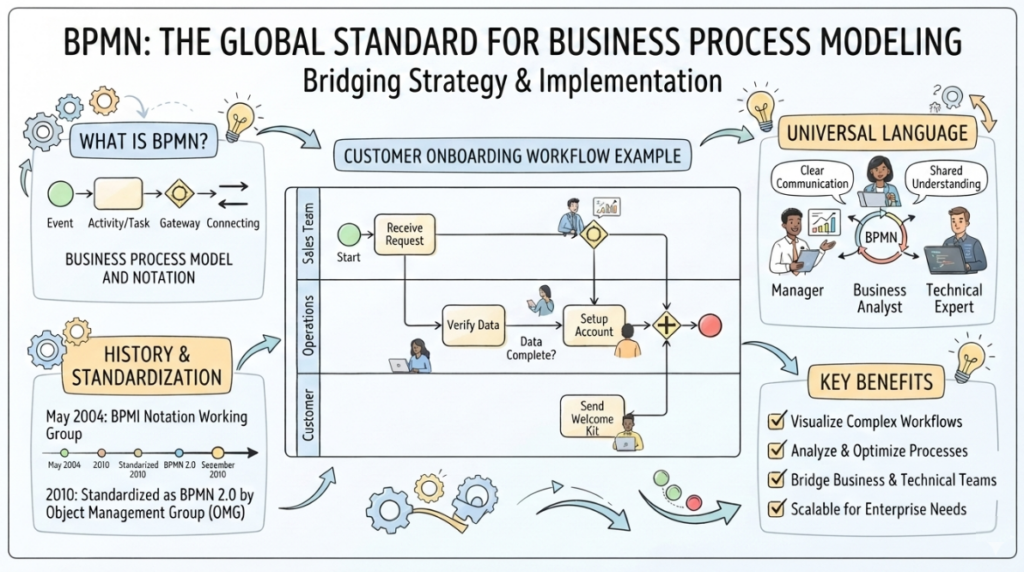
Let’s apply this to a real-world scenario to see how it works in practice. Imagine we are mapping a “Customer Onboarding Workflow.” This process spans three different roles or “swimlanes”: the Sales Team, the Operations Team, and the Customer.
The process begins with the Sales Team receiving a request. Once that request is logged, the work handoffs to the Operations Team to “Verify Data.” Here, we encounter a critical decision point—a gateway asking, “Data Complete?”
If the data is not complete, the process loops back to correct the information. If the data is complete, the Operations team proceeds to “Setup Account.” Once the account is ready, the flow merges and moves to the final step: sending the “Welcome Kit” to the Customer. This visual clarity allows every team member to see exactly where their responsibilities begin and end.
History and Standardization
You might wonder how this notation became so widespread. The journey began in May 2004 with the formation of the BPMI Notation Working Group. Their goal was to create a common standard for process modeling. This effort culminated in September 2010, when the Object Management Group (OMG) officially standardized the notation as BPMN 2.0. This standardization ensures that a diagram drawn in 2024 looks and functions the same way as one drawn in 2015, regardless of the software used.
Why BPMN is a Universal Language
One of the greatest challenges in modern business is communication between different departments. A Manager might view a process through the lens of strategy, while a Technical Expert views it through code and architecture. A Business Analyst acts as the translator between the two.
BPMN serves as the bridge. By using a standardized notation, it facilitates clear communication and shared understanding. It ensures that the Manager, the Business Analyst, and the Technical Expert are all looking at the same blueprint, reducing the risk of errors and misinterpretation.
Key Benefits for Your Organization
Why should you adopt this standard? The benefits are tangible and far-reaching:
- Visualize Complex Workflows: It turns abstract ideas into concrete, visual maps that are easy to grasp.
- Analyze & Optimize: Once a process is mapped, you can identify bottlenecks and inefficiencies that were previously hidden.
- Bridge Business & Technical Teams: It eliminates the “lost in translation” phenomenon between stakeholders and developers.
- Scalability: BPMN is robust enough to handle simple tasks and complex enterprise-wide systems alike.
By mastering BPMN, you are not just learning to draw diagrams; you are learning to orchestrate efficiency and clarity across your entire organization.”