Introduction to BPMN Structure
Welcome to your introduction to Business Process Model and Notation (BPMN). If you are looking to map out workflows, understanding the structural containers is your first step. BPMN is the industry standard for business process modeling, and its syntax is built on a few fundamental shapes that act as the building blocks for complex systems. Today, we are focusing on the most essential structural elements: the Pool and the Lane.
The Foundation: Understanding the Pool
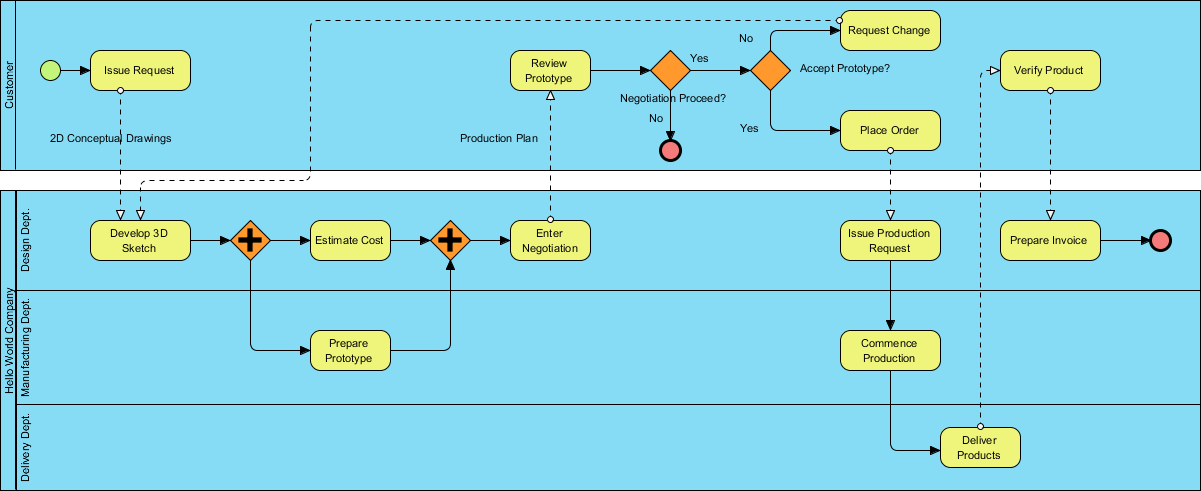
At the highest level of a BPMN diagram, you have the Pool. Think of a pool as the boundary of a specific business process or the organization participating in a collaboration. It defines the scope. In the visual representation we are discussing, the large blue rectangle represents this Pool. It acts as a container that holds all the activities and flow objects relevant to that specific entity.
Partitioning Responsibility: The Role of Lanes
Inside that Pool, you will often see vertical or horizontal bars. These are Lanes. The primary purpose of a lane is to partition the diagram to show who performs the work. This could be a specific role (like “Customer” or “Manager”), a department (like “Sales” or “IT”), or even a software system. In the diagram provided, we see a single vertical partition labeled “Lane” inside the pool.
Why Structure Matters
Using lanes is crucial for clarity and accountability. When a process becomes complex, a single list of steps can become confusing. By adding lanes, you assign specific activities to specific actors. Even in this simple, empty state, the presence of a lane tells us that this process is designed to be organized by function or role. It sets the stage for you to fill in the activities, ensuring that every step in the workflow is assigned to the correct person or system.
Conclusion
Mastering the relationship between pools and lanes is the key to creating readable, professional diagrams. The pool provides the container, and the lanes provide the organization within that container. As you move forward in your process modeling journey, remember that every lane you add brings a new layer of clarity to your workflow.