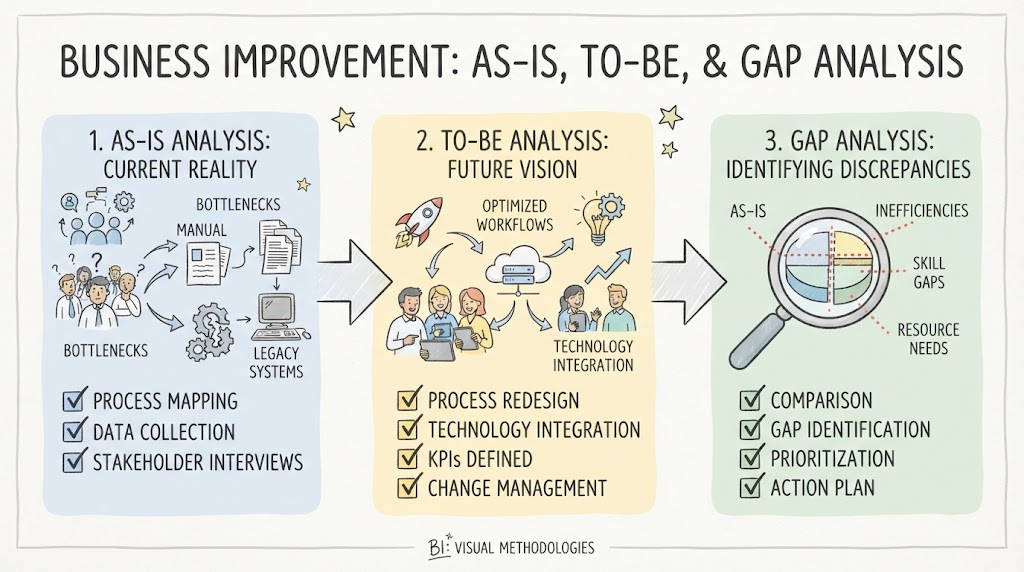
In the realm of digital transformation, bridging the gap between where a business currently stands and where it needs to be is the single most critical challenge leaders face. As highlighted in modern business methodologies, the path to operational excellence is not a straight line but a structured process of discovery, design, and diagnosis. This tutorial explores the “Holy Trinity” of business improvement: As-Is Analysis, To-Be Analysis, and Gap Analysis.
By leveraging visual modeling tools like Visual Paradigm, organizations can move beyond abstract concepts and create tangible blueprints for success. Let’s walk through the system architecture of business improvement, step by step.
Phase 1: As-Is Analysis (Current Reality)
The foundation of any successful transformation project is an honest, data-driven assessment of the present state. The As-Is model represents the current reality of the organization. It is often messy, complex, and riddled with inefficiencies, but it is the baseline from which all future improvements are measured.
Core Objectives
The primary goal of the As-Is phase is to map out the “current reality” without bias. This involves:
- Process Mapping: Documenting every step of the existing workflow to understand the flow of information and materials.
- Identifying Bottlenecks: Pinpointing specific areas where the process slows down or stops. As seen in the diagram, this often manifests as manual hand-offs or legacy system dependencies.
- Data Collection: Gathering quantitative data on cycle times, error rates, and costs.
- Stakeholder Interviews: Understanding the human element—where the pain points lie for the employees performing the work.
The Technical Model
From a system architecture perspective, the As-Is model usually reveals a fragmented landscape. You will likely identify:
- Manual Processes: Reliance on paper or ad-hoc spreadsheets.
- Legacy Systems: Older IT infrastructure that does not communicate well with modern tools.
- Redundancies: Multiple people or systems performing the same task inefficiently.
Phase 2: To-Be Analysis (Future Vision)
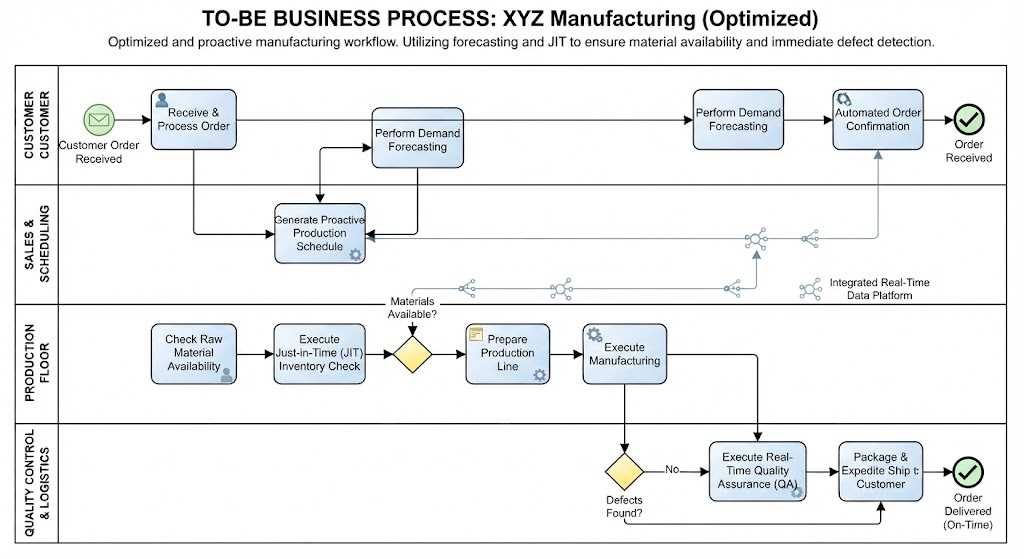
Once the current reality is understood, the focus shifts to the To-Be state. This is the “Future Vision”—the optimized, ideal state of the business after digital transformation has taken place. It is a theoretical model that represents the maximum potential of the organization.
Designing the Ideal State
The To-Be model is not just about “fixing” the old process; it is often about redesigning it entirely. This phase involves:
- Process Redesign: Re-engineering workflows to eliminate unnecessary steps. Instead of a linear, manual chain, the goal is a streamlined, automated loop.
- Technology Integration: Connecting disparate systems (e.g., CRM, ERP, and Cloud services) so data flows seamlessly between them, reducing manual entry.
- KPI Definition: Establishing clear Key Performance Indicators to measure the success of the new state.
- Change Management: Planning for the cultural shift required to adopt these new technologies.
The Technical Model
In a To-Be diagram, you will see a shift from complex, manual nodes to streamlined, automated nodes. The architecture moves toward:
- Automation: Replacing human intervention with scripts or workflow engines.
- Cloud Architecture: Leveraging scalable cloud resources for better performance.
- Optimized Workflows: Parallel processing and real-time data updates.
Phase 3: Gap Analysis (Identifying Discrepancies)
The final, and perhaps most critical, step is the Gap Analysis. This is the diagnostic phase where the “As-Is” and “To-Be” models are overlaid to identify the discrepancies. If the As-Is is the “diagnosis” and the To-Be is the “prescription,” the Gap Analysis is the “treatment plan.”
What the Gap Reveals
By comparing the two models, you can identify specific deficits in the current system that prevent the organization from reaching its future vision. These gaps generally fall into three categories:
- Inefficiencies: The “waste” in the current process (e.g., waiting time, rework).
- Skill Gaps: The lack of necessary expertise or training in the current workforce to support the new technology.
- Resource Needs: The financial, hardware, or software investments required to bridge the divide.
Creating the Action Plan
Once the gaps are identified, the business analyst creates a roadmap. This is not just a wish list, but a prioritized list of actions:
- Comparison: Systematically checking every step of the As-Is against the To-Be.
- Prioritization: Deciding which gaps must be fixed immediately versus those that can be addressed later.
- Action Plan: Developing a project schedule to execute the changes.
Conclusion: From Theory to Execution
Understanding the architecture of business improvement requires moving beyond simple diagrams. It requires a deep dive into the “As-Is” to understand the pain, a clear vision of the “To-Be” to inspire the team, and a rigorous “Gap Analysis” to chart the course. By using powerful tooling to visualize these states, organizations can turn the daunting task of digital transformation into a manageable, actionable roadmap.