


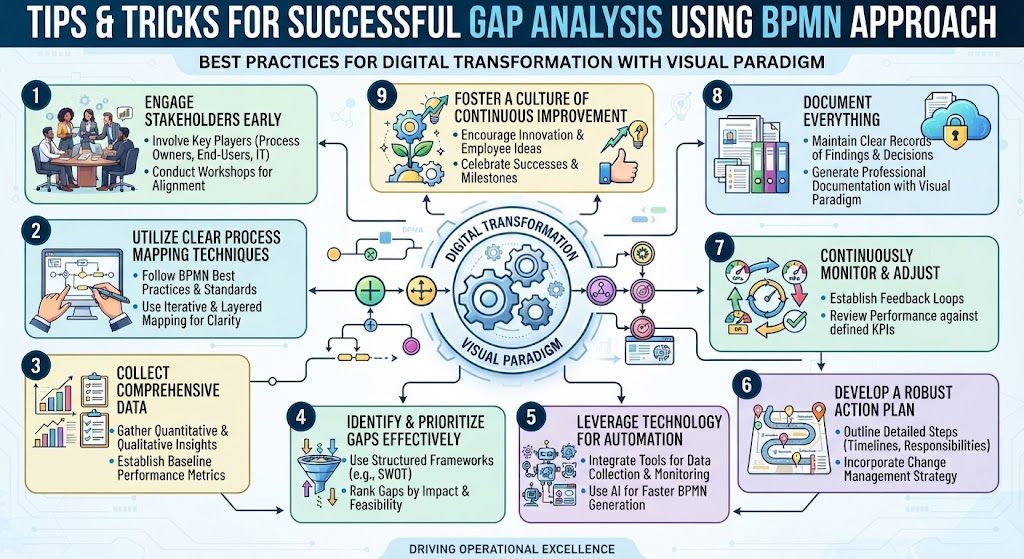
Transitioning from legacy systems to modern digital infrastructures is one of the most significant challenges facing organizations today. To navigate this complex journey, businesses often employ Gap Analysis—a systematic method used to compare actual performance with potential or desired performance. When paired with Business Process Model and Notation (BPMN) and supported by robust tooling like Visual Paradigm, this analysis transforms from a theoretical exercise into a powerful engine for operational excellence.
This tutorial breaks down the nine essential components of a successful BPMN-driven Gap Analysis, guiding you from stakeholder engagement to continuous improvement.
Phase 1: Preparation and Foundation
1. Engage Stakeholders Early
The success of any digital transformation initiative hinges on the people involved. You cannot map a process in a vacuum. This phase focuses on gathering the right input from the right people.
- Involve Key Players: Ensure that all relevant stakeholders—including process owners, end-users, and IT staff—are present from the outset. Their insights are vital for accurately mapping the As-Is (current) process and envisioning a realistic To-Be (future) state.
- Conduct Collaborative Workshops: Use tools like Visual Paradigm’s sharing features to organize workshops. This fosters team alignment on goals and expectations, ensuring that the resulting BPMN diagrams reflect a consensus rather than a single perspective.
2. Utilize Clear Process Mapping Techniques
Once the team is assembled, the focus shifts to the technical representation of the workflow. Clarity is the enemy of ambiguity.
- Adhere to BPMN Best Practices: Familiarize yourself with BPMN symbols and conventions to create standardized diagrams. Visual Paradigm enforces these standards, which enhances communication and prevents misinterpretation among team members.
- Iterative Mapping: Avoid the trap of over-complication. Start with high-level process maps and progressively add detail. Use Visual Paradigm’s layering features to manage complexity, allowing stakeholders to zoom in only when necessary.
3. Collect Comprehensive Data
Diagrams tell you “how” a process works, but data tells you “how well” it works. A true Gap Analysis requires a holistic view of current performance.
- Gather Quantitative and Qualitative Data: Collect quantitative metrics such as cycle times and error rates, alongside qualitative insights like employee feedback. This dual approach provides a complete picture of the current state.
- Establish Performance Metrics: Define baseline performance metrics (KPIs) now to compare against future improvements. Visual Paradigm allows you to annotate diagrams directly with these data points, creating a living document of performance.
Phase 2: Analysis and Planning
4. Identify and Prioritize Gaps Effectively
With the data collected, you can now identify the discrepancies between the current state and the desired digital transformation goals.
- Use a Structured Framework: Apply systematic frameworks like SWOT (Strengths, Weaknesses, Opportunities, Threats) analysis to ensure a comprehensive assessment of the gaps.
- Prioritize Based on Impact: Not all gaps are created equal. Rank identified gaps by their potential impact on the organization and the feasibility of closing them. Focus on “quick wins”—high-impact, low-effort areas—to build momentum early in the project.
5. Leverage Technology for Automation
Digital transformation is not just about changing processes; it is about automating them. Technology should be an integral part of the solution.
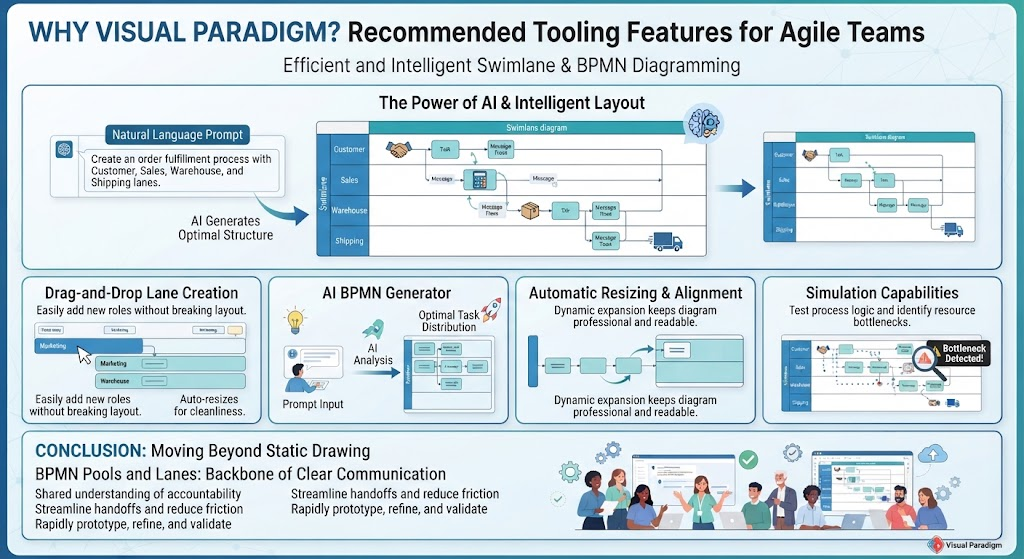
- Integrate Tools: Consider integrating technology solutions that automate data collection. Visual Paradigm’s AI capabilities can assist in generating initial drafts of BPMN diagrams from text descriptions, speeding up the modeling process significantly.
- Real-Time Monitoring: Implement systems that allow for real-time tracking of processes. This helps quickly identify bottlenecks and streamline operations as you move toward the To-Be state.
6. Develop a Robust Action Plan
Identifying gaps is useless without a roadmap to close them. This phase bridges the gap between analysis and execution.
- Outline Detailed Steps: Create a plan with clear, actionable steps for addressing each gap. Define timelines, allocate resources, and assign responsible parties.
- Implement Change Management: Address the human side of the transition. Incorporate a change management strategy to facilitate the move from As-Is to To-Be, ensuring adequate training and support are available to address resistance.
Phase 3: Execution and Evolution
7. Continuously Monitor and Adjust
A digital transformation is a journey, not a destination. The process requires constant vigilance and adjustment.
- Establish Feedback Loops: Create mechanisms for continuous feedback during and after implementation. This allows the organization to identify new gaps or areas for improvement as they arise.
- Performance Reviews: Regularly review performance metrics against the defined KPIs. If the actual performance deviates from the plan, make necessary adjustments to the strategy.
8. Document Everything
Documentation is the institutional memory of the transformation. It ensures that knowledge is preserved and audit trails are clear.
- Maintain Clear Records: Document all findings, decisions, and changes throughout the analysis process. This serves as a valuable resource for future reference.
- Visual Documentation: Leverage the power of visuals. Use BPMN diagrams not just for current and future processes, but to illustrate gaps and action plans. Visual Paradigm’s reporting features can generate professional documentation directly from your models.
9. Foster a Culture of Continuous Improvement
The final, and perhaps most critical, step is cultural. The tools and diagrams are merely enablers; the culture drives the success.
- Encourage Innovation: Promote an organizational culture that values continuous improvement. Encourage employees at all levels to share ideas for process enhancements.
- Celebrate Successes: Acknowledge and celebrate milestones achieved during the transformation. Maintaining momentum and enthusiasm is essential for long-term sustainability.
Conclusion
By following these nine steps, organizations can effectively navigate the complexities of Gap Analysis using BPMN. This structured approach, supported by robust tooling like Visual Paradigm, helps bridge the divide between current and desired states, driving successful digital transformation and operational excellence. Embrace the journey, leverage insights, and remain adaptable to thrive in a dynamic business environment.
Related posts:
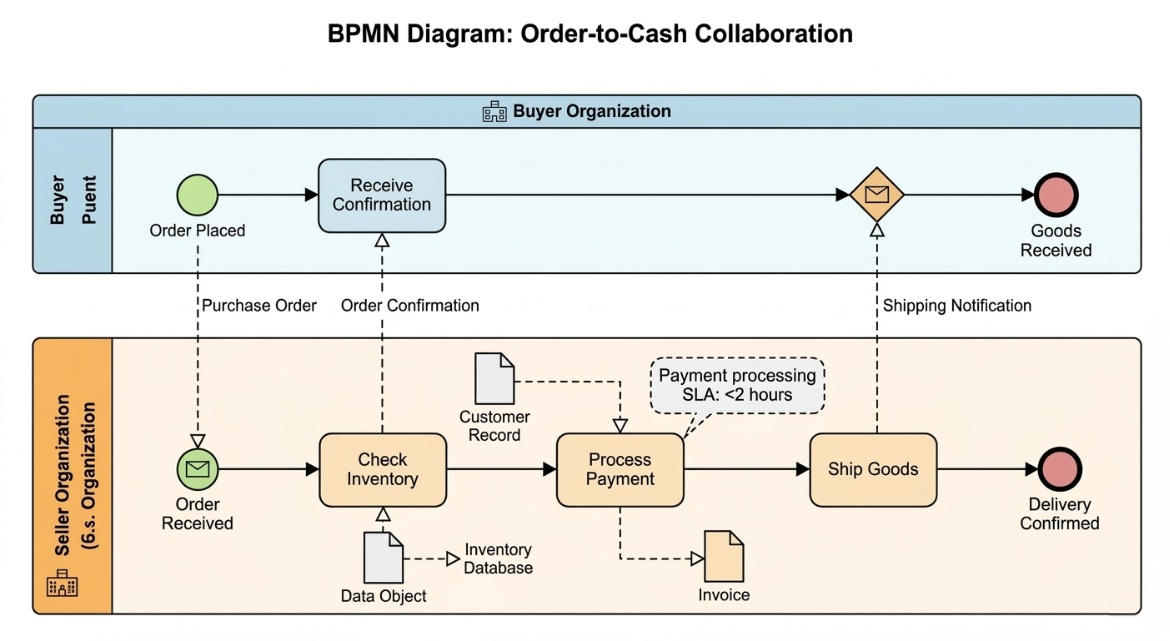 Mastering Order-to-Cash: A BPMN Collaboration Guide
 Mastering Sequential Multi-Instance Markers: A Guide to Batch Processing in BPMN
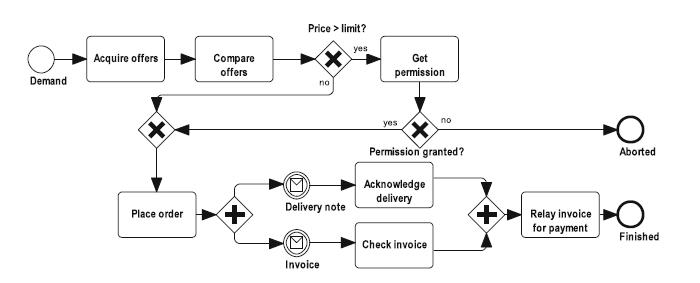 Mastering Business Process Modeling: A Deep Dive into the Order Process Diagram
 Mastering BPMN Swimlanes: An Agile Guide to Intelligent Process Modeling with Visual Paradigm