


In the complex world of software development and project management, clarity regarding roles and responsibilities is just as critical as the timeline itself. While a standard PERT (Program Evaluation and Review Technique) chart provides a visual roadmap of your project’s schedule and dependencies, adding a RACI matrix transforms it into a powerful management tool. This tutorial explores how to leverage the Enhanced PERT Chart feature in Visual Paradigm to not only track when tasks happen, but also who is driving them.
Understanding the Visual Structure: Swimlanes and Dependencies
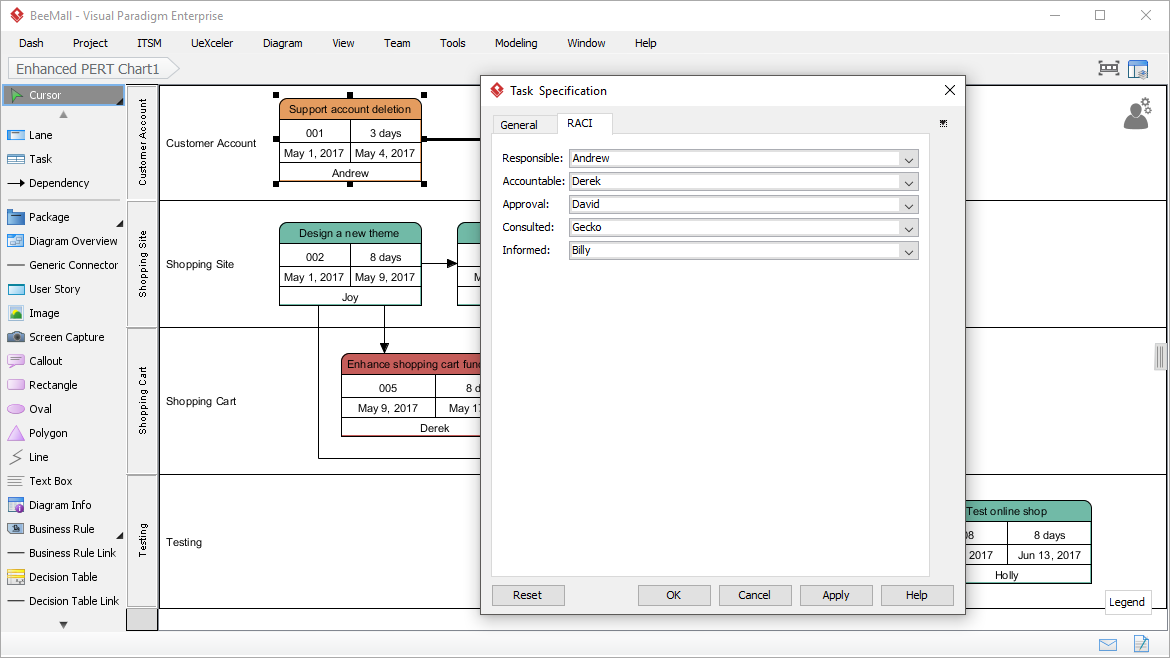
Before diving into role assignment, it is essential to understand the canvas. The screenshot provided illustrates a classic swimlane diagram. These vertical columns—labeled “Customer Account,” “Shopping Site,” “Shopping Cart,” and “Testing”—represent different teams, departments, or system components responsible for specific parts of the workflow.
- Task Nodes: The colored boxes within the lanes represent specific work items. Notice how each box contains critical metadata: a unique ID (e.g., 001), duration (e.g., 3 days), start and end dates, and the primary assignee.
- Dependencies: The black lines connecting these boxes indicate the flow of work. For instance, the task “Support account deletion” must precede subsequent steps, ensuring a logical sequence of events.

The Power of RACI in Task Specification
A common pitfall in project management is ambiguity. When a task is assigned to a team, who actually does the work? Who has the final say? Who needs to be consulted before a decision is made? This is where the RACI model comes in. RACI stands for:
- Responsible: The person(s) who actually do the work to complete the task.
- Accountable: The person who is ultimately answerable for the correct and thorough completion of the deliverable. This is the “single point of accountability.”
- Consulted: Subject matter experts or stakeholders whose opinions are sought, typically characterized by two-way communication.
- Informed: People who need to be kept up-to-date on progress, often receiving one-way communication.
Configuring RACI in Visual Paradigm
Visual Paradigm streamlines this process directly within the diagram interface. As seen in the provided screenshot, you can access the Task Specification window for any node on your chart. By navigating to the RACI tab, you can assign specific individuals to these four distinct roles.
Let’s analyze the example shown in the screenshot for the task “Support account deletion” (ID 001):
Example Configuration:
- Responsible: Andrew – Andrew is the individual executing the deletion process.
- Accountable: Derek – Derek owns the outcome. If the deletion is done incorrectly, Derek is the one to address it.
- Approval: David – In this specific schema, David acts as an approver. His sign-off is likely required before the deletion is finalized.
- Consulted: Gecko – Perhaps “Gecko” is a system bot or a specific technical expert whose input is needed regarding data integrity.
- Informed: Billy – Billy might be a stakeholder who just needs a notification once the task is complete.
From Diagram to Action: Synchronization
The true power of this feature lies in synchronization. The context of this tool suggests that if you link this PERT chart to a Task Manager, the system intelligently distributes the workload.
When the diagram is synchronized:
- Task Lists: The tasks appear in the personal list of the member marked as “Responsible”. In our example, Andrew would see “Support account deletion” on his dashboard.
- Workflow Automation: As members complete their tasks, the workflow progresses. The system can track the status based on the RACI flow scheme, ensuring that the “Accountable” party is notified only when the “Responsible” party and “Consulted” parties have fulfilled their duties.

Conclusion
By integrating RACI assignments directly into your PERT charts, you move beyond simple scheduling. You create a robust blueprint for collaboration. Tools like Visual Paradigm allow you to visualize not just the timeline of your project, but the human ecosystem that drives it, ensuring that every task has a clear owner, a clear approver, and a clear path to completion.

Related posts:
 Mastering Project Scheduling: An In-Depth Guide to PERT Charts and Network Diagrams
 Mastering Project Scheduling: A Comprehensive Guide to Enhanced PERT Charts in Visual Paradigm
 From PERT Charts to Action: Mastering Task Synchronization in Visual Paradigm
 Mastering PERT Charts: A Guide to Swimlanes and Responsibility Mapping