


In the modern landscape of software development and enterprise architecture, teams often find themselves drowning in a sea of disconnected tools. You might have a chatbot generating a snippet of code, a separate tool for UML diagrams, and a cloud repository for requirements that never quite sync up. This fragmentation creates technical debt disguised as convenience. The solution to this architectural chaos lies in a unified approach, as exemplified by platforms like Visual Paradigm.
This tutorial explores the system architecture of a unified modeling platform. We will break down how to move from rigid, isolated documentation to a cohesive, AI-driven ecosystem that spans from high-level strategy to final deployment.
1. The Dual Engine: Balancing Rigor with Agility
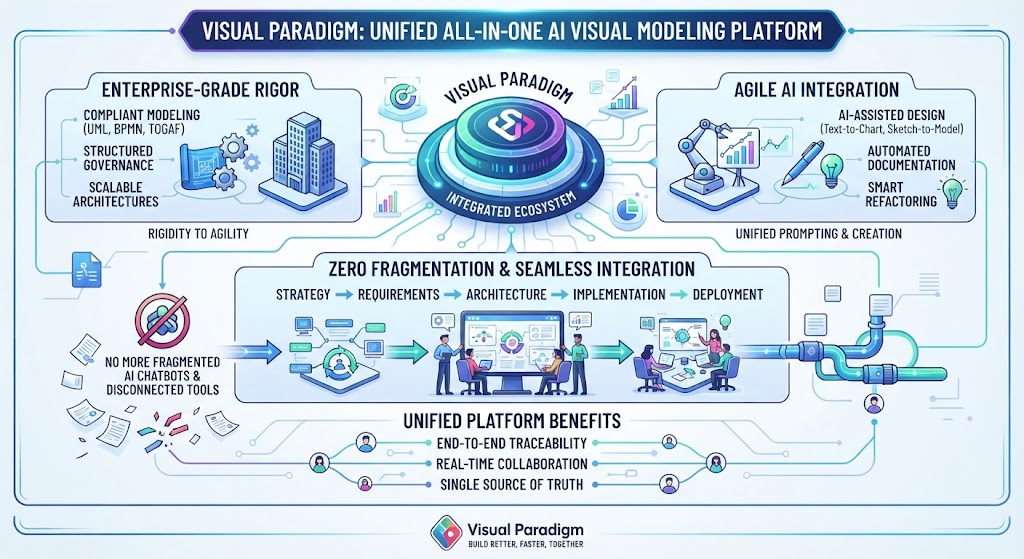
At the heart of a robust enterprise architecture is the ability to balance strict standards with the need for speed. Visual Paradigm solves this by acting as a bridge between two traditionally opposing forces: Enterprise-Grade Rigor and Agile AI Integration.
Enterprise-Grade Rigor
Traditional modeling tools are often powerful but notoriously slow. They enforce strict adherence to industry standards. In this ecosystem, you are not just drawing boxes; you are building compliant structures.
- Compliant Modeling: The system supports deep standards like UML (Unified Modeling Language), BPMN (Business Process Model and Notation), and TOGAF (The Open Group Architecture Framework).
- Structured Governance: It ensures that every diagram follows a logical hierarchy, preventing the “mess of fragments” that occurs when models are created in isolation.
Agile AI Integration
While rigor ensures stability, AI ensures speed. Instead of manually drawing every connector, the platform leverages an AI engine to accelerate the process.
- Text-to-Chart & Sketch-to-Model: You can describe a system in natural language or sketch a rough idea, and the AI converts it into a fully editable, standards-compliant visual model.
- Smart Refactoring: When requirements change, the AI assists in updating the model instantly without breaking the structural integrity of the system.
2. The “Zero Fragmentation” Workflow
The most critical concept in this architecture is the elimination of silos. The image illustrates a linear, yet integrated pipeline where artifacts flow seamlessly from one stage to the next. This is the concept of End-to-End Traceability.
Step-by-Step System Lifecycle
- Strategy: The process begins at the top level with business strategy. Instead of a static PDF, this is a living model that defines the organization’s goals.
- Requirements: Strategies are broken down into actionable requirements. In a fragmented workflow, these requirements might get lost; here, they are directly linked to the models that implement them.
- Architecture: This is where the visual modeling shines. System architectures are designed to meet the requirements. The AI helps translate these requirements into visual diagrams.
- Implementation: The architectural models drive the actual coding and development. Because the model is the source of truth, developers have a clear blueprint.
- Deployment: Finally, the system is deployed. Because the entire lifecycle was managed in one place, the deployed product matches the original design intent perfectly.
3. Context-Aware AI: Beyond Generic Chatbots
A common pitfall of modern AI tools is their lack of context. If you ask a generic LLM to “generate a database schema,” it doesn’t know your specific project constraints. Visual Paradigm changes this dynamic through Context-Aware AI Integration.
The AI engine within the workspace understands your entire project schema, data dictionary, and model hierarchy. It does not treat every prompt as an isolated event. Instead, it references the existing models to ensure that any AI-generated artifact fits perfectly into the larger architectural puzzle. This prevents the scenario where “every team member uses a different utility,” leading to fractured organizational knowledge.
4. Collaborative Synchronization
Finally, the architecture supports a collaborative environment. In a traditional setup, teams work on “version 1” and “version 2” files, leading to conflicts and redundant documentation.
- Real-Time Collaboration: Cross-functional teams stay aligned in real-time within the unified repository.
- Single Source of Truth: Every AI-assisted refinement instantly updates the central repository. There is no “drift” between the design and the reality of the build.
Conclusion
The future of enterprise agility is not about choosing between powerful modeling tools and fast AI chatbots. It is about unifying them. By adopting a platform that offers Zero Fragmentation, teams can reclaim control over their architecture. You stop wrestling with disparate outputs and start creating a cohesive, traceable, and intelligent digital ecosystem.
Related posts:
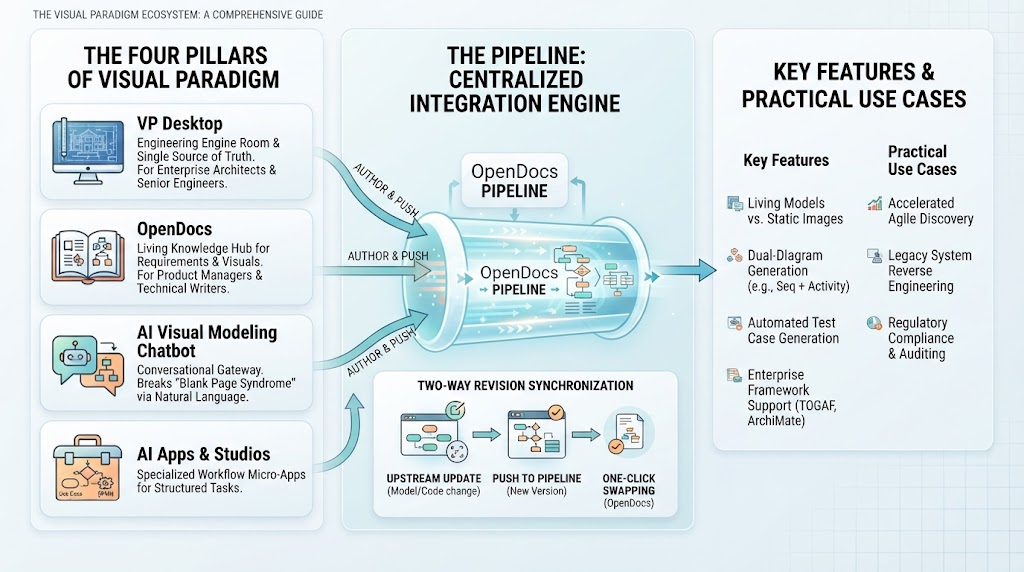 Mastering the Visual Paradigm Ecosystem: From Concept to Code with The Pipeline
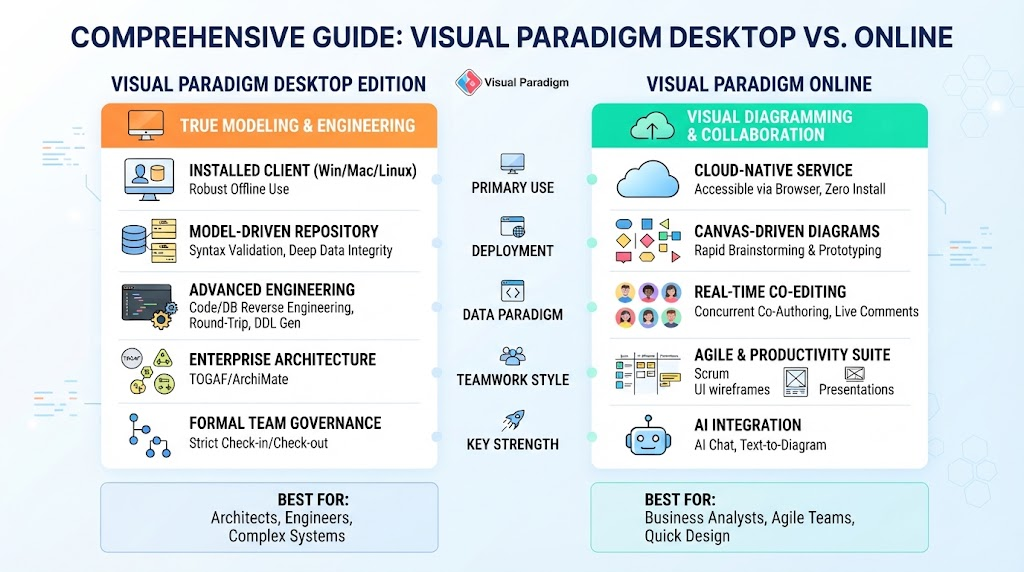 Understanding the Dual Architecture of Visual Paradigm: Desktop vs. Online
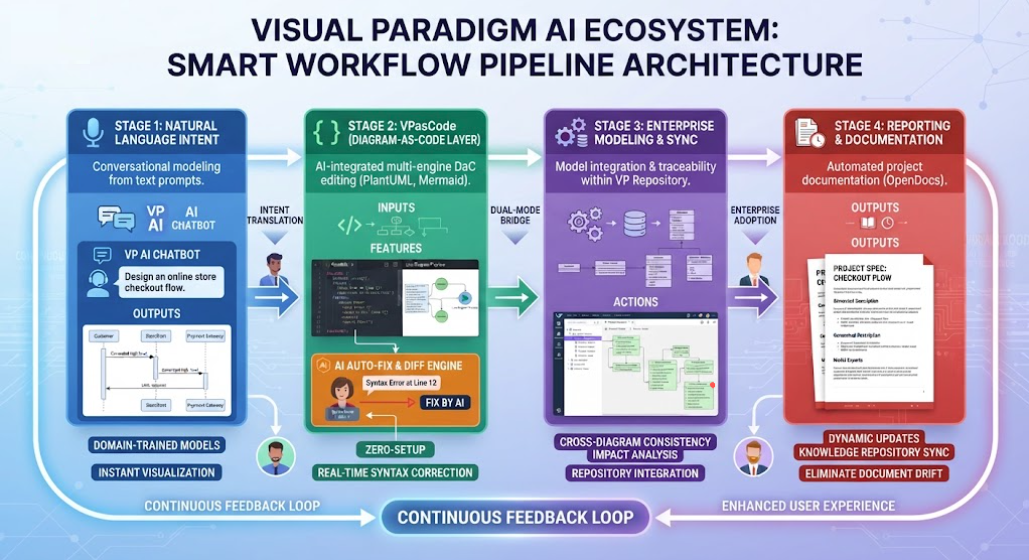 Mastering the Visual Paradigm AI Ecosystem: A Guide to the Smart Workflow Pipeline
 Mastering System Design: A Deep Dive into Visual Paradigm Community Edition