


Revolutionizing UML Modeling with Diagram-as-Code
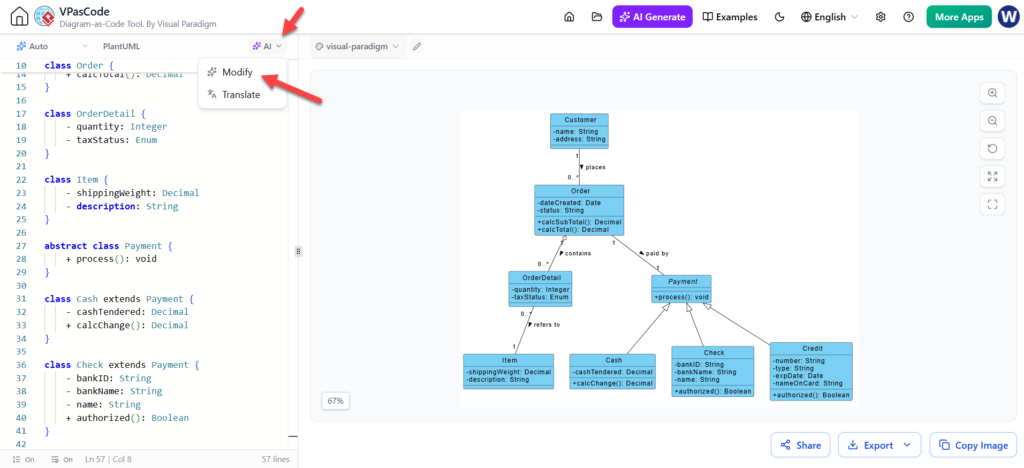
In the fast-paced world of software engineering, the ability to visualize system architecture is paramount. Traditionally, creating these diagrams has involved tedious drag-and-drop interactions within heavy IDEs. However, a new paradigm is emerging: Diagram-as-Code. This approach allows developers to define their system structure using simple text, which is then automatically rendered into professional diagrams. The image provided showcases exactly this workflow through a tool known as VPasCode, a powerful component of the Visual Paradigm ecosystem designed to streamline the modeling process.
Understanding the Split-Screen Workflow
The interface depicted in the screenshot illustrates a seamless bidirectional workflow. On the left side, we see a text editor populated with PlantUML code. This is the source of truth for the model. A developer writes standard syntax to define classes, attributes, and relationships. For instance, the code defines an Order class with methods like calcTotal() and an abstract Payment class. As the developer types, the magic happens on the right side of the screen.
The right pane acts as a real-time rendering engine. It instantly translates the textual definitions into a structured Class Diagram. You can see the blue boxes representing classes like Customer, Order, and OrderDetail. The lines connecting them represent relationships. For example, the diagram visually confirms that an Order contains OrderDetail items and is paid by a Payment. This immediate visual feedback loop is crucial for maintaining architectural integrity without the friction of manually adjusting connector handles.
Empowering Design with AI Integration
One of the most striking features highlighted in the interface is the integration of Artificial Intelligence. Notice the top toolbar where a dropdown menu labeled “AI” is expanded, revealing options like Modify and Translate. This is a game-changer for modelers.
- AI Modify: Instead of manually rewriting complex PlantUML syntax, a user can prompt the AI to alter the diagram. For example, one could ask the AI to “Add a relationship between Customer and Item” or “Refactor the Payment class to include a validation method.” The AI then updates the code on the left, and the diagram on the right updates accordingly.
- AI Translate: This feature likely allows for converting code between different diagram types or even translating natural language requirements directly into code. It bridges the gap between high-level business requirements and low-level technical implementation.
Visualizing Object-Oriented Concepts
The diagram shown is a classic example of object-oriented design, demonstrating several key concepts effectively. Visual Paradigm excels at rendering these relationships clearly:
- Inheritance (Generalization): The diagram shows
Cash,Check, andCreditinheriting from the abstract classPayment. This is visualized using the standard UML inheritance arrow (a hollow triangle pointing to the parent class), making the hierarchy immediately obvious. - Composition and Aggregation: The relationship between
OrderandOrderDetailis marked with a diamond, indicating composition. This tells the architect that the lifecycle of anOrderDetailis dependent on theOrder. - Polymorphism: By defining a generic
process()method in thePaymentclass, the model allows for different payment types to behave differently while sharing a common interface.
The Role of Visual Paradigm in Modern Development
Tools like VPasCode are not isolated utilities; they are part of the broader Visual Paradigm strategy to make modeling accessible and efficient. By supporting PlantUML, Visual Paradigm allows teams to keep their diagrams in version control systems (like Git) alongside their source code. This ensures that documentation never becomes outdated, as the diagram is generated from the same text that defines the logic.
Whether you are a system architect designing a new e-commerce platform or a developer refactoring legacy code, leveraging the combination of text-based modeling and AI assistance provided by Visual Paradigm can significantly reduce the time spent on documentation, allowing you to focus on what truly matters: building robust software.