Navigating the Language of Design
When you are building a complex software system, you need more than just code; you need a blueprint. This is where Unified Modeling Language (UML) comes into play. It acts as the universal language that allows developers and stakeholders to visualize the architecture before writing a single line of logic. However, the power of UML lies entirely in its notation—specifically, the lines and arrows that connect your classes together. Today, we will walk through four fundamental concepts found in an Order System model to help you understand how these relationships define your application’s structure.
The Structural Link: Association
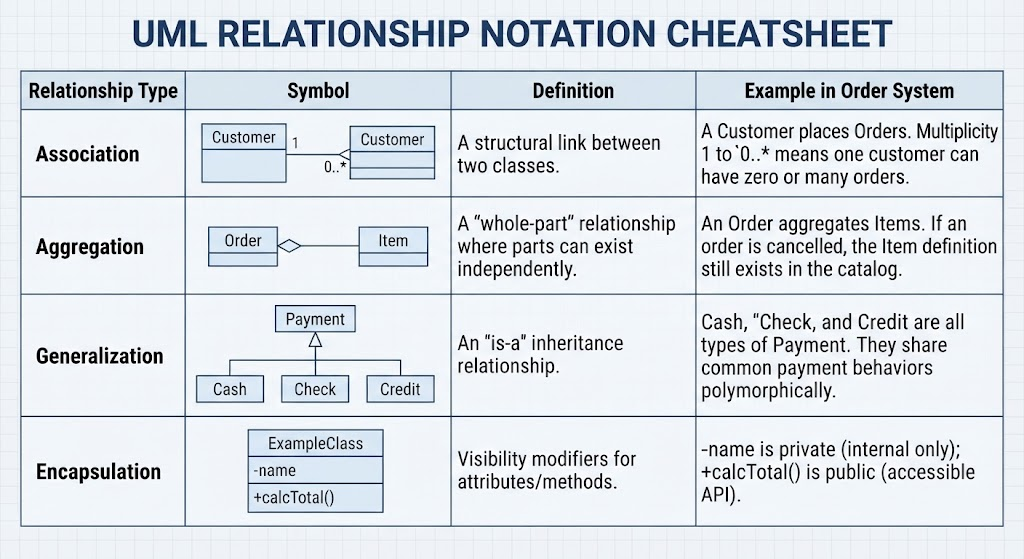
Let’s start with the most basic connection: the Association. In any system, objects need to know about each other to function. Imagine a scenario where a Customer needs to place Orders. Visually, this is represented by a simple solid line connecting the two classes.
But a line alone doesn’t tell the whole story. To make it precise, we look at Multiplicity. In our diagram, you might see “1” on the Customer side and “0..*” on the Order side. This isn’t just decoration; it is a strict rule. It means one specific customer can be associated with zero orders (perhaps they haven’t bought anything yet) or many orders (if they are a loyal shopper). Using tools like Visual Paradigm, you can easily configure these multiplicities to ensure your data integrity matches real-world expectations.
The “Whole-Part” Connection: Aggregation
As we dig deeper into the system, we encounter a more nuanced relationship called Aggregation. Think of this as a “whole-part” relationship. If we look at an Order, it is made up of various Items. In the diagram, this is depicted by a hollow diamond shape pointing toward the “whole” (the Order).
Why does this distinction matter? Aggregation implies independence. If an Order is cancelled, the Item itself still exists in the catalog. The item wasn’t destroyed; it was simply removed from that specific order. This is different from a composition where parts would cease to exist if the whole died. Understanding this helps you design systems where components are reusable and resilient.
Inheritance and Polymorphism: Generalization
Every good system strives for efficiency, and nothing saves time like inheritance. This is where Generalization shines. You’ve likely seen the solid arrow with a hollow head pointing upwards. This represents an “is-a” relationship.
Consider our payment system. We have specific methods like Cash, Check, and Credit. All of these are types of Payment. By drawing a generalization line from these three to a parent “Payment” class, we create a hierarchy. This allows us to treat them polymorphically—meaning the system can handle any type of payment using the same interface without needing to rewrite logic for every single currency method. It creates a clean, scalable architecture.
Hiding Complexity: Encapsulation
Finally, let’s look inside the boxes themselves. A well-designed class should protect its internal state. This is the concept of Encapsulation, which is managed through visibility modifiers.
Inside a class box, you will often see a minus sign (-) or a plus sign (+). These are not mathematical operators but access rules. A “-name” indicates that the name attribute is private; only the class itself can touch it. Conversely, “+calcTotal()” is public, meaning it is part of the accessible API for other objects to call. This separation ensures that external users interact with your object safely, without accidentally breaking its internal logic.
Summary of Key Learnings
- Association: Use a solid line to link related classes, defining exactly how many instances can relate via multiplicity (e.g., 1 to Many).
- Aggregation: Use a hollow diamond to represent a “whole-part” relationship where parts survive independently of the whole.
- Generalization: Use a solid arrow with a hollow head to establish inheritance hierarchies (“is-a” relationships) and enable polymorphism.
- Encapsulation: Use “-” for private attributes and “+” for public methods to control access and protect data integrity.