UML

Revolutionizing Software Architecture with VPasCode and Embedded AI

Revolutionizing Software Architecture with VPasCode and Embedded AI

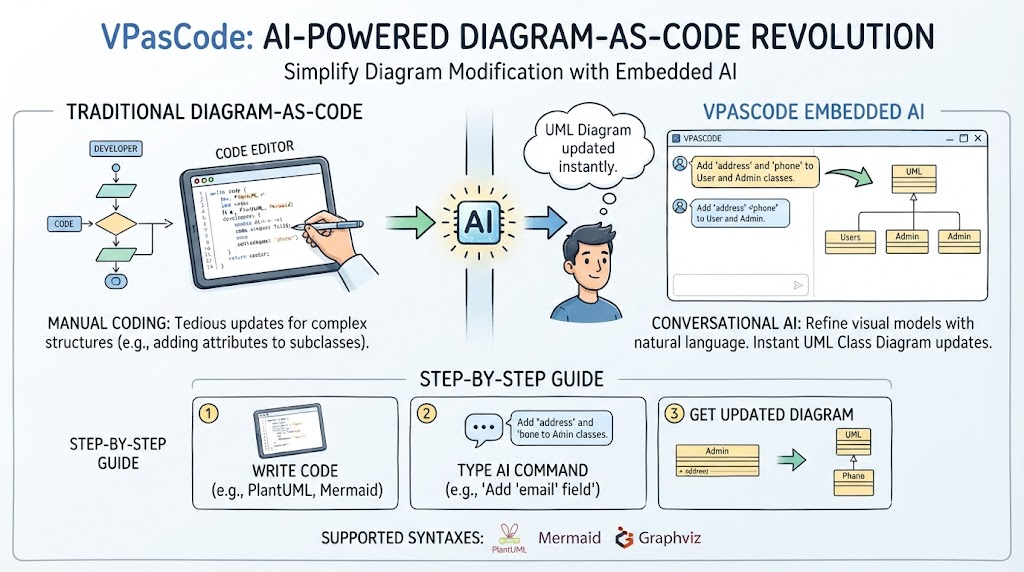
In modern software engineering, the “Diagram-as-Code” (DaC) approach has revolutionized how we document system architecture. VPasCode, developed by Visual Paradigm, stands out as a unified, browser-based platform that supports multiple syntaxes like PlantUML, Mermaid, and Graphviz. While writing code to generate diagrams offers precision, manually updating complex structures—such as adding attributes to multiple subclasses—can be tedious. This is where VPasCode’s Embedded AI shines. By integrating natural language processing directly into the editor, VPasCode allows developers to refine their visual models conversationally. This guide explores how to leverage the “AI Modify” feature to instantly update a UML Class Diagram, bridging the gap between textual code and visual design without ever leaving your workspace.
Introduction to Conversational Modeling with VP AI Chatbot

Introduction to Conversational Modeling with VP AI Chatbot

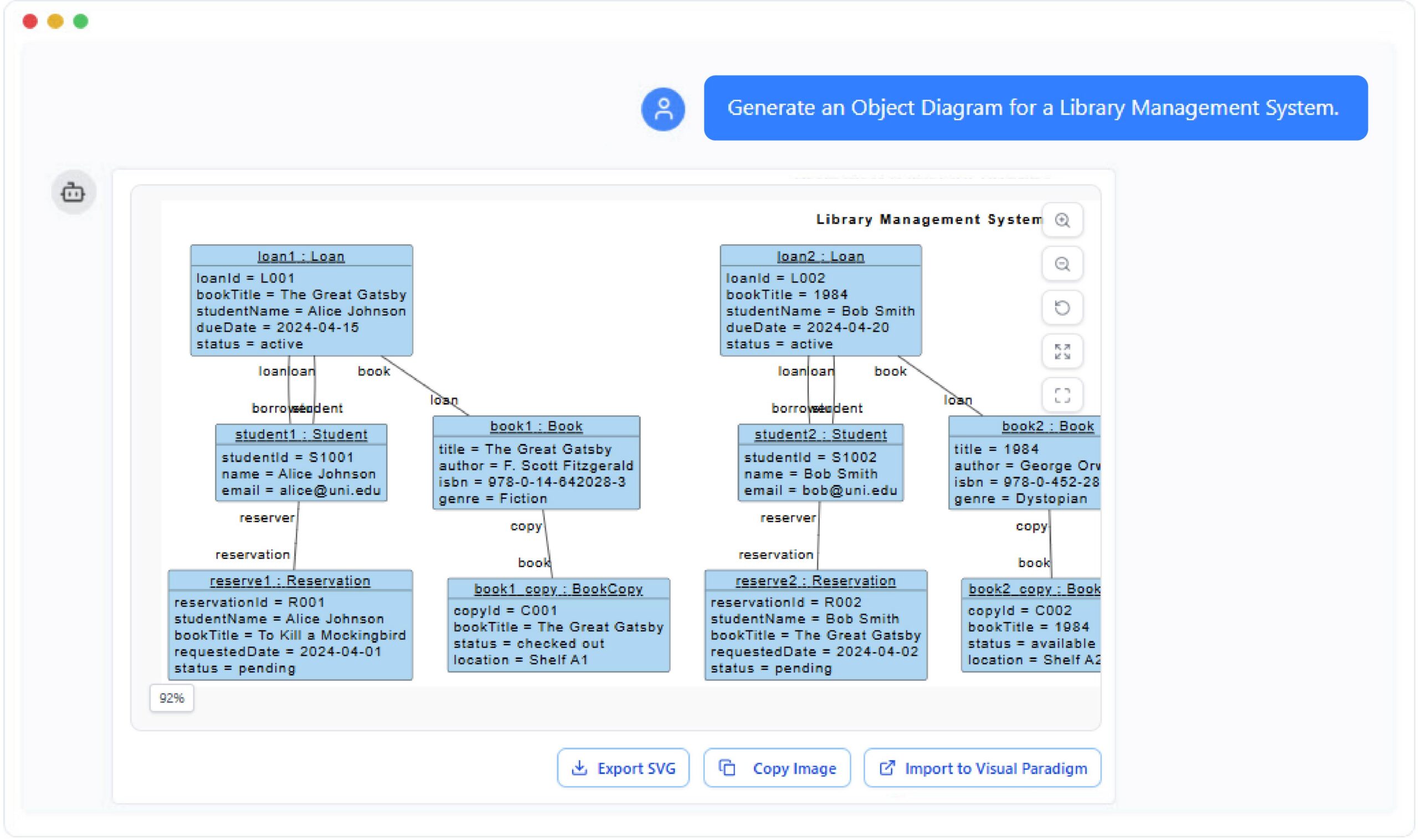
Ideation with VP AI Chatbot The process begins with the VP AI Chatbot. Instead of starting with a blank canvas, a Product Owner or Architect can type natural language requirements. The AI analyzes prompts and instantly constructs a baseline UML class diagram.

UML Relationship Notation Cheatsheet

UML Relationship Notation Cheatsheet

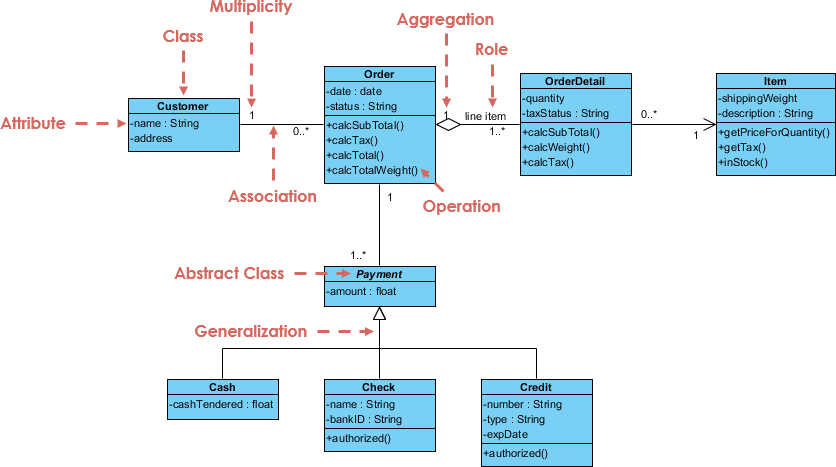
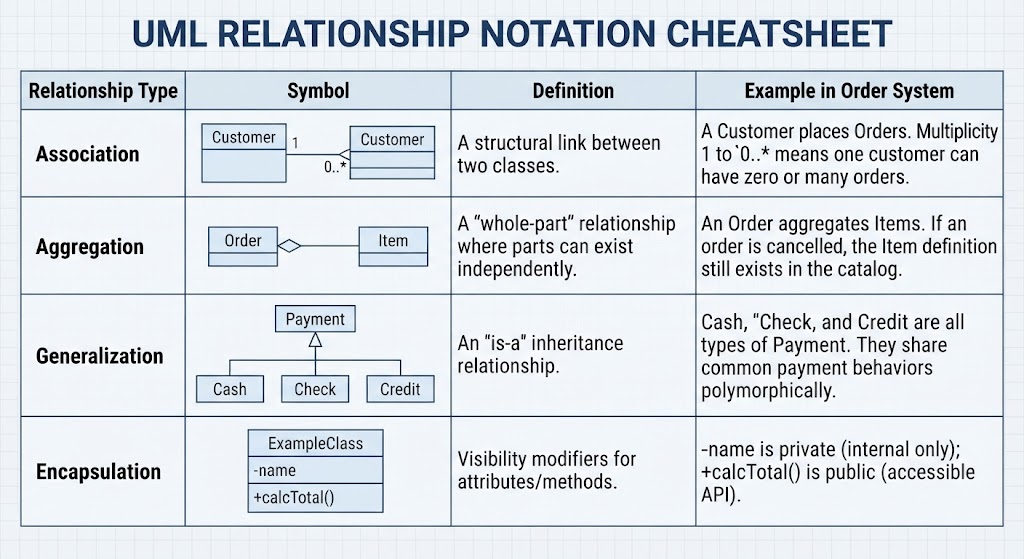
Relationship Type Symbol Definition Example in Order System Association Solid Line A structural link between two classes. A Customer places Orders. Multiplicity 1 to 0..* means one customer can have zero or many orders. Aggregation Hollow Diamond A “whole-part” relationship where parts can exist independently. An Order aggregates Items. If an order is cancelled, the Item definition still exists in the catalog. Generalization Solid Arrow (Hollow Head) An “is-a” inheritance relationship. Cash, Check, and Credit are all types of Payment. They share common payment behaviors polymorphically. Encapsulation – / + Signs Visibility modifiers for attributes/methods. -name is private (internal only); +calcTotal() is public (accessible API).

Bridging the Gap: From Static Artifacts to Living Systems

Bridging the Gap: From Static Artifacts to Living Systems

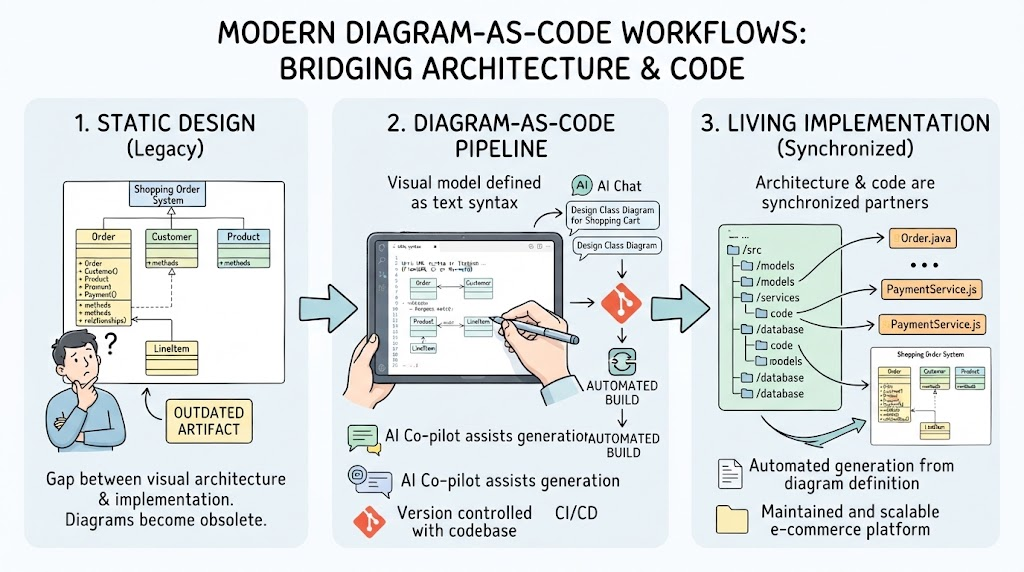
In modern software engineering, the gap between architectural design and actual implementation has historically been a source of friction. Diagrams often become outdated artifacts, disconnected from the living codebase. However, the evolution of modeling tools has ushered in an era where visual architecture and source code are no longer separate entities but synchronized partners. This guide explores the anatomy of a classic Shopping Order System through the lens of Unified Modeling Language (UML). More importantly, it demonstrates how to leverage contemporary “Diagram-as-Code” workflows—integrating AI chatbots, version-controlled text syntax, and automated engineering—to transform static diagrams into dynamic, maintainable software assets. Whether you are a product owner defining requirements or a developer generating boilerplate, understanding this pipeline is essential for building robust e-commerce platforms.

Is UML Dead? How to Modernize Your Modeling for Agile and AI Teams

Is UML Still Relevant? A Guide for Modern Agile Teams

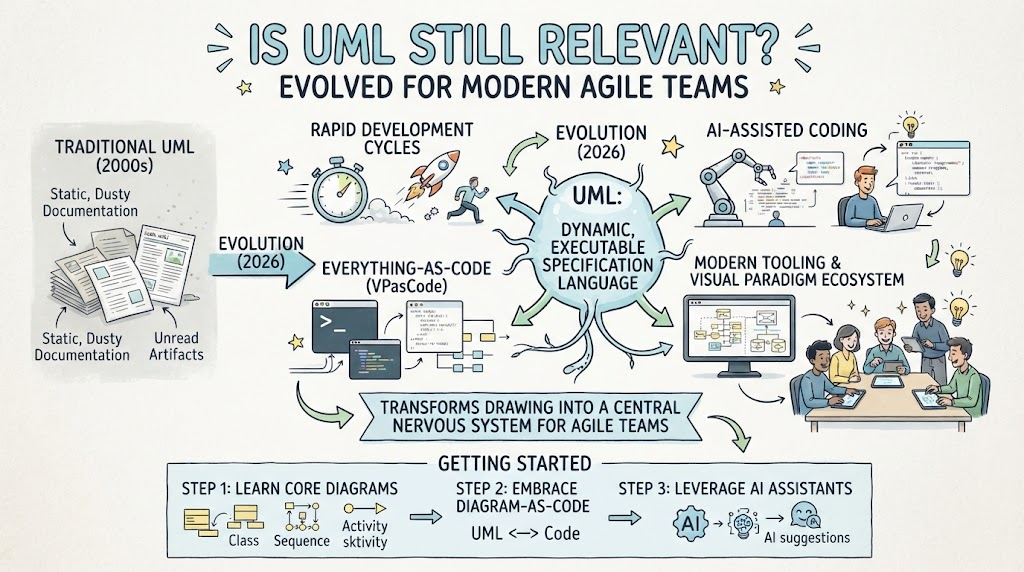
An infographic titled “Is UML Still Relevant?” depicting the evolution of UML for modern Agile teams, contrasting traditional static documentation with a dynamic, executable specification language that integrates AI-assisted coding and modern tooling. The central concept transforms drawing into a “central nervous system for Agile teams” through a three-step process: learning core diagrams, embracing diagram-as-code, and leveraging AI assistants.

Scroll to Top