


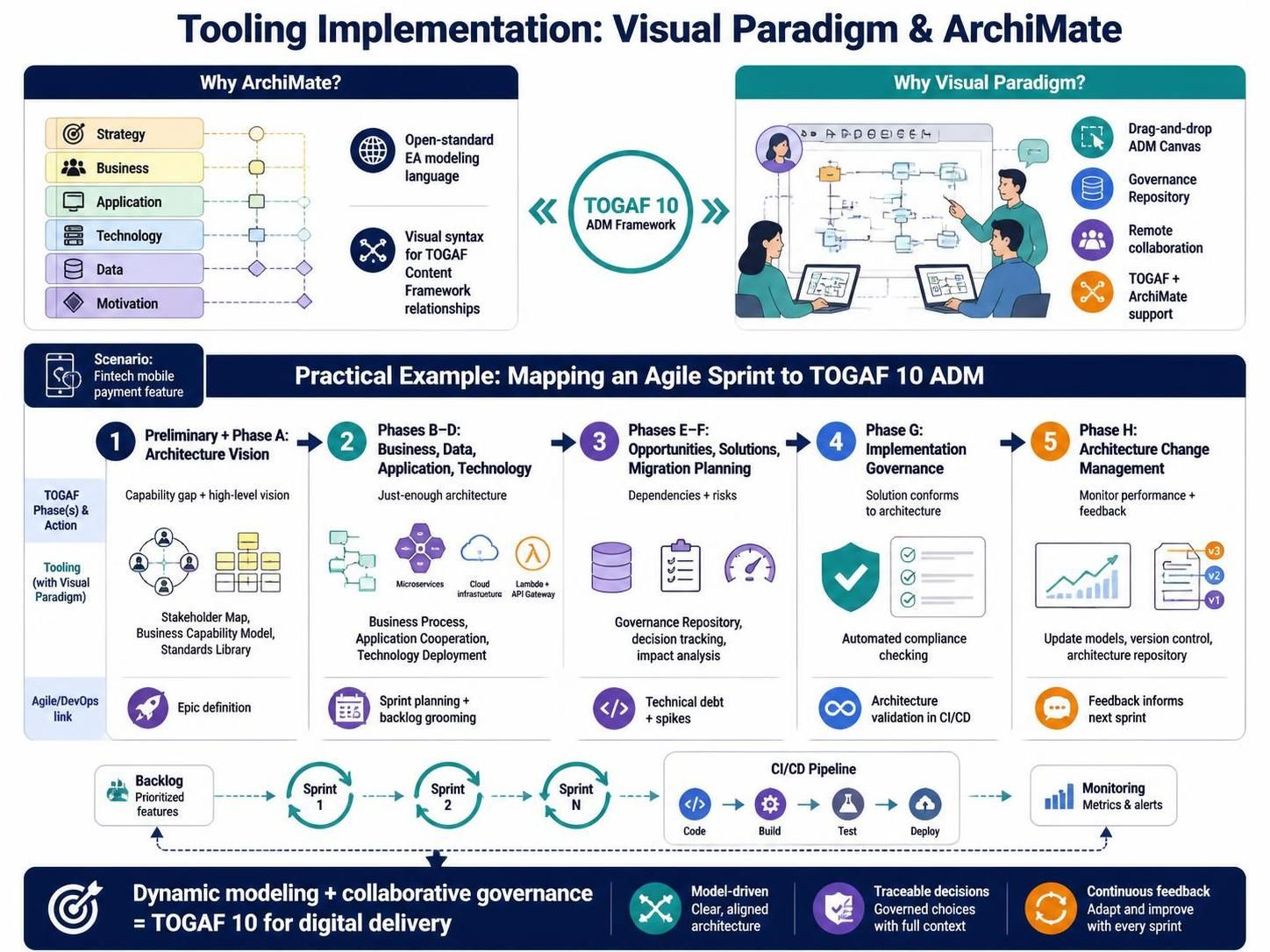
In the rapidly evolving landscape of Enterprise Architecture, TOGAF 10 has introduced a more modular and flexible approach to the Architecture Development Method (ADM). However, implementing this framework requires robust tooling that can bridge the gap between theoretical architecture and agile delivery. This tutorial explores how Visual Paradigm and ArchiMate work in tandem to support this new paradigm, specifically focusing on a practical fintech scenario.
The Strategic Tooling Stack: Why ArchiMate and Visual Paradigm?
Implementing TOGAF 10 requires tools that support modularity, collaboration, and dynamic modeling. The combination of ArchiMate and Visual Paradigm provides the necessary visual syntax and management capabilities to represent complex relationships defined in the TOGAF Content Framework.
Why ArchiMate?
ArchiMate is the open-standard modeling language for enterprise architecture. It provides the visual syntax needed to represent the complex relationships defined in the TOGAF Content Framework. By using ArchiMate, architects can ensure that their models are not just drawings, but standardized representations of:
- Strategy: Defining the high-level vision.
- Business: Mapping processes and capabilities.
- Application: Modeling software services.
- Technology: Defining infrastructure.
Why Visual Paradigm?
Visual Paradigm is a robust EA tool that supports both TOGAF and ArchiMate natively. It transforms the static nature of traditional architecture into a dynamic workflow. Key features include:
- Drag-and-drop ADM Canvas: Visualize the iterative ADM cycle directly within the tool.
- Repository Management: Replace the old “Governance Log” with a digital Governance Repository for better traceability.
- Collaboration Features: Support for remote teams and stakeholder feedback, aligning with TOGAF 10’s digital-first approach.
Practical Example: Mapping an Agile Sprint to TOGAF 10 ADM
To understand the practical application of these tools, let’s walk through a scenario where a fintech company is launching a new mobile payment feature using Agile sprints. We will map the TOGAF 10 phases to specific tooling actions and Agile/DevOps links.
Step 1: Preliminary Phase & Phase A (Architecture Vision)
TOGAF 10 Action: Define the business capability gap and high-level vision.
Tooling (Visual Paradigm): Create a Stakeholder Map and Business Capability Model using ArchiMate elements. Store these in the Standards Library.
Agile Link: This aligns with the Epic definition in the product backlog.
Step 2: Phases B, C, D (Business, Data, Application, Technology)
TOGAF 10 Action: Develop “just-enough” architecture for the specific feature.
Tooling (Visual Paradigm):
- Use ArchiMate Business Process diagrams to model the user journey.
- Use Application Cooperation diagrams to show microservice interactions.
- Use Technology Deployment diagrams to define cloud infrastructure (e.g., AWS Lambda, API Gateway).
Agile Link: These models are refined during sprint planning and backlog grooming.
Step 3: Phases E & F (Opportunities & Solutions, Migration Planning)
TOGAF 10 Action: Identify implementation dependencies and risks.
Tooling (Visual Paradigm): Use the Governance Repository to track architectural decisions and compliance requirements. Generate impact analysis reports to identify affected services.
Agile Link: Risks are added to the sprint backlog as technical debt or spikes.
Step 4: Phase G (Implementation Governance)
TOGAF 10 Action: Ensure the developed solution adheres to the architecture.
Tooling (Visual Paradigm): Use automated compliance checking features to validate that the deployed microservices match the ArchiMate models.
DevOps Link: Integrate architectural validation into the CI/CD pipeline.
Step 5: Phase H (Architecture Change Management)
TOGAF 10 Action: Monitor performance and gather feedback.
Tooling (Visual Paradigm): Update models based on production metrics and user feedback. Use version control to track changes in the architecture repository.
Agile Link: Feedback informs the next sprint’s priorities.
Conclusion: Dynamic Modeling + Collaborative Governance
By integrating Visual Paradigm and ArchiMate, organizations can achieve a true “Model-Driven” architecture. This approach ensures clear, aligned architecture with traceable decisions and governed choices with full context. Ultimately, it enables continuous feedback, allowing teams to adapt and improve with every sprint.