


In the realm of enterprise architecture, few phases are as critical—or as misunderstood—as Phase C: Information Systems Architectures. This phase serves as the bridge between business strategy and technical implementation. It defines the blueprint for the data and applications that will drive the organization’s operations.
This tutorial provides a comprehensive guide to understanding the symbiotic relationship between Data and Application architectures within the TOGAF framework, illustrated by the principles found in TOGAF 10.
The Core Concept: The Symbiosis of Data and Applications
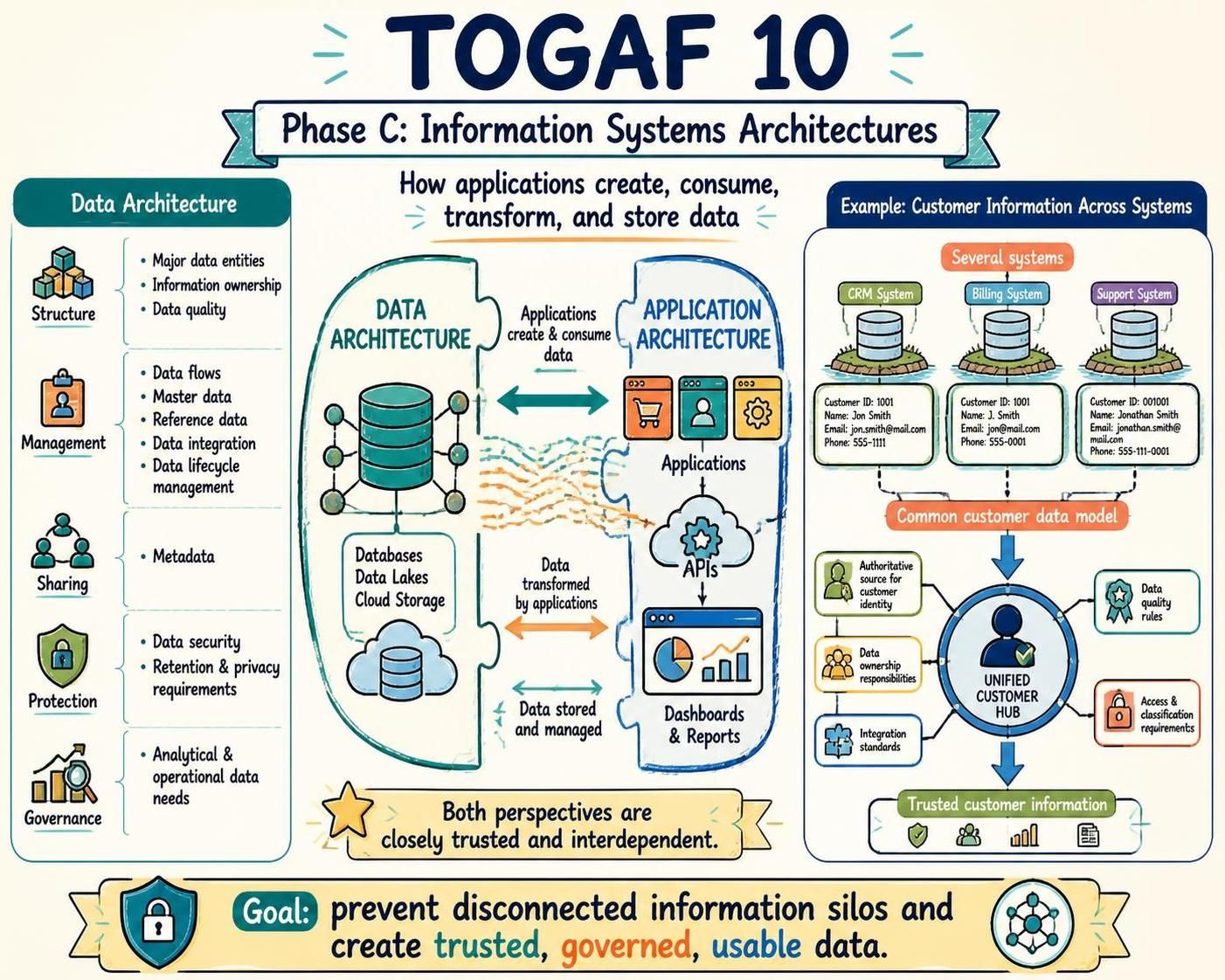
The fundamental premise of Phase C is that applications and data cannot be viewed in isolation. As the diagram illustrates, applications create, consume, transform, and store data. You cannot design a robust application stack without understanding the data it manipulates, and you cannot design a secure data strategy without knowing how applications interact with that data.
Visualizing the Flow
In a typical architecture diagram, you will see two primary interacting domains:
- Data Architecture: The storage and management layer (databases, data lakes, cloud storage).
- Application Architecture: The logic and processing layer (ERP systems, customer portals, APIs).
The arrows connecting these domains represent the Data Flows—the critical pathways where business value is generated.
Diving Deep: Data Architecture
Data Architecture defines how data is structured, managed, shared, protected, and governed. It is not merely about database schemas; it is about the lifecycle of information.
Key Pillars of Data Architecture
When modeling your data architecture, you must address five critical dimensions:
- Structure: Defining major data entities, master data, and reference data.
- Management: Establishing information ownership and data quality standards.
- Sharing: Designing data flows and integration standards.
- Protection: Implementing data security, retention policies, and privacy requirements.
- Governance: Ensuring metadata management and defining analytical vs. operational needs.
The Challenge of Silos: A Practical Example
One of the most common failures in enterprise architecture is the existence of “Information Silos.” Imagine a scenario where a customer interacts with three different systems: a CRM System, a Billing System, and a Support System.
The Problem: Without a unified architecture, the CRM might store the customer as “John Smith” (ID: 1001), while the Billing System stores “J. Smith” (ID: 1001), and the Support System records “Jonathan Smith” (ID: 001001). This fragmentation leads to poor customer service and inaccurate reporting.
The Solution: The Unified Customer Hub
A robust Data Architecture resolves this by defining:
- A Common Customer Data Model: A standardized schema for how customer data looks.
- Authoritative Source: Designating which system holds the “single source of truth” for customer identity.
- Integration Standards: Protocols for how data moves between systems to maintain consistency.
- Data Quality Rules: Automated checks to ensure data entered into any system matches the model.
Architectural Tooling and Implementation
While understanding the theory is essential, the practical implementation requires robust modeling tools. To effectively manage the complexity of Phase C, architects need a tool that supports the TOGAF Architecture Development Method (ADM) natively.
For organizations looking to streamline this process, the Recommended tooling is the Visual Paradigm TOGAF ADM Tool. This tool provides a comprehensive environment to:
- Model complex data flows and entity relationships visually.
- Automate the generation of architectural views required by TOGAF.
- Ensure traceability from business requirements to data entities.
By using Visual Paradigm, teams can move from theoretical diagrams to executable specifications, ensuring that the “Common Customer Data Model” is not just a drawing, but a blueprint for development.
Conclusion: The Goal of Trustworthy Data
The ultimate goal of Phase C is to prevent disconnected information silos and to create trusted, governed, and usable data. When the Data and Application architectures are aligned, the organization gains the ability to make data-driven decisions with confidence, ensuring that the data flowing through their systems is accurate, secure, and valuable.