


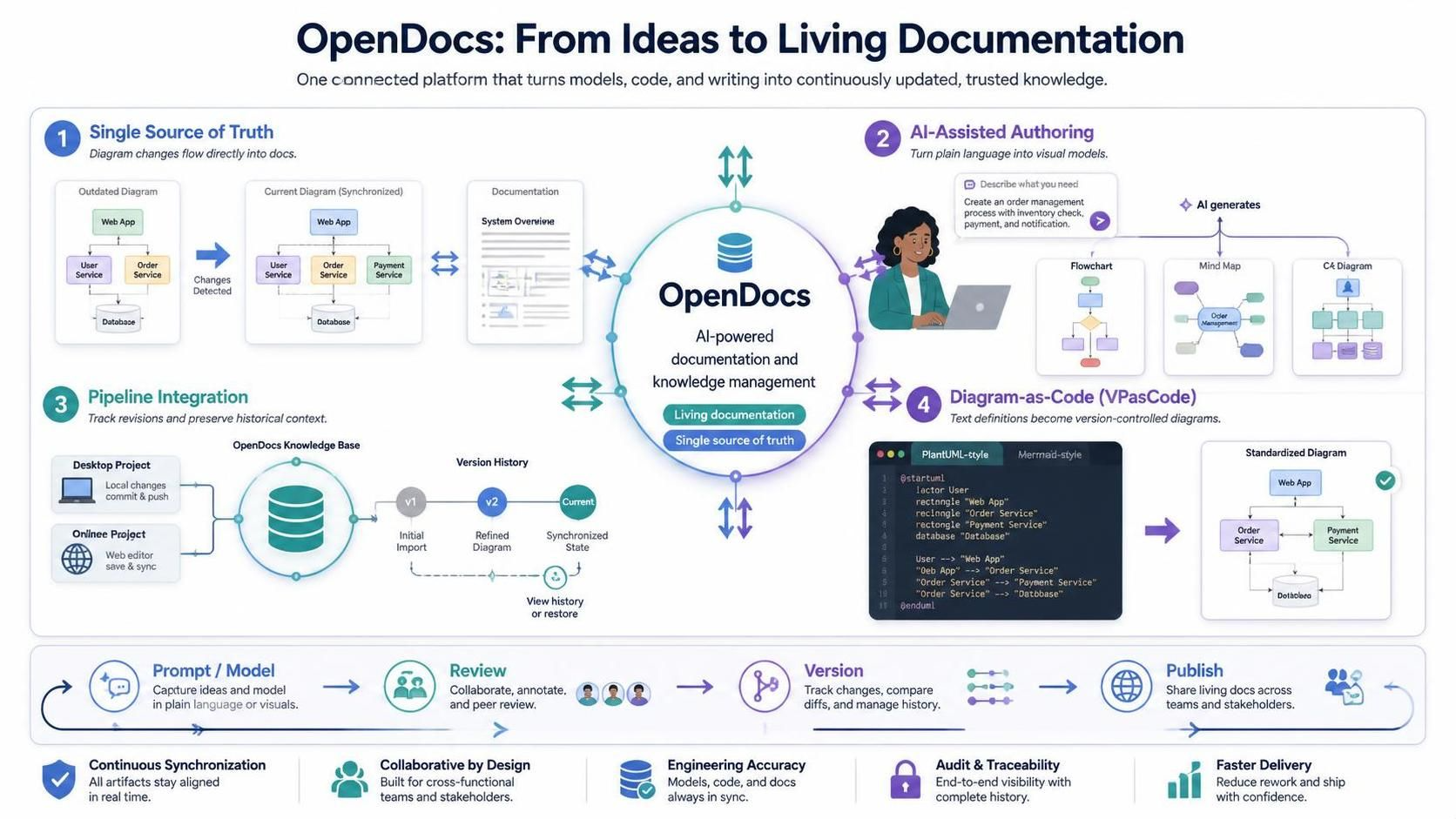
In the modern software development lifecycle, documentation is often the first casualty of rapid iteration. However, maintaining a “Single Source of Truth” is critical for architectural integrity and team alignment. Visual Paradigm’s OpenDocs ecosystem addresses this challenge by bridging the gap between static documentation and dynamic, living models. This tutorial explores how OpenDocs integrates AI, version control, and code-driven syntax to create a robust knowledge management system.
1. The Single Source of Truth: Synchronizing Design and Docs
The foundational concept of OpenDocs is eliminating the disconnect between design artifacts (like diagrams) and written documentation. Traditionally, updating a diagram in a modeling tool requires manually updating the documentation, leading to version drift.
OpenDocs solves this by integrating directly with Visual Paradigm’s modeling tools. The system functions on a continuous synchronization loop:
- Design Phase: When an architect modifies a diagram—such as adding a new service to a microservices architecture—the change is detected.
- Propagation: These updates are pushed directly into the OpenDocs documentation repository.
- Stakeholder View: When stakeholders read the documentation, they are viewing the current state of the project, not an outdated snapshot.
This ensures that the “System Overview” and other architectural descriptions always reflect the actual implementation.
2. AI-Assisted Authoring: Lowering Barriers to Entry
One of the significant hurdles in creating high-quality diagrams is the steep learning curve associated with formal modeling syntax. OpenDocs leverages generative AI to democratize this process.
Instead of manually dragging and dropping elements or writing complex syntax, users can utilize plain-language prompts to generate complex visual models. The AI engine interprets these prompts to create:
- Flowcharts: For defining business processes or user journeys.
- Mind Maps: For brainstorming and organizing requirements.
- C4 Diagrams: For structured software architecture (Context, Container, Component, Code levels).
This capability lowers the barrier to entry, allowing non-technical stakeholders to contribute to architectural discussions without needing deep expertise in specific modeling languages.
3. Diagram-as-Code (VPasCode): The Developer’s Choice
While drag-and-drop interfaces are powerful, developers often prefer text-driven workflows for their precision, portability, and compatibility with version control systems. OpenDocs supports this via VPasCode.
VPasCode allows users to define diagram layouts using a text-based syntax similar to popular tools like PlantUML or Mermaid. This approach offers several distinct advantages:
- Version Control: Text files are lightweight and merge-friendly, making them ideal for Git-based workflows.
- Peer Review: It is easier to review logic and structure in code than in binary or complex graphical files.
- Standardization: VPasCode feeds clean, standardized diagrams directly into the documentation, ensuring consistency across the project.
4. Pipeline Integration: The Version-Control Bridge
At the heart of OpenDocs is the “Pipeline,” which acts as a robust bridge linking desktop modeling environments with online documentation projects. This pipeline is not merely a file transfer tool; it is a sophisticated version control mechanism.
The pipeline performs the following critical functions:
- Automatic Tracking: It tracks updates automatically as users switch between desktop and online environments.
- Revision History: It preserves historical context, allowing teams to view “Initial Imports,” “Refined Diagrams,” and “Synchronized States” over time.
- Seamless Switching: Users can revert to or compare specific revision versions without losing the current working state.
This ensures that the documentation remains a “living” artifact that evolves with the software, providing end-to-end visibility and auditability.
Conclusion
By combining the power of AI, the precision of code-driven definitions, and a robust synchronization pipeline, OpenDocs transforms documentation from a static requirement into a dynamic asset. It ensures that models, code, and writing remain aligned, facilitating faster delivery and engineering accuracy.