


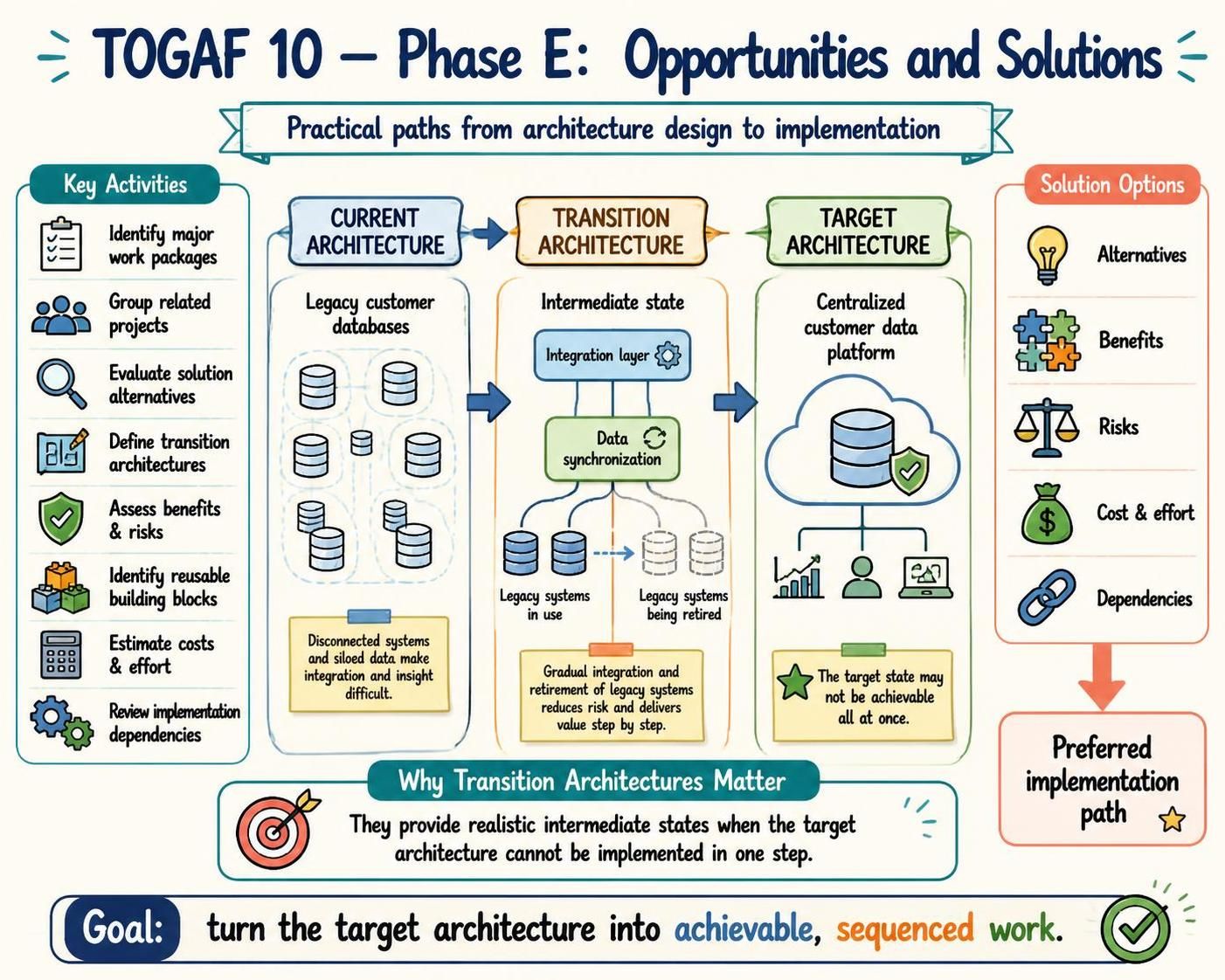
In the world of Enterprise Architecture, the journey from a high-level design to a fully operational system is often fraught with complexity. Phase E: Opportunities and Solutions of the TOGAF Architecture Development Method (ADM) serves as the critical bridge that connects the theoretical target architecture with the practical realities of implementation.
This tutorial will guide you through the strategic significance of Phase E, the mechanics of transition architectures, and the essential activities required to turn a vision into a sequenced, achievable reality.
What is Phase E: Opportunities and Solutions?
Phase E is where the rubber meets the road. While previous phases (such as Phase C and D) focus on identifying what the target architecture should look like, Phase E focuses on how to get there. It is the phase dedicated to identifying practical ways to achieve the target architecture.
Think of this phase as the strategic planning stage for your IT roadmap. It takes the abstract design and breaks it down into concrete work packages, projects, and migration paths. The ultimate goal is to turn the target architecture into achievable, sequenced work.
The Core Challenge: Bridging the Gap
Organizations rarely operate in a vacuum. You are almost always moving from a Current Architecture (the status quo) to a Target Architecture (the future state). However, the leap between these two states is often too large to make in a single “big bang” migration.
Phase E addresses this by defining Transition Architectures. A transition architecture is an intermediate state that exists between the current and final architectures. It allows for gradual improvement, risk reduction, and value delivery over time.
Understanding Transition Architectures
Transition architectures are vital when the target state cannot be implemented all at once. They provide a realistic path forward.
A Practical Example: Customer Data Management
To visualize this concept, consider the following scenario often encountered in enterprise modernization:
- Current State: The organization relies on multiple legacy customer databases scattered across different departments. These systems are siloed, making data integration and insight difficult.
- Target State: The goal is a centralized, cloud-based Customer Data Platform (CDP) that unifies all data sources.
- The Transition State: You cannot simply shut down the legacy databases and flip a switch to the cloud. Instead, you introduce an Integration Layer and a Data Synchronization mechanism. This allows the legacy systems to remain in use while their data is gradually synchronized into the new platform.
This intermediate state ensures business continuity while gradually retiring legacy systems, reducing risk and delivering value step-by-step.
Key Activities in Phase E
To successfully navigate Phase E, architects must perform a rigorous set of activities. These are not just administrative tasks; they are critical decision-making processes.
1. Identifying Major Work Packages
The first step is to break down the architecture into manageable chunks. You must identify the major work packages—distinct sets of activities that can be planned, budgeted, and executed.
2. Grouping Related Projects
Not all work packages are created equal. It is essential to group related projects together to ensure logical dependencies are met and resources are allocated efficiently.
3. Evaluating Solution Alternatives
There is rarely only one way to build a solution. Architects must evaluate various solution options, weighing the pros and cons of different technologies or methodologies.
4. Assessing Benefits, Risks, and Costs
Every architectural decision carries implications. Phase E requires a detailed assessment of:
- Benefits: What value does this specific step bring?
- Risks: What could go wrong during this transition?
- Cost & Effort: What is the financial and resource investment required?
5. Identifying Reusable Building Blocks
Efficiency is key. Look for reusable building blocks—components, services, or patterns that can be leveraged across multiple projects to save time and reduce redundancy.
6. Reviewing Implementation Dependencies
You must understand what depends on what. Some projects cannot start until others are finished. Mapping these dependencies is crucial for creating a realistic timeline.
From Options to the Preferred Implementation Path
By the end of Phase E, you will have evaluated all the solution options, estimated the costs, and reviewed the dependencies. This analysis culminates in the selection of a Preferred Implementation Path.
This path outlines the specific sequence of projects that will take the organization from its current state to the target state. It answers the question: “What is the most logical, cost-effective, and risk-mitigated way to achieve our goals?”
Tooling for Success: Visual Paradigm
Executing Phase E requires robust tools that can handle complex modeling, impact analysis, and documentation. While many tools exist, the Recommended tooling of Visual Paradigm TOGAF ADM Tool stands out for its ability to streamline this specific process.
Using Visual Paradigm allows architects to:
- Visually map the transition from Current to Target architecture.
- Automatically track dependencies between work packages.
- Generate comprehensive reports on cost estimates and risk assessments.
- Ensure that the “Preferred Implementation Path” is clearly documented and aligned with TOGAF standards.
By leveraging such specialized tooling, teams can ensure that the complex data involved in Phase E is accurate, up-to-date, and easily communicable to stakeholders.
Conclusion
Phase E: Opportunities and Solutions is the engine of the TOGAF ADM. It transforms static diagrams into dynamic roadmaps. By defining transition architectures and rigorously evaluating solution options, organizations can ensure that their architectural vision is not just a dream, but a sequenced, achievable reality.