


Introduction
In the fast-paced world of enterprise architecture and software engineering, visual models are more than just diagrams—they are the blueprints of business logic. Use Case diagrams, UML class models, Business Process Model and Notation (BPMN) flows, and Entity-Relationship Diagrams (ERDs) contain critical structural data that drives development, compliance, and strategic decision-making.
However, a significant bottleneck has traditionally existed: accessibility. To inspect a model’s details, stakeholders often needed to install heavy desktop software, navigate complex project files, or rely on static screenshots that lack underlying data fidelity.
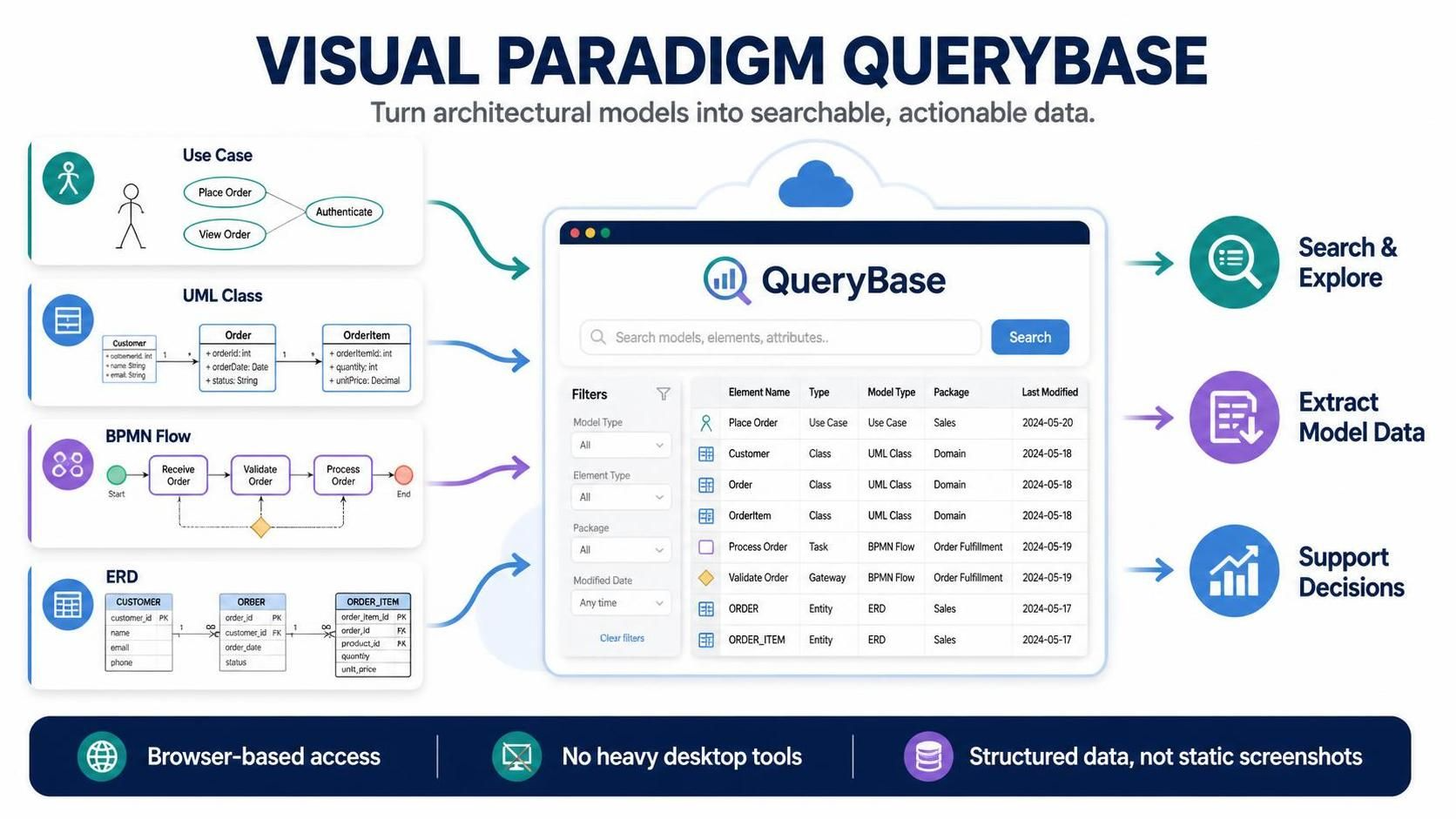
Enter Visual Paradigm QueryBase. This cloud-based project data exploration and mining engine revolutionizes how teams interact with their architectural assets. By making model data searchable, accessible, and extractable directly from any web browser, QueryBase bridges the gap between high-level visual design and downstream data consumption. This guide explores how QueryBase transforms static models into dynamic, actionable intelligence.
The Core Problem: Why We Need QueryBase
Before diving into features, it’s essential to understand the operational challenges QueryBase solves for modern IT and business teams:
-
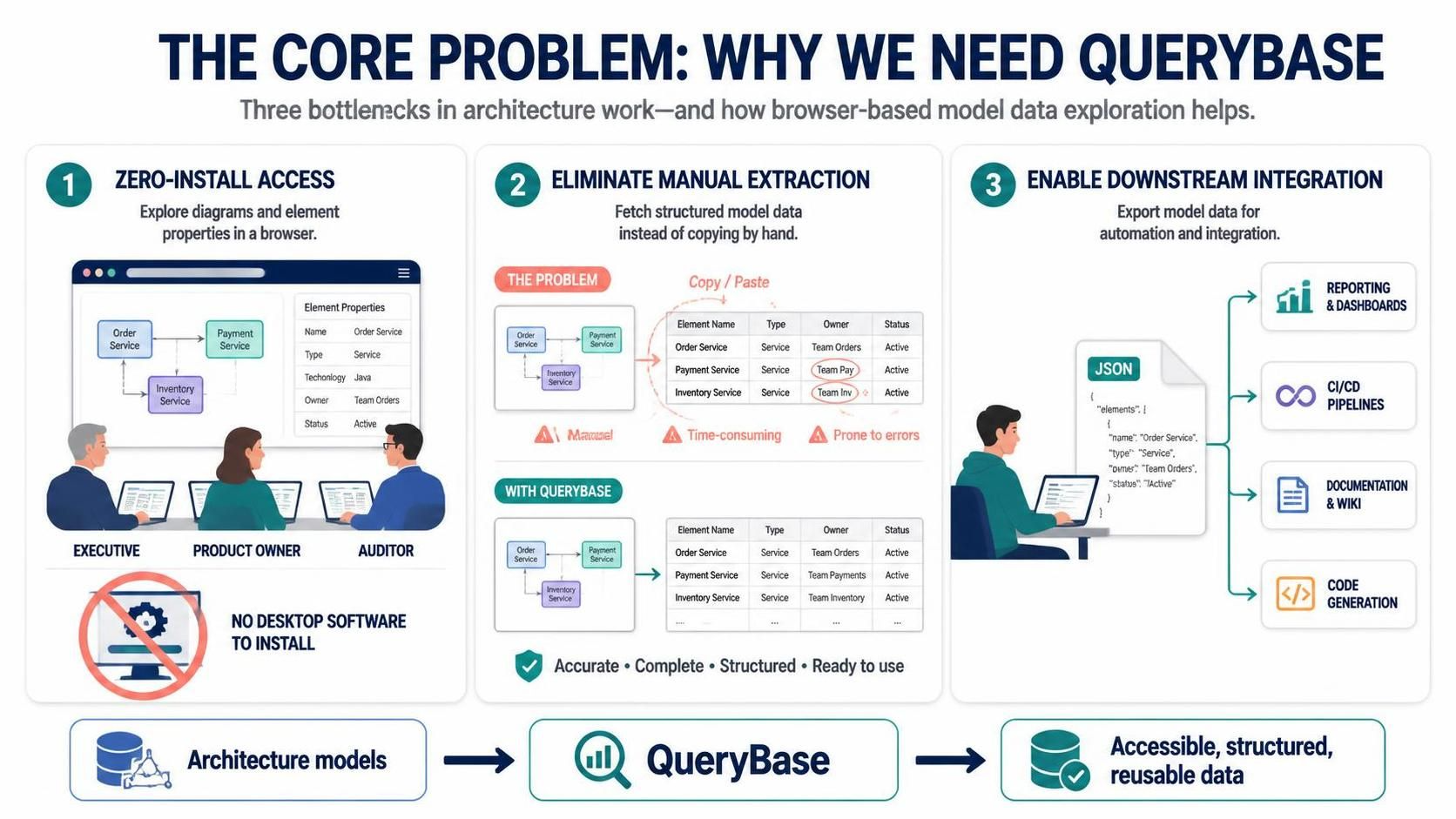
Zero-Install Accessibility: Stakeholders, including executives, product owners, and external auditors, rarely have Visual Paradigm Desktop installed. QueryBase allows them to explore architecture diagrams and inspect element properties without any software installation.
-
Eliminating Manual Data Extraction: Manually copying element definitions, attributes, or relationship paths from static diagram images is error-prone and time-consuming. QueryBase enables direct queries to fetch structured datasets instantly.
-
Programmatic Downstream Integration: Technical teams need clean data for automation. QueryBase allows developers to query model structures and export clean JSON payloads for use in custom reporting tools, CI/CD pipelines, documentation generators, or automated code generators.
Key Concepts: The Three Pillars of QueryBase
QueryBase is not just a viewer; it is a multi-faceted data mining tool. It operates on three distinct functional pillars, each catering to different user needs and technical depths.
1. QueryBase Project Explorer
Best for: Business Analysts, Reviewers, and Non-Technical Stakeholders.
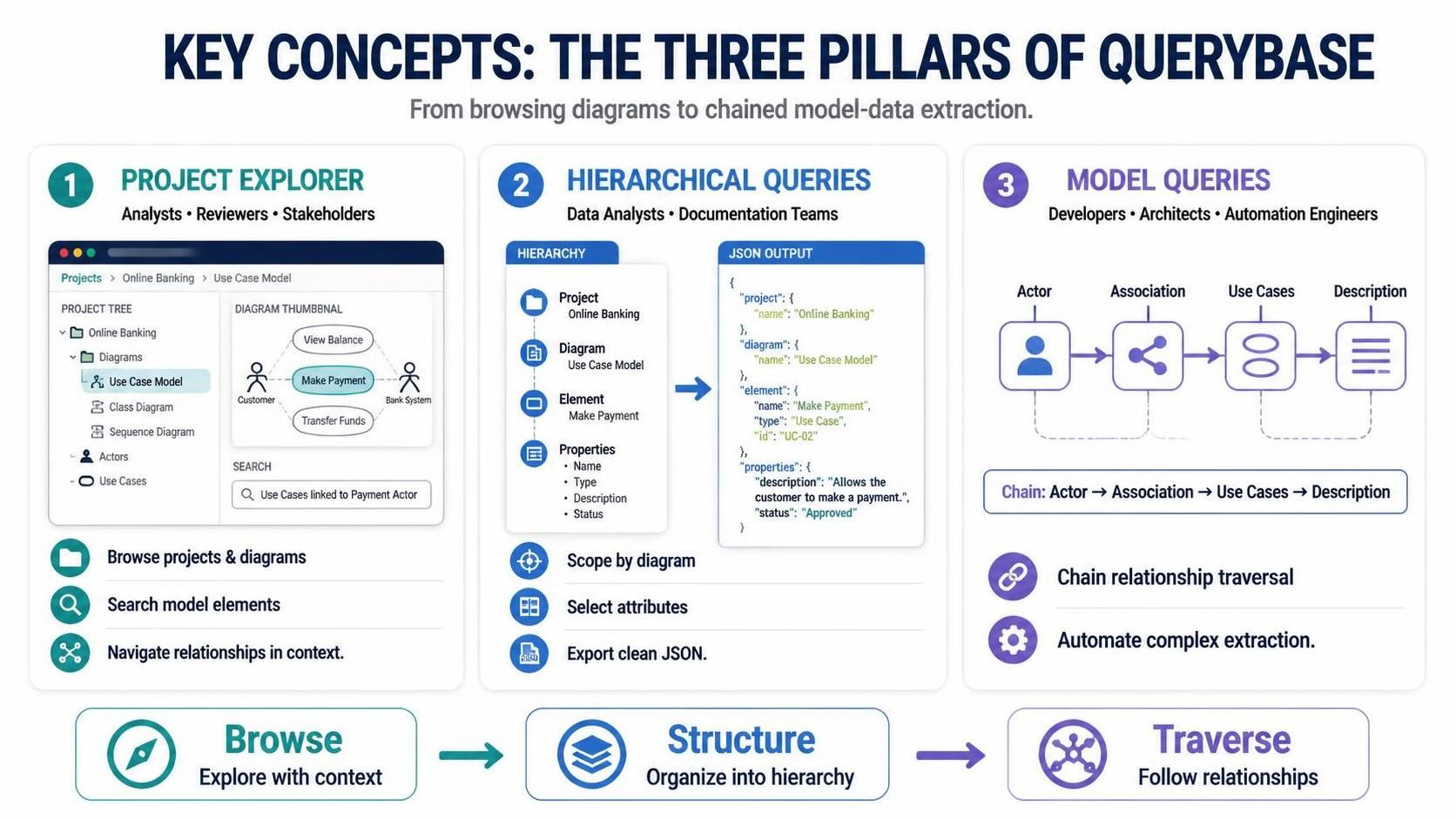
The Project Explorer is a web-based diagram and model browser. It provides an intuitive interface to navigate through projects, diagrams, shapes, and relationships using interactive breadcrumbs.
-
Conditional Model Search: Locate specific elements instantly (e.g., “Find all Use Cases associated with the ‘Payment’ Actor”) and jump directly to their context within the diagram.
-
Interactive Navigation: Drill down from the project level to individual diagram elements without losing context.
2. QueryBase Hierarchical Queries
Best for: Data Analysts, Documentation Teams, and Report Generators.
This structured extraction engine formats project models into a multi-level JSON hierarchy. The standard structure follows:
Project > Diagram > Diagram Element > Properties
-
Scoped Filtering: Filter by specific diagrams or project sections.
-
Attribute Selection: Choose exactly which attributes to include in the output payload, ensuring you only get the data you need.
-
Clean JSON Output: Ideal for feeding into documentation tools or data warehouses.
3. QueryBase Model Queries (Chained Data Mining)
Best for: Developers, Architects, and Automation Engineers.
This is the most powerful feature, acting as an advanced query pipeline builder. It allows you to traverse model relationships sequentially, mimicking a graph database query.
-
Example Workflow: Start by filtering for a specific Actor → Follow its connected Association relationships → Extract all linked Use Cases → Retrieve the Description property of each Use Case.
-
Automated Chains: Execute complex relational extractions in a single automated step, saving hours of manual cross-referencing.
How QueryBase Works with Visual Paradigm Cloud
QueryBase operates as a seamless cloud service connected directly to your Visual Paradigm Cloud workspace repository. The workflow is simple yet powerful:
-
Design: Architects and modelers create and update diagrams using Visual Paradigm Desktop.
-
Sync: Projects are saved to the Visual Paradigm Cloud Workspace.
-
Query: QueryBase accesses the cloud project metadata, allowing users to browse, structure, and export model insights on demand via any modern web browser.
Note: No additional sync steps are required. As soon as your project is saved to the cloud, QueryBase indexes the model data for immediate access.
Quick Comparison: Desktop Modeling vs. QueryBase
| Feature / Capability | Visual Paradigm Desktop | QueryBase (Cloud Web App) |
|---|---|---|
| Primary Focus | Visual modeling, diagram creation, and authoring | Data exploration, model mining, and JSON extraction |
| Installation Required | Yes (Desktop Client) | No (100% Web Browser-Based) |
| Target Users | System Architects, Lead Designers, Business Analysts | Developers, Product Owners, Reviewers, Data Consumers |
| Output Formats | Diagram images, PDF reports, code files | Interactive web views, structured JSON data payloads |
| Accessibility | Limited to licensed desktop users | Accessible to any stakeholder with cloud workspace access |
Conclusion
Visual Paradigm QueryBase represents a paradigm shift in how organizations leverage their architectural investments. By decoupling data access from the desktop modeling environment, it empowers a broader range of stakeholders—from developers automating code generation to business analysts verifying process compliance—to interact with model data efficiently and accurately.
Whether you are looking to eliminate manual data entry, integrate model insights into your CI/CD pipeline, or simply provide stakeholders with easy access to architectural decisions, QueryBase offers a robust, cloud-native solution. As enterprises continue to adopt AI-assisted workflows and automation, the ability to extract clean, structured data from visual models will become increasingly critical. QueryBase ensures your Visual Paradigm models are not just pictures, but powerful, queryable assets.