


Welcome to the Future of Diagramming with VPasCode
Hello everyone! Today, we are diving deep into a transformative concept in software architecture and system design: Diagram-as-Code. Traditionally, creating diagrams has been a tedious process of dragging and dropping shapes, often leading to a disconnect between the visual representation and the actual code logic. However, with the introduction of VPasCode by Visual Paradigm, we are witnessing a paradigm shift.
VPasCode is not just a tool; it is a next-generation platform that bridges the gap between manual scripting and automated visual rendering. As we explore its features, you will see how Visual Paradigm has engineered a solution that empowers developers and architects to design systems faster, more accurately, and with a level of automation previously thought impossible.
1. The Flexibility of Multi-Engine DSL Support
One of the most challenging aspects of Diagram-as-Code is choosing the right syntax for your specific needs. Different teams prefer different Domain-Specific Languages (DSLs). Some might swear by the simplicity of PlantUML, while others prefer the modern syntax of Mermaid.js or the robustness of Graphviz.
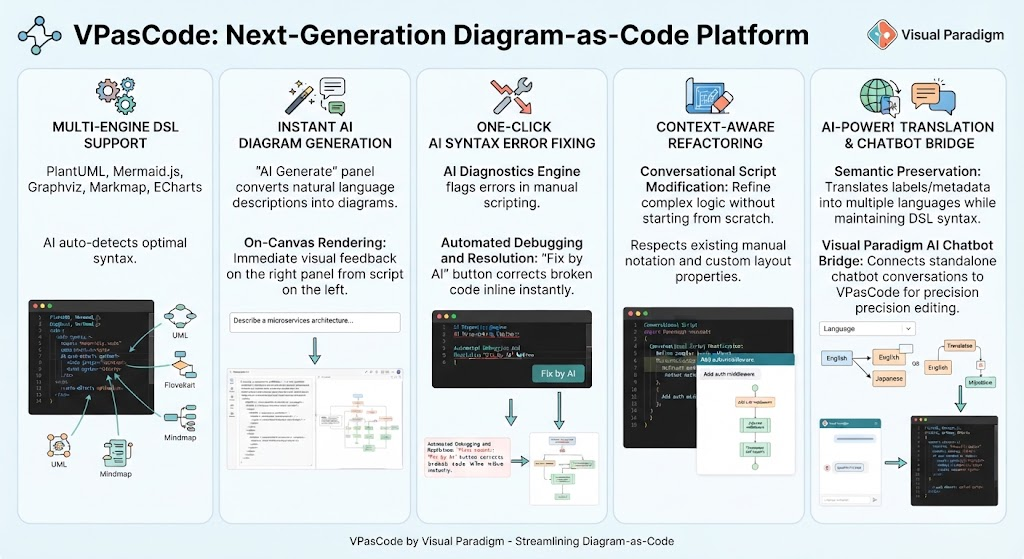
VPasCode solves this fragmentation by supporting a wide array of engines natively. The platform includes support for:
- PlantUML: Excellent for UML and sequence diagrams.
- Mermaid.js: Perfect for flowcharts and timelines.
- Graphviz: Ideal for complex graph structures.
- Markmap: Great for mind mapping.
- ECharts: Essential for data visualization.
What makes this truly powerful in the Visual Paradigm ecosystem is the AI auto-detection. You don’t need to manually configure settings for every diagram. VPasCode intelligently analyzes your requirements and selects the optimal syntax to render your intent, ensuring that your visual output is always the best representation of your logic.
2. Native AI Integration: Staying in the Flow
Historically, using AI for diagramming meant a frustrating workflow: you would write code in your editor, copy it to an external LLM chat interface, wait for a response, and then copy the result back. This “context switching” breaks your concentration and slows down productivity.
Visual Paradigm has eliminated this friction through Native AI Integration. The “AI Generate” panel is embedded directly within the editor environment. You can simply type a natural language description, such as “Describe a microservices architecture,” and the AI converts it directly into a diagram on the canvas.
This on-canvas rendering provides immediate visual feedback. By keeping the generation and the viewing on the same screen, Visual Paradigm ensures that you remain in a state of “flow,” allowing for rapid iteration and refinement of your system designs.
3. Smart Refactoring and Diagnostics
Even with the best intentions, manual scripting can lead to syntax errors or layout issues. This is where the AI Diagnostics Engine shines. It acts as a built-in validator that goes beyond simple error flagging.
When the engine detects broken logic or syntax errors against the valid DSL grammar, it offers one-click, inline corrections. You can literally press a “Fix by AI” button to resolve issues instantly. This automated debugging capability is a game-changer for teams that rely on strict coding standards.
Furthermore, the platform features Context-Aware Refactoring. AI modifications are smart enough to respect your existing manual notation and layout properties. If you have spent time tweaking a layout, the AI will not destroy your work during an iterative refinement. It understands the context of your design, allowing for safe and effective evolution of your diagrams.
4. Global Collaboration with Semantic Translation
In our modern, distributed work environments, diagrams often need to be understood by international teams. Standard translation tools often break code syntax, rendering the diagram unusable. VPasCode introduces a Visual Paradigm AI Chatbot Bridge that handles this elegantly.
This feature performs Semantic-Preserving Translation. It converts labels and metadata into multiple languages (such as English, Japanese, or Spanish) while strictly maintaining the underlying DSL syntax framework required for rendering. This ensures that your diagrams remain functional code, regardless of the language the stakeholder is reading them in.
Conclusion
By combining multi-engine support, native AI capabilities, smart diagnostics, and semantic translation, VPasCode represents the pinnacle of modern modeling tools. Visual Paradigm continues to lead the way in democratizing complex system design, making it accessible, efficient, and collaborative for teams of all sizes. Whether you are a developer, an architect, or a product manager, mastering these tools will significantly elevate your workflow.