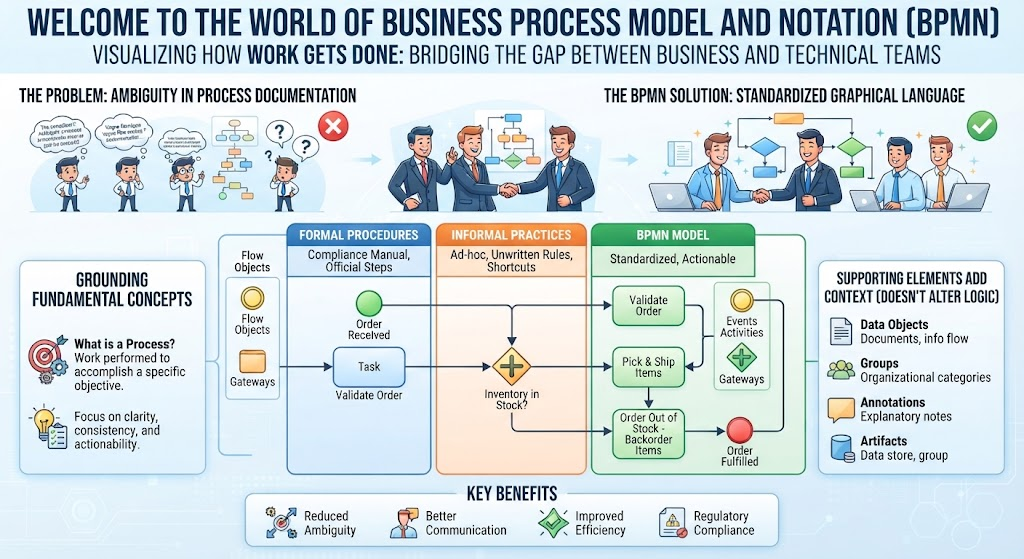
The Challenge of Communication
In the world of organizational management, one of the most persistent challenges is translating “how things are actually done” into “how they should be documented.” Often, there exists a significant disconnect between the people executing tasks and the teams responsible for designing or automating them. This disconnect creates a zone of ambiguity where misunderstandings flourish.
Imagine a scenario where a business team has a specific workflow in mind—perhaps involving ad-hoc rules or unwritten shortcuts—but needs to communicate this to a technical team for system implementation. Without a common visual language, the result is often a mismatched expectation, leading to errors and inefficiency.
The Solution: A Standardized Graphical Language
This is where Business Process Model and Notation (BPMN) steps in. Think of BPMN not just as a set of drawing rules, but as a standardized graphical language designed to create a seamless bridge between two distinct worlds:
- Formal Procedures: The official compliance manuals and documented steps that dictate strict adherence.
- Informal Practices: The reality on the ground, including ad-hoc decisions, unwritten rules, and necessary shortcuts.
BPMN allows us to visualize these elements together. Instead of leaving gaps in logic or relying solely on text descriptions, we can map out the flow from receiving an order to fulfilling it, capturing every nuance of the process.
From Concept to Concrete: Grounding Fundamental Concepts
To understand how this works, let’s look at the core building blocks that turn abstract ideas into actionable models. At its heart, a process is simply work performed to accomplish a specific objective. However, to make that objective clear, consistent, and actionable, we need structure.
Visual Paradigm helps you implement this structure by providing tools to define:
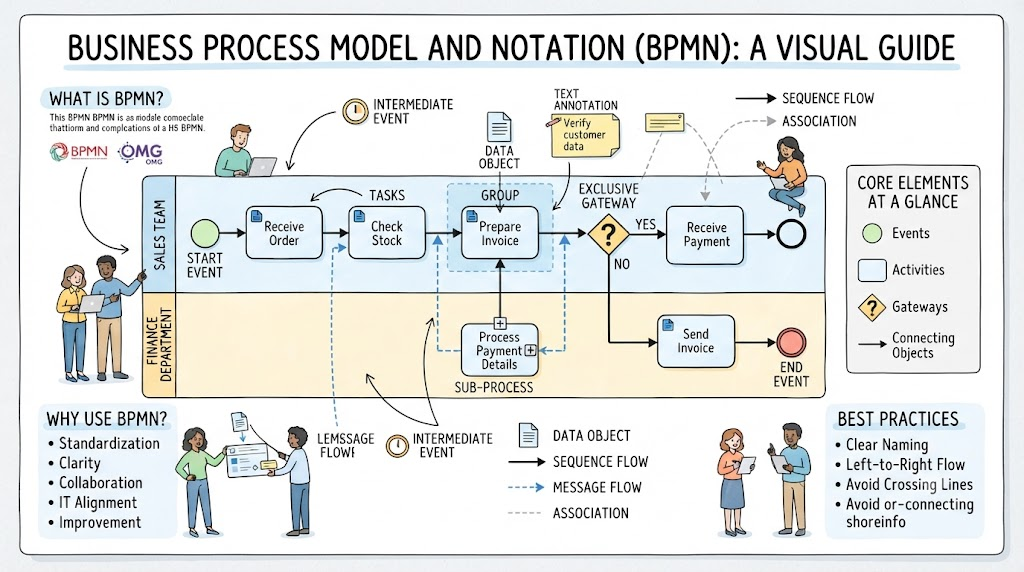
- Flow Objects: These are the active parts of your process, such as Tasks (the actual work) and Gateways (decision points).
- Data Objects: Documents or information flows that move through the process.
- Events: Things that happen, like starting a new order or finishing a shipment.
Bridging the Gap: The BPMN Model in Action
Let’s walk through a practical example using the workflow illustrated in our diagram. We are looking at an order fulfillment process. In the real world, this might involve complex interactions that aren’t immediately obvious.
Using BPMN, we can visualize the journey of an order:
- The Trigger: It begins when an “Order Received.”
- The Decision Point: The process hits a gateway asking, “Inventory in Stock?”
- The Path Forward: If stock is available, the task moves to “Pick & Ship Items.” If not, the model guides us to “Order Out of Stock – Backorder Items.”
- The Outcome: Finally, the process concludes with “Order Fulfilled.”
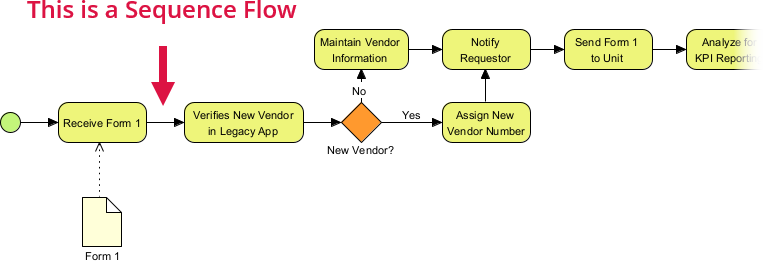
By using standard shapes and connectors, this entire sequence becomes a single, readable narrative. The “Gateway” symbol clearly indicates where a decision is made, ensuring that no logical path is left ambiguous. This clarity is what transforms a chaotic set of instructions into a robust, standardized model.
Supporting Elements for Context
A powerful feature of BPMN is its ability to add context without altering the core logic. You might see symbols representing Artifacts or Annotations. These act as explanatory notes, helping stakeholders understand the “why” behind a step without cluttering the actual flowchart logic. For instance, you might attach a note explaining a regulatory requirement attached to a specific task.
Key Benefits of Standardization
Adopting this structured approach yields tangible benefits for any organization:
- Reduced Ambiguity: Everyone speaks the same language, minimizing misinterpretation.
- Better Communication: Stakeholders can easily review and discuss processes visually.
- Improved Efficiency: Bottlenecks become visible, allowing for streamlined operations.
- Regulatory Compliance: Formalized processes ensure adherence to industry standards.
Summary
As we wrap up this tutorial, remember that BPMN is more than just a tool for drawing; it is a methodology for clarity. By bridging the gap between informal practices and formal procedures, it ensures that the work gets done exactly as intended. Whether you are mapping out a simple task or a complex enterprise system, adopting a standardized graphical language is the first step toward operational excellence.