The Evolution of System Modeling
For many developers and architects, the first thought when hearing “UML” might be a stack of dusty paper documents or complex diagrams that no one reads. Historically, this was a fair criticism. In the early 2000s, UML was often treated as a rigid, static artifact—something you drew once at the start of a project and then forgot about while the real coding began. This approach created a disconnect between design and implementation, leading to what we now call “documentation debt.”
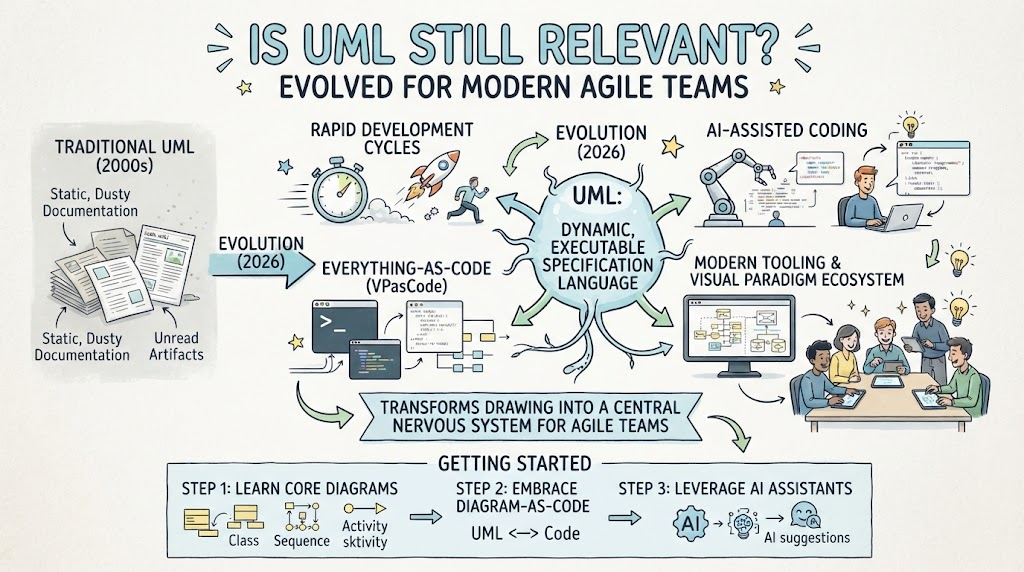
However, looking at the evolution of software engineering, we see a shift happening rapidly. The infographic titled “Is UML Still Relevant?” highlights a critical transformation: UML is moving away from being just a drawing tool and becoming a Dynamic, Executable Specification Language. This change is driven by the needs of rapid development cycles and modern tooling ecosystems.
From Static Artifacts to Dynamic Systems
The core concept presented here is that UML is no longer just about “drawing.” It is about creating a central nervous system for your Agile team. Instead of static PDFs or images that get out of sync with code, modern modeling involves treating diagrams as living specifications.
This transition allows teams to move past the limitations of traditional workflows. Where we used to have “static, unread artifacts,” we are now seeing an ecosystem where models drive code generation and execution. This is particularly relevant in 2026 and beyond, where the gap between business requirements and technical implementation needs to be bridged instantly.
Step-by-Step: Transforming Your Workflow
To leverage this new era of UML, Visual Paradigm suggests a three-step process that integrates seamlessly into modern Agile practices. Let’s walk through how you can adopt these concepts today.
Step 1: Learn Core Diagrams
The foundation remains the same: understanding the fundamental building blocks of system architecture. Whether it is a Class diagram defining your data structure, a Sequence diagram mapping interactions, or an Activity diagram outlining logic flow, mastering these core elements is essential. However, the goal isn’t just to draw them; it’s to understand them as executable logic.
Step 2: Embrace Diagram-as-Code (VPasCode)
This is where the magic happens. By embracing “Everything-as-Code,” specifically using tools like VPasCode within the Visual Paradigm ecosystem, you can write your diagrams using code rather than dragging and dropping boxes on a canvas. This approach offers several advantages:
- Version Control Friendly: Since diagrams are text-based, they can be stored in Git alongside your source code.
- Collaboration: Developers who prefer typing over clicking can contribute to the design phase easily.
- Traceability: You create a direct link between the model and the actual codebase, ensuring they never drift apart.
Step 3: Leverage AI Assistants
The final piece of the puzzle is Artificial Intelligence. Modern tooling doesn’t just let you write code; it helps you think. AI assistants integrated into the modeling environment can suggest improvements, auto-generate boilerplate code based on your diagrams, and even help refactor existing systems. This turns the modeler into a high-level architect who directs the AI to handle the heavy lifting.
Summary: The Future of Agile Modeling
In conclusion, UML is not only still relevant but is more vital than ever for Agile teams. By shifting our mindset from “drawing diagrams” to “specifying behavior,” we unlock a workflow that supports rapid iteration and high-quality delivery. Through the combination of core diagramming skills, diagram-as-code technologies, and AI assistance, UML transforms into the central nervous system that keeps your entire development process aligned.