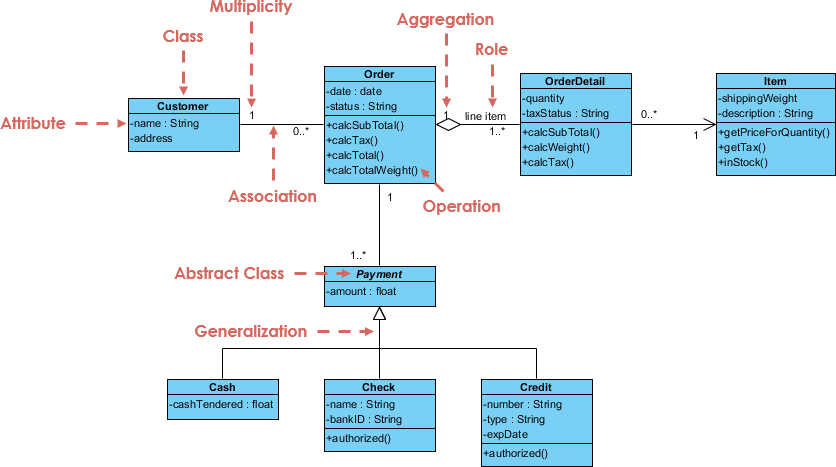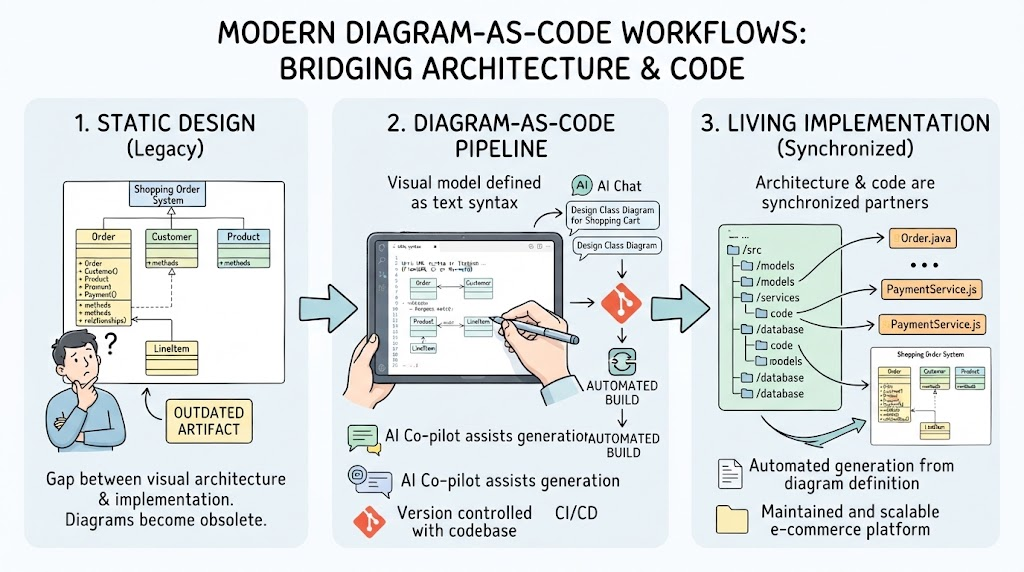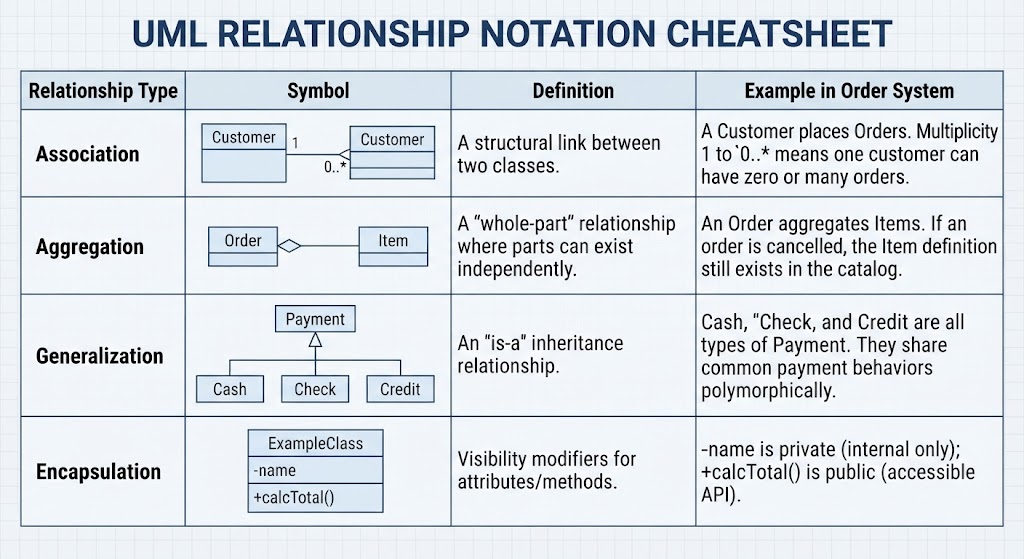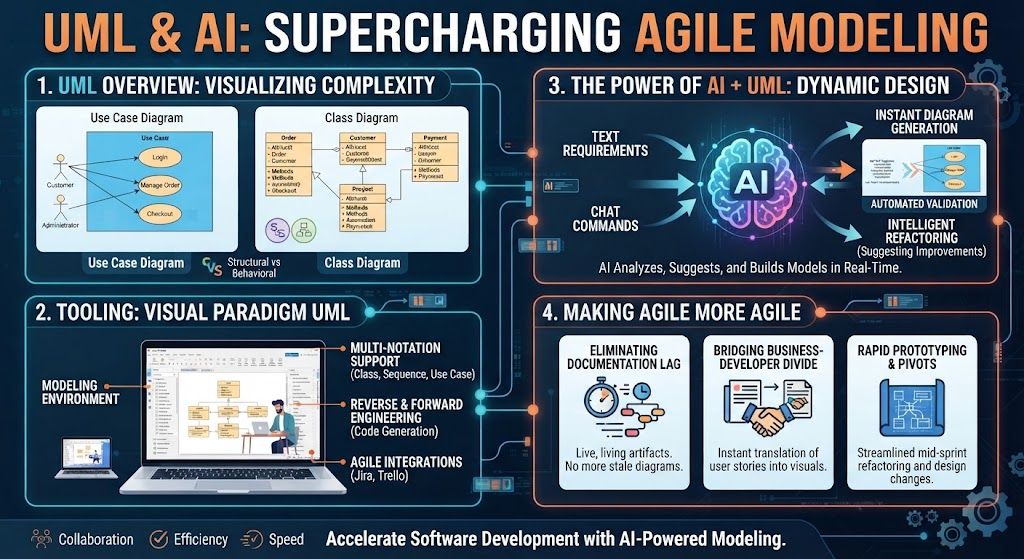
In the modern software development landscape, the gap between high-level requirements and technical implementation can often be bridged by powerful AI tools. The VP AI Chatbot represents a significant shift in how Product Owners and Architects approach system design. Instead of staring at a blank canvas and struggling to place the first box, you can now begin with natural language requirements. The AI analyzes your prompts and instantly constructs a baseline UML diagram, serving as a solid foundation for further refinement.
From Prompt to Blueprint: A Practical Example
Let’s look at a concrete example of how this workflow functions in practice. Imagine a Product Owner needs to visualize the data structure of a new feature. Instead of manually drawing rectangles and arrows, they simply type a request into the chat interface.
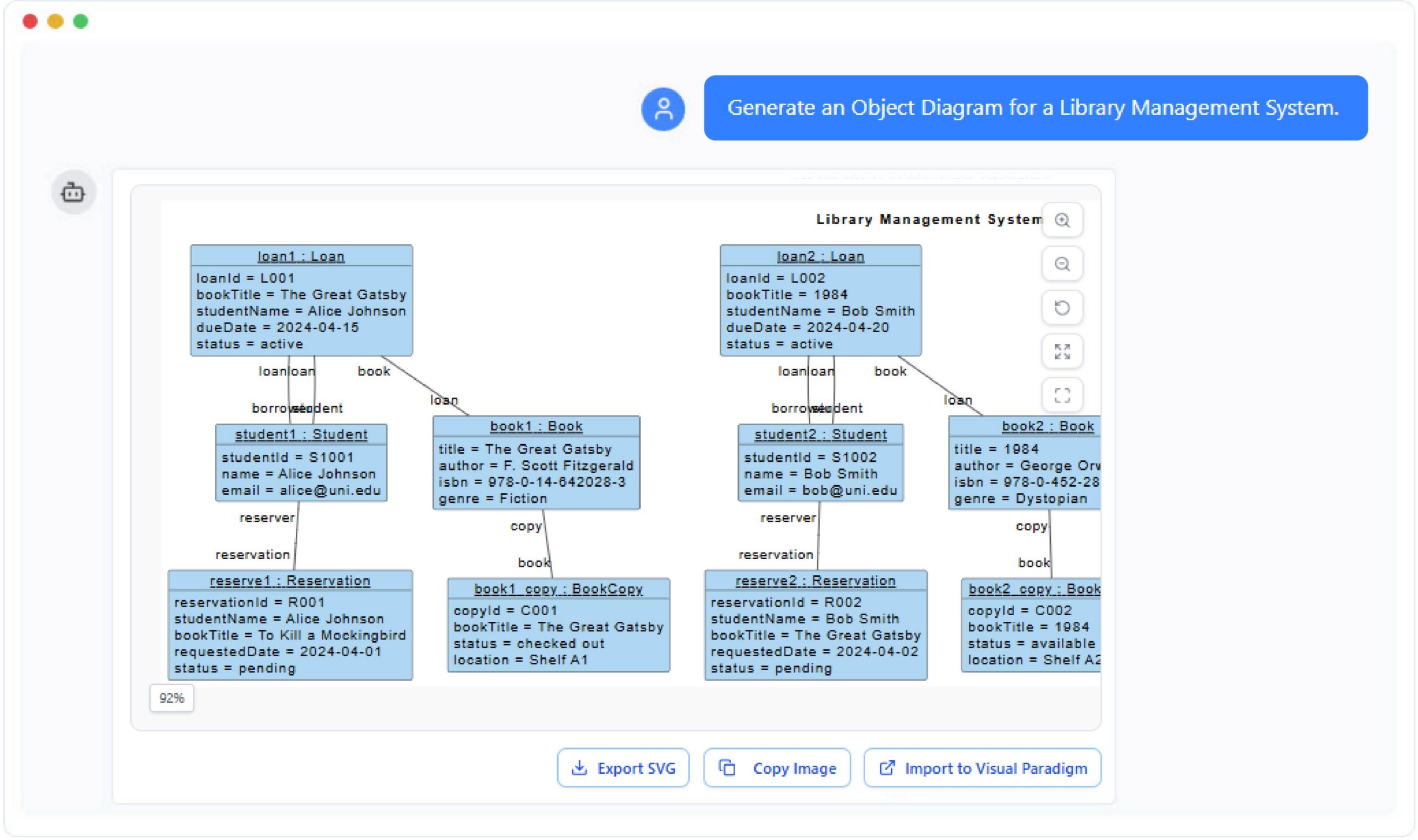
The Prompt: “Generate an Object Diagram for a Library Management System.”
Immediately, the system processes this request. The result, as seen in the interface, is a detailed Object Diagram. This diagram goes beyond simple class definitions to show actual instances of objects and their relationships. For instance:
- You see specific objects like loan1: Loan and student1: Student.
- The diagram captures real data states, such as bookTitle = The Great Gatsby or status = active.
- It visualizes the complex relationships between loans, books, and reservations, showing how student1 borrows book1 through the loan1 instance.
This instant visualization allows stakeholders to verify if the logic holds up before a single line of code is written. The interface also provides immediate utility with options to Export SVG, Copy Image, or Import to Visual Paradigm, ensuring the diagram fits seamlessly into your existing workflow.
Introducing VPasCode: The Engine Behind the Scenes
Underpinning this conversational experience is VPasCode, a sophisticated tool recently updated with embedded AI capabilities. VPasCode transforms the way we handle UML modeling by treating diagrams as code. This is a game-changer for developers who prefer text-based manipulation over drag-and-drop interfaces.
The newly added AI Diagram generation features within VPasCode include several powerful capabilities:
- Multi-Language Engine: The system is not limited to a single syntax. It supports various modeling languages, allowing you to generate diagrams that fit your specific technical stack.
- AI Self-Syntax Healing: One of the most common frustrations in “Diagram as Code” is a missing semicolon or a typo breaking the entire render. VPasCode utilizes AI to detect and automatically fix these syntax errors, ensuring your diagram renders correctly every time.
- AI Diagram Text Translation: If you need to switch from one modeling language to another, or translate a concept from one format to another, the AI can handle the translation, preserving the structural integrity of your model.
Bridging the Gap Between Vision and Reality
The combination of the VP AI Chatbot and VPasCode creates a seamless loop of ideation and implementation. By allowing natural language inputs to drive complex diagram generation, we reduce the cognitive load on architects. They can focus on the what and the why of the system, while the AI handles the how of the structural representation.
Whether you are sketching out a simple library system or a complex enterprise architecture, this toolset empowers you to iterate faster, communicate clearer, and build better software from day one.