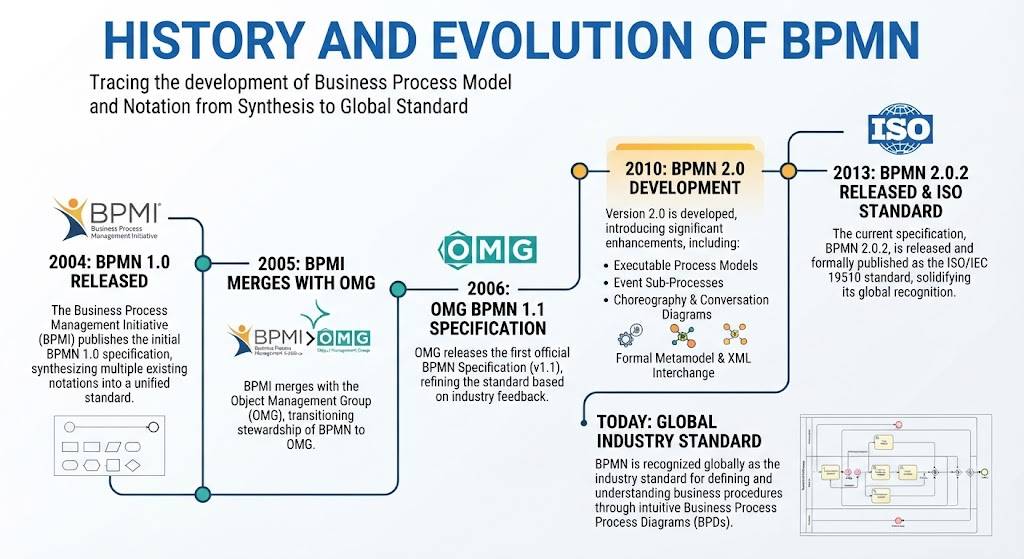
Hello everyone! Today, we are diving into the fascinating history and evolution of BPMN. If you have ever wondered how businesses translate complex workflows into a universal language, you are in the right place. BPMN, or Business Process Model and Notation, wasn’t created in a vacuum; it was born from the need to unify various business modeling notations into a single, cohesive standard.
Imagine trying to speak a different dialect of English in every country you visit. That was the state of business modeling before BPMN. Now, let’s trace this evolution chronologically to understand how we arrived at the industry standard we rely on today.
The Genesis: 2004 and the Rise of BPMI
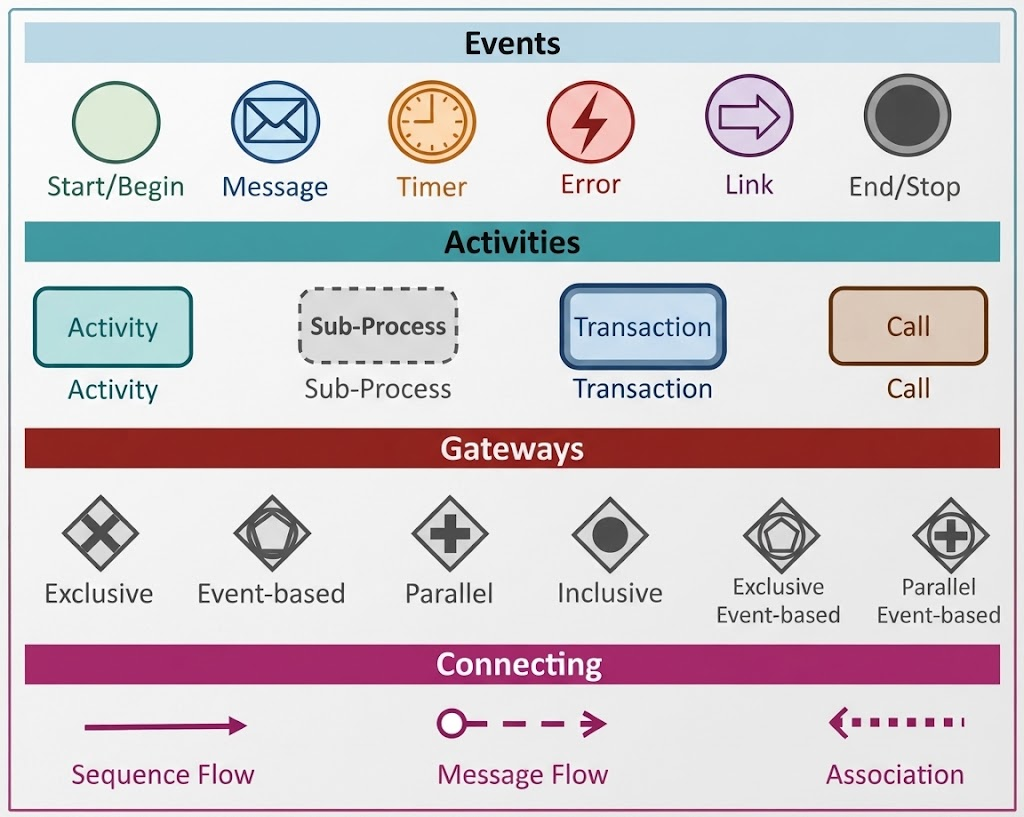
Our story begins in 2004, when the Business Process Management Initiative (BPMI) released the initial BPMN 1.0 specification. This was a pivotal moment because it synthesized multiple existing notations into a unified standard. Before this, organizations struggled with disparate tools that spoke different languages. BPMN 1.0 laid the groundwork, introducing the core symbols and basic flow concepts that would become the backbone of process modeling.
However, for a standard to truly succeed, it needed broader industry backing. This led to a major structural change in 2005, when BPMI merged with the Object Management Group (OMG). This merger was crucial as it transitioned the stewardship of BPMN to OMG, a global consortium that sets standards for software and systems. This move signaled that BPMN was evolving from a niche initiative into a serious global standard.
Formalizing the Standard: 2006 and the OMG Era
In 2006, OMG released the first official BPMN Specification (v1.1). This version refined the standard based on feedback from the industry, ensuring that the notation was practical and robust. It was during this period that the notation began to gain traction in the enterprise software market.
As we moved towards 2010, the demand for more sophisticated modeling grew. Businesses didn’t just want diagrams for documentation; they wanted diagrams that could actually be executed by software. This necessity drove the development of BPMN 2.0.
The Revolution of 2010: BPMN 2.0
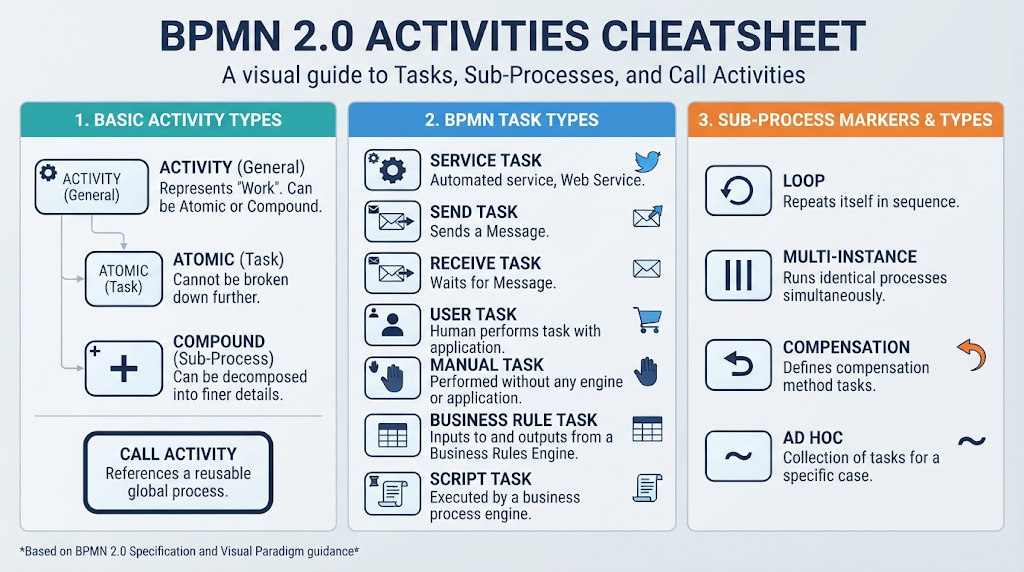
The release of Version 2.0 in 2010 was a game-changer. It introduced significant enhancements that bridged the gap between design and implementation. Instead of just drawing a picture of a process, BPMN 2.0 allowed for the creation of Executable Process Models. This meant that the diagrams you drew could be directly deployed to a workflow engine.
Key features introduced in this era included:
- Executable Process Models: Moving from static diagrams to dynamic, runnable processes.
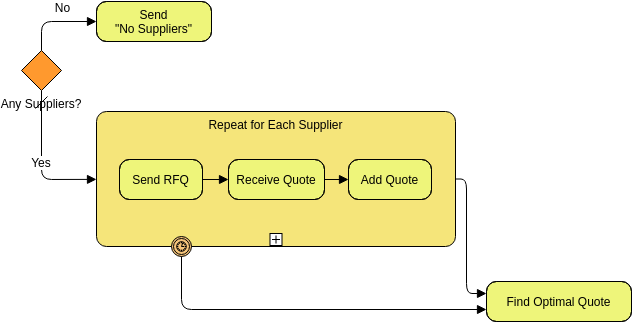
- Event Sub-Processes: Allowing processes to react to events rather than just following a linear path.
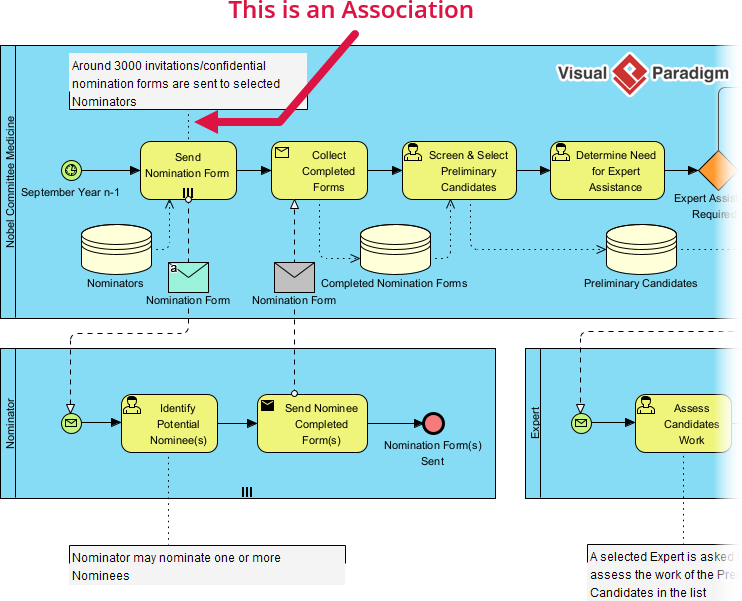
- Choreography & Conversation Diagrams: Enabling the modeling of interactions between multiple participants, not just a single organization.
- Formal Metamodel & XML Interchange: Ensuring that diagrams could be exchanged between different tools without losing data.
This is where tools like Visual Paradigm shine. When you are designing complex choreography diagrams in Visual Paradigm, you aren’t just drawing shapes; you are leveraging the formal metamodel introduced in 2010. The platform ensures that your models are compliant with the specification, allowing for seamless XML interchange with other enterprise systems.
Global Recognition: 2013 and the ISO Standard
The culmination of this evolution occurred in 2013, when the current specification, BPMN 2.0.2, was released and formally published as the ISO/IEC 19510 standard. This solidified its global recognition. It meant that a BPMN diagram created in one company could be understood perfectly by a partner on the other side of the world, regardless of the software they used.
Today: The Global Industry Standard
Today, BPMN is recognized globally as the definitive industry standard for defining and understanding business procedures through intuitive Business Process Diagrams (BPDs). It serves as a lingua franca for business analysts, developers, and stakeholders alike.
When you utilize Visual Paradigm for your BPMN modeling today, you are leveraging over two decades of refinement. Whether you are mapping out a simple approval workflow or designing a complex, multi-party choreography, the platform supports the full depth of the ISO/IEC 19510 standard. It allows you to focus on the logic and efficiency of your business processes, knowing that the underlying notation is robust, standardized, and ready for execution.