


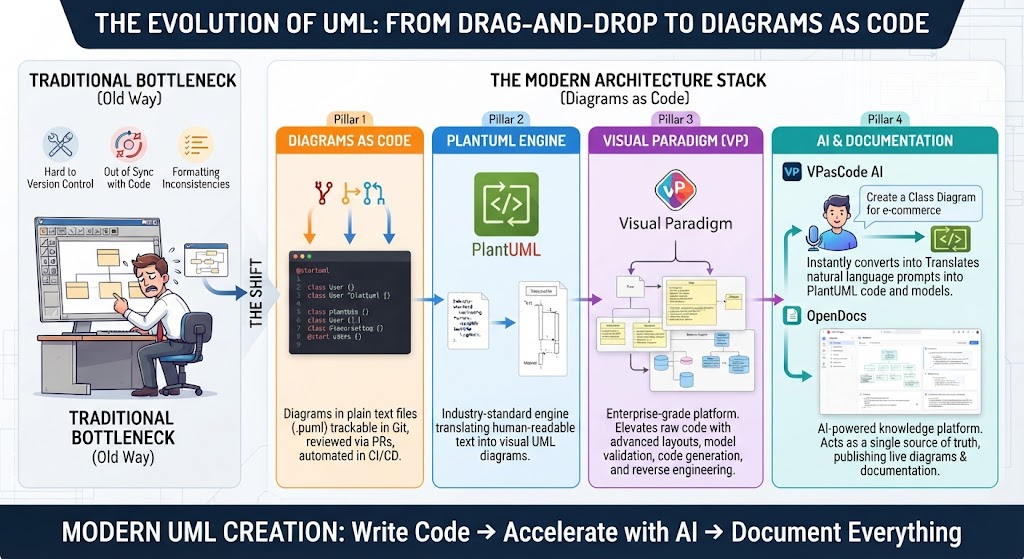
In the modern era of software architecture, the “Diagram-as-Code” (DaC) paradigm has long been the gold standard for precision and version control. However, the steep learning curve associated with Domain-Specific Languages (DSLs) and the tedious nature of manual syntax editing have historically hindered widespread adoption. VPasCode redefines this ecosystem by embedding a native, intelligent AI pair programmer directly into the workspace canvas. This tutorial explores the system architecture and modeling concepts behind VPasCode’s Embedded AI Feature, guiding you through how it transforms technical diagramming from a rigid coding task into an intuitive, conversational workflow.
1. The Generation Engine: Natural Language to Structured Code
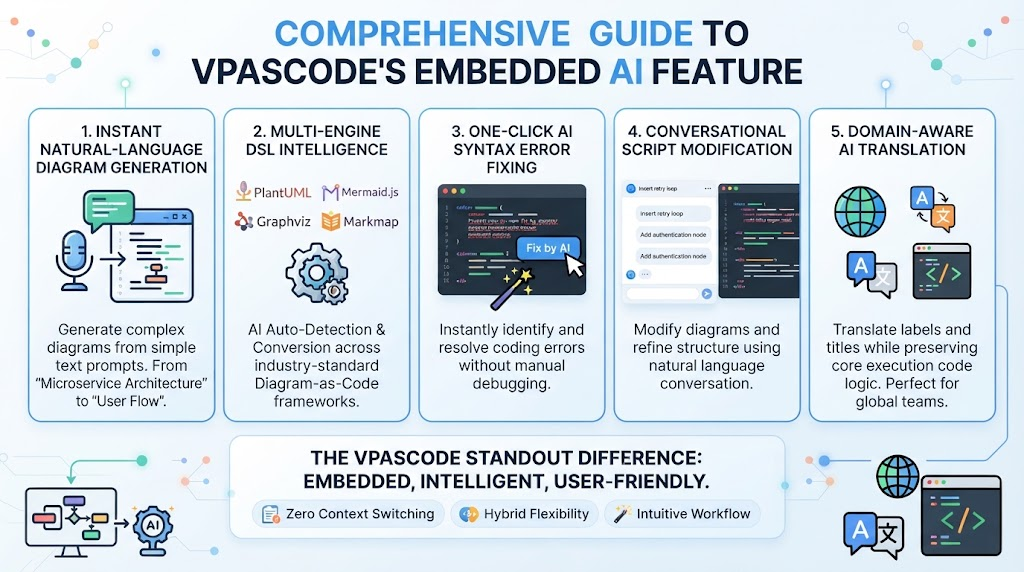
The foundational capability of VPasCode is its ability to bridge the gap between high-level conceptual thinking and low-level syntax execution. In traditional DaC tools, a user must memorize specific commands to define nodes and edges. VPasCode eliminates this barrier through its Instant Natural-Language Diagram Generation engine.
The Workflow Architecture
- Input: The user interacts with the AI panel or prompt window using plain English. Examples include “Generate a microservice architecture for a food delivery app” or “Create a sequence diagram for a user login flow.”
- Processing: The embedded AI interprets the semantic intent of the prompt. It identifies the necessary entities (nodes) and relationships (edges) required to satisfy the request.
- Output: The system instantly populates the code editor with valid syntax while concurrently rendering a clean visual preview on the split-screen workspace.
This dual-output approach ensures that the developer never loses sight of the “source of truth” (the code) while benefiting from the immediate visual feedback of a rendered diagram.
2. The Hybrid DSL Engine: Multi-Standard Intelligence
One of the most significant architectural advantages of VPasCode is its “Multi-Engine DSL Intelligence.” Unlike legacy tools locked into a single syntax, VPasCode is designed to be agnostic, bridging several industry standards through AI auto-detection.
Supported Frameworks
- PlantUML & Mermaid.js: Ideal for software flows, system architectures, and sequence diagrams. These are the standard for agile development documentation.
- Graphviz: Utilized for complex network topologies and heavy-duty node networks where strict layout algorithms are required.
- Markmap & ECharts: Integrated for structured mind-mapping and data visualization, allowing for dynamic data representation within the diagram.
Technical Insight: The AI acts as a translator layer. If a user describes a concept, the AI can select the optimal framework to render it or even convert code from one standard to another, ensuring flexibility across different project requirements.
3. Self-Healing Syntax: One-Click AI Error Fixing
In the world of Diagram-as-Code, a single misplaced bracket or a missing connector can break the entire rendering process. Traditional debugging requires hunting through documentation or manually tracing syntax lines. VPasCode introduces a “Self-Healing” architecture to resolve this.
The Debugging Loop
- Inline Flagging: When a syntax error occurs, the editor flags the specific issue directly within the code block.
- AI Intervention: Instead of manual correction, the user clicks the “Fix by AI” button.
- Patching: The assistant parses the broken syntax, identifies the root cause (e.g., a missing arrow or incorrect node definition), and patches the error.
- Visual Verification: The system provides a clear side-by-side or inline adjustment, effectively doubling as an instant learning tool for complex scripting rules.
4. Conversational Script Modification & Refinement
Once a diagram is generated, the iterative process of refinement is where most productivity is lost. In rigid tools, touching up an existing diagram often breaks formatting or requires rewriting large blocks of code. VPasCode’s AI respects the existing layout while allowing for granular logic changes.
Context-Aware Editing
The system utilizes a “Pair Programmer” model for modification. By highlighting specific blocks of code or issuing chat commands, users can refine the structure without losing their custom styling.
- Logic Injection: Command the assistant: “Insert a retry loop if the database query fails.” The AI modifies only the specified logic, preserving the surrounding code.
- Structural Addition: Request: “Add an authentication middleware node.” The AI inserts the node and connects it to the appropriate flow without disrupting the global layout.
5. Domain-Aware AI Translation for Global Teams
For global teams, localization is often a manual, error-prone process involving re-typing labels and titles. VPasCode solves this with a semantic-preserving translation filter.
Preserving Execution Logic
The translation engine is designed to distinguish between execution code and display text. When translating a diagram from English to another language:
- Protected Elements: The underlying code logic, variable names, and structural syntax remain untouched to ensure the diagram still renders correctly.
- Translated Elements: Internal text labels, titles, and comments are converted into the target language.
Conclusion: The Zero-Context Switching Architecture
The overarching philosophy of VPasCode is to eliminate “Context Switching.” By keeping generation, debugging, code modification, and rendering natively on a single screen, the tool removes the friction of juggling external chat windows or copy-pasting snippets. It bridges high-level conceptual freedom down to granular line-by-line micro-editing, turning technical diagramming into an intuitive, conversational workflow that accelerates the design-to-documentation cycle.
Related posts:
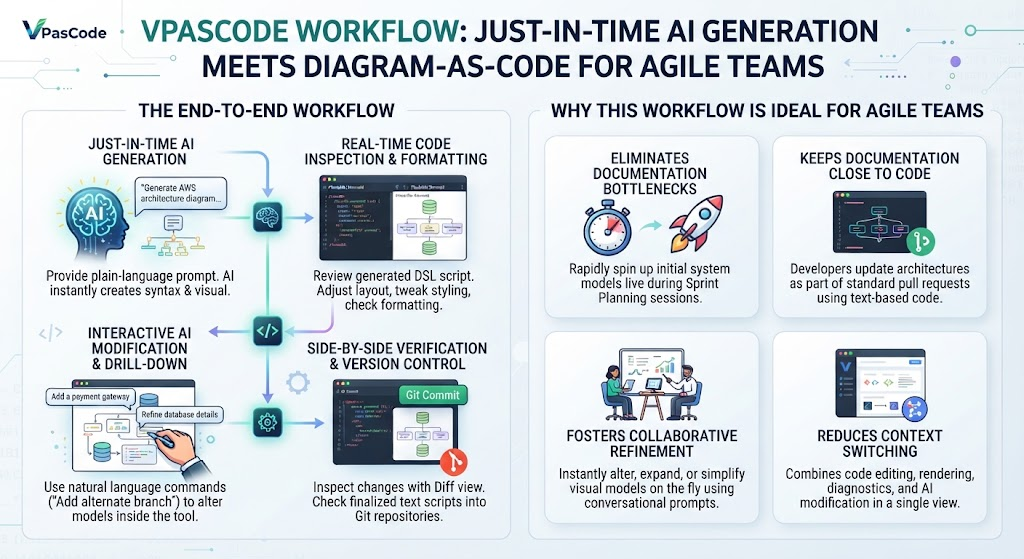 Mastering System Architecture with VPasCode: A Guide to Just-in-Time Diagram-as-Code
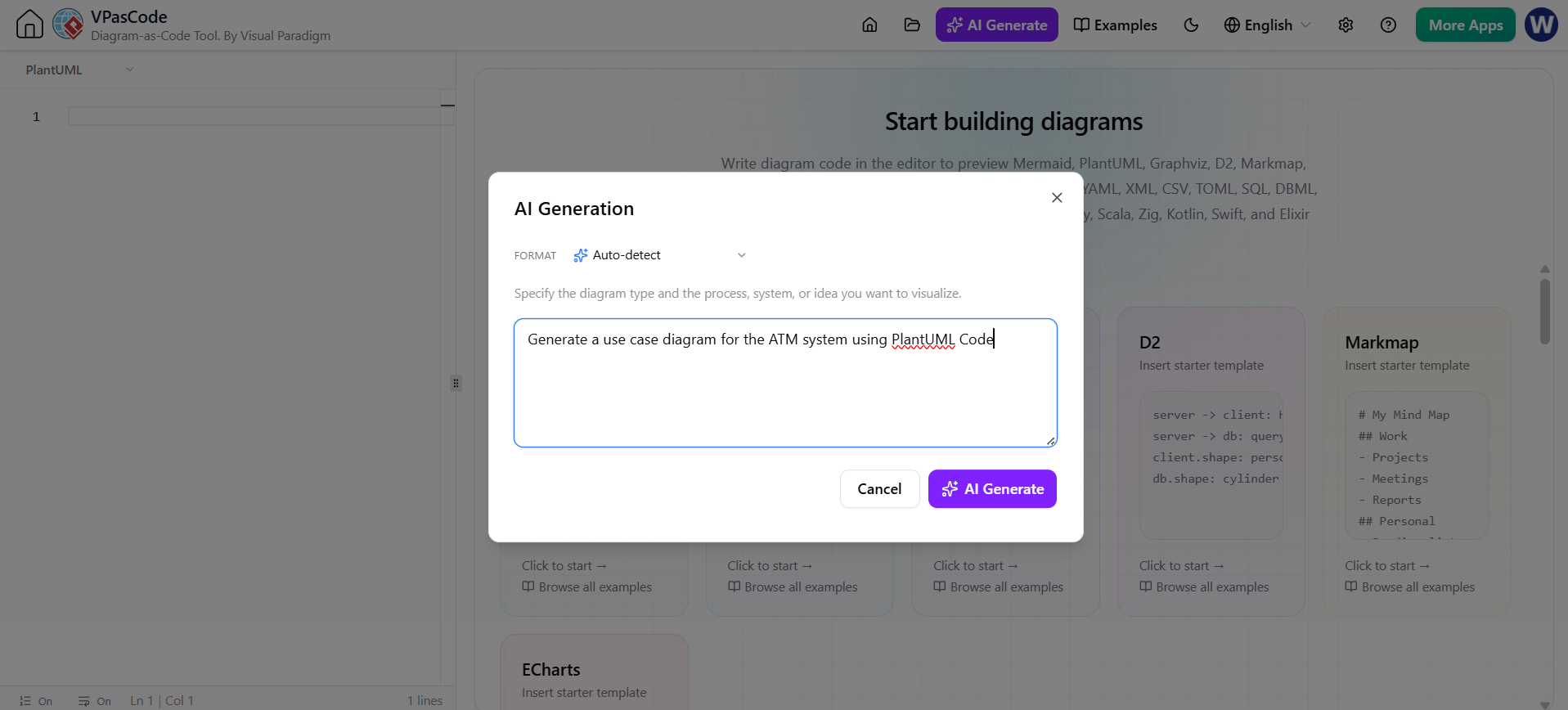 Revolutionizing System Modeling: The Power of Instant AI Diagram Generation
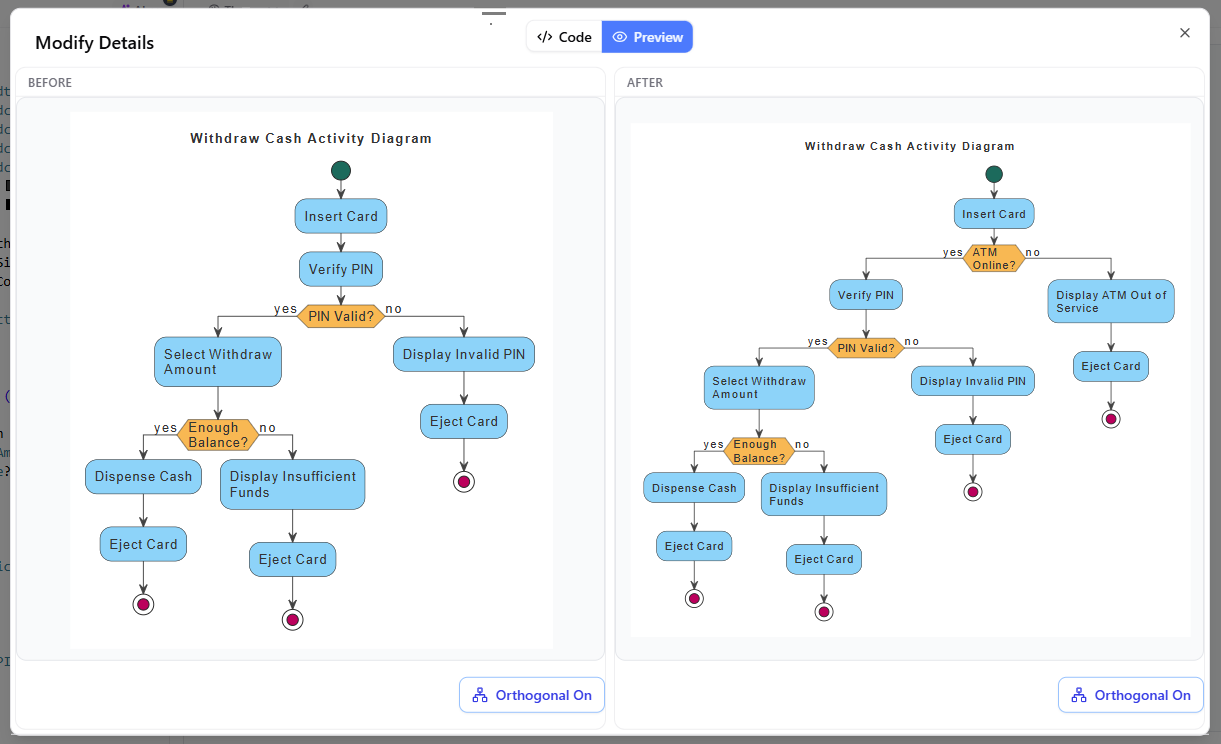 ATM Withdraw Cash Activity Diagram Modification
 The Evolution of UML: Mastering the Modern Architecture Stack from Drag-and-Drop to Diagrams as Code