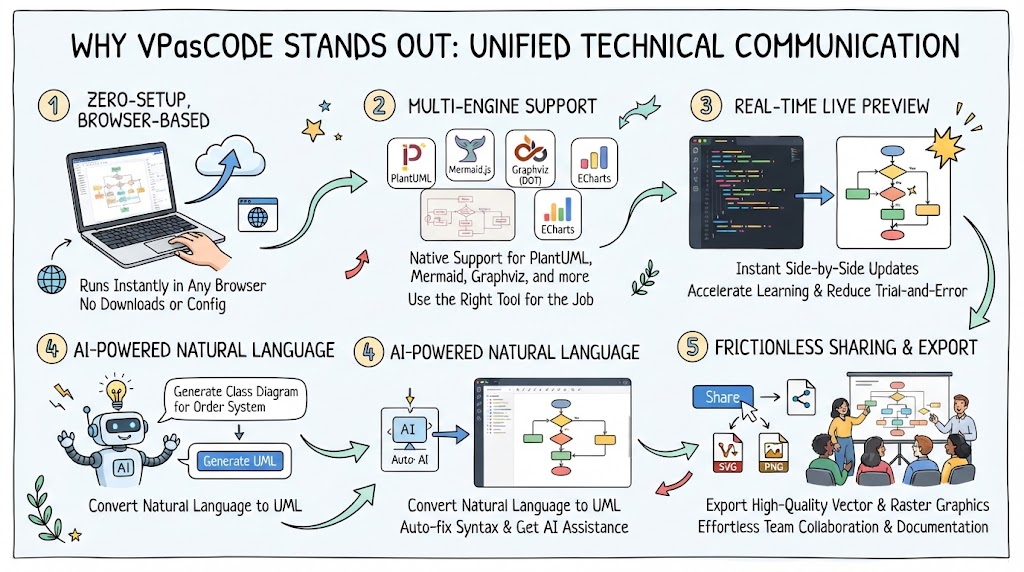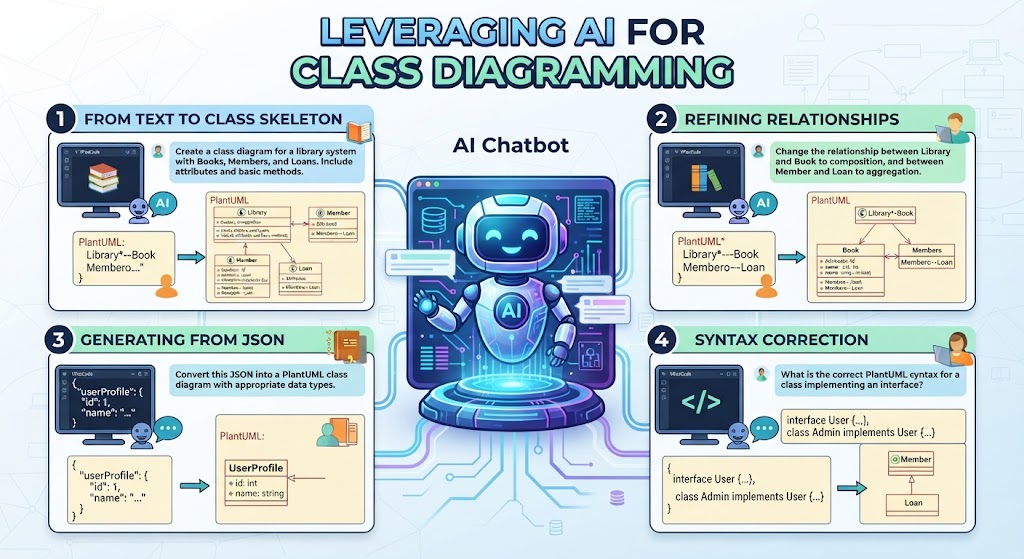
In the evolving landscape of software engineering, the gap between conceptual design and executable code is narrowing. Traditionally, creating UML class diagrams required deep knowledge of specific syntax languages like PlantUML or Mermaid. However, the integration of Artificial Intelligence into modeling tools like VPasCode and Visual Paradigm is revolutionizing this process. This tutorial explores how AI assistants transform the way developers architect their systems, moving from simple text prompts to fully realized, syntactically correct diagrams.
1. From Text to Class Skeleton: The Power of Natural Language
The most immediate benefit of AI-assisted diagramming is the ability to translate natural language directly into structural code. Instead of manually typing out class definitions, developers can describe their system’s requirements.
- The Process: A user provides a prompt describing the domain, such as a library system.
- The Prompt: “Create a class diagram for a library system with Books, Members, and Loans. Include attributes and basic methods.”
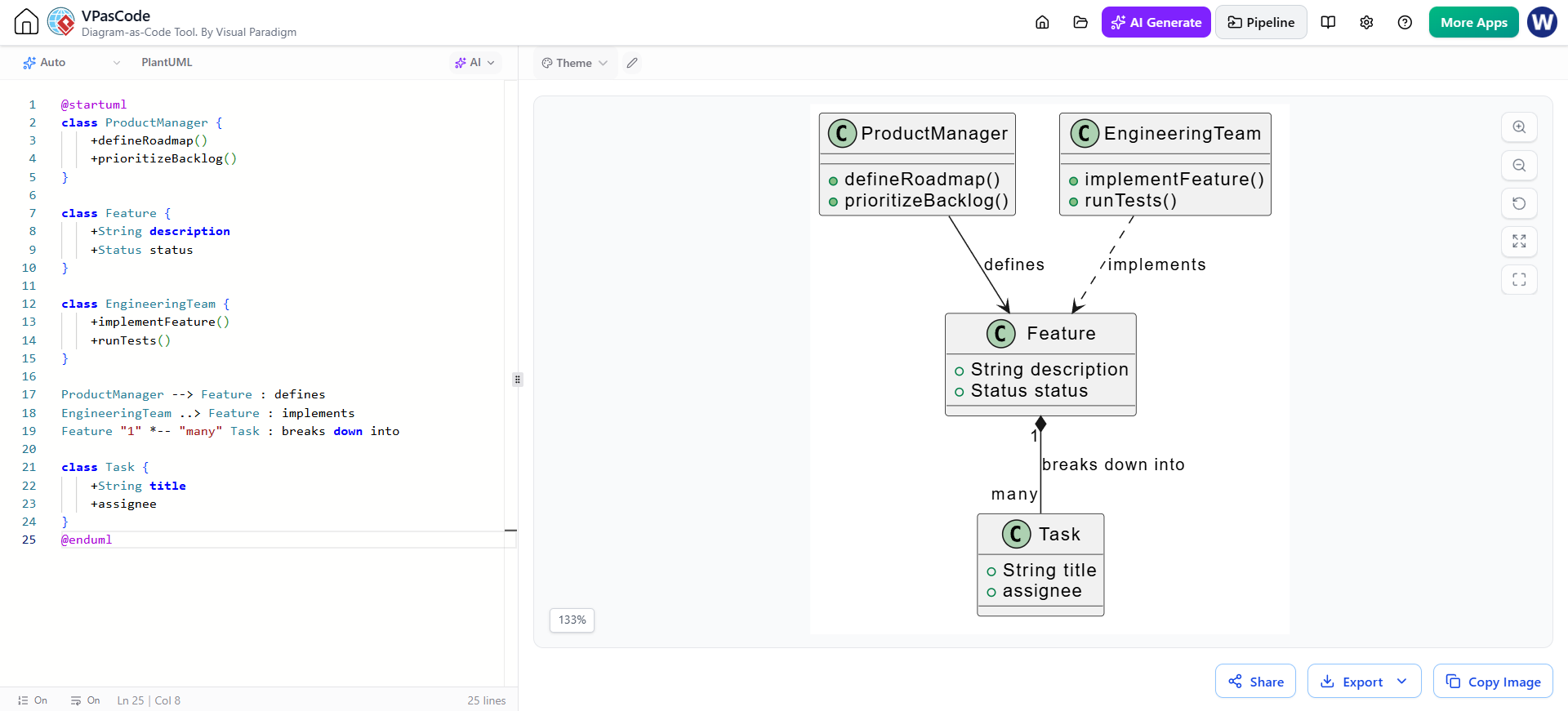
- The Result: The AI Chatbot instantly generates the full
PlantUMLcode. This includes the class definitions, attributes (likeISBNorMemberID), and methods (likeborrowBook()).
This approach drastically reduces the time spent on boilerplate syntax, allowing architects to focus on the logical structure of the application rather than the text editor.
2. Refining Relationships: Composition vs. Aggregation
Once the initial skeleton is generated, the AI acts as a senior architect, helping to refine the semantic relationships between classes. Understanding the lifecycle of objects is crucial in UML.
Understanding Ownership
A common challenge in class modeling is defining how classes relate. The AI can interpret specific instructions to update the diagram’s semantics:
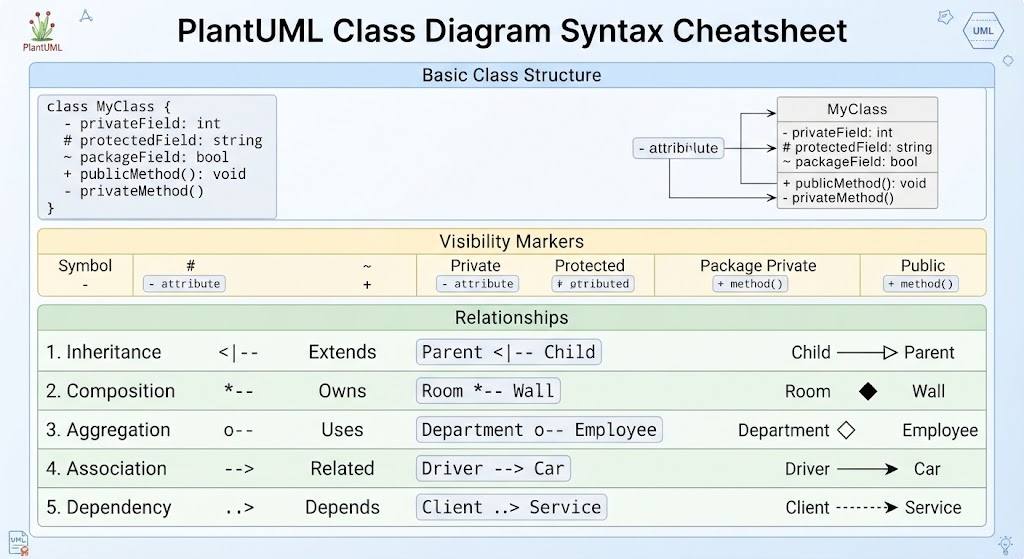
- Composition (Strong Ownership): If you ask the AI to change the relationship between
LibraryandBookto composition, it implies that aBookcannot exist independently of theLibrary. The AI updates the syntax to show a filled diamond. - Aggregation (Weak Ownership): Conversely, if you request the relationship between
MemberandLoanbe an aggregation, it suggests aLoanmight exist or be tracked even if the specificMemberrecord is modified. The AI adjusts the syntax to show an empty diamond.
Example Prompt: “Change the relationship between Library and Book to composition, and between Member and Loan to aggregation.”
3. Generating from JSON: Data-Driven Modeling
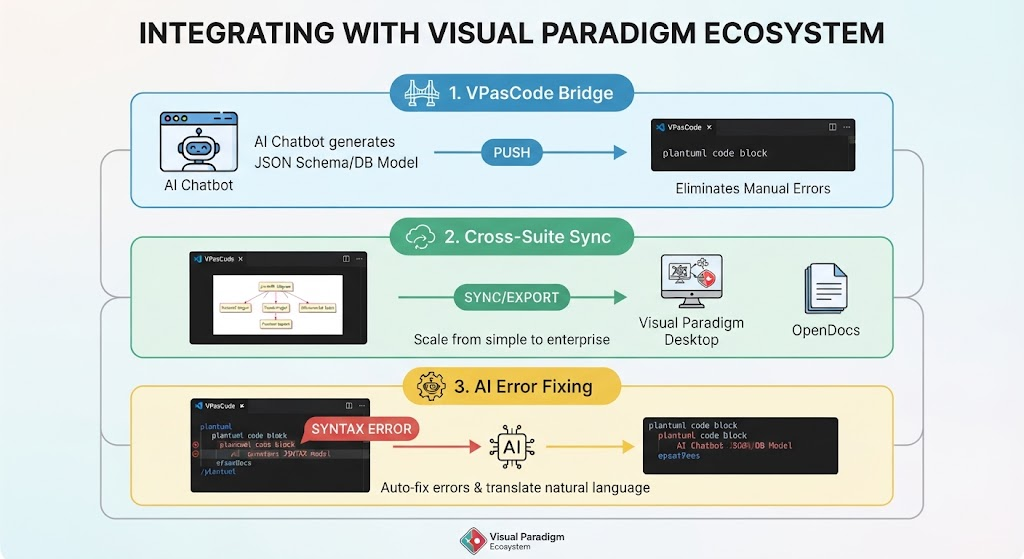
In modern microservices architectures, data structures often drive the system design. The VPasCode Bridge facilitates a workflow where existing data definitions are converted directly into visual models.
- Input: Paste a JSON object representing a user profile or configuration.
- Instruction: Ask the AI to “Convert this JSON into a PlantUML class diagram with appropriate data types.”
- Output: The tool instantly infers the class structure. For example, a JSON field
"id": 1becomes an attributeid: int, and"name": "..."becomesname: string.
This method ensures that your class diagrams are perfectly synchronized with your actual data contracts, reducing the risk of schema mismatches during implementation.
4. Syntax Correction: The Intelligent Syntax Checker
One of the most frustrating aspects of diagramming is debugging syntax errors that prevent a diagram from rendering. The AI Chatbot serves as an immediate, context-aware syntax checker.
If you are unsure about specific UML notation—such as the arrow type for an interface implementation—you can query the AI directly:
Question: “What is the correct PlantUML syntax for a class implementing an interface?”
The AI provides the exact code snippet (e.g., class Admin implements User) and explains the visual representation (a solid line with a hollow triangle arrowhead). This instant feedback loop accelerates the learning curve for new developers and ensures accuracy for seasoned engineers.
Conclusion: The Future of Visual Modeling
By leveraging AI for class diagramming, developers shift from being “diagrammers” to “architects.” The combination of Visual Paradigm’s robust modeling engine and VPasCode’s AI capabilities allows for a fluid, iterative design process. Whether you are starting from a text prompt, a JSON file, or a simple question about syntax, the AI empowers you to build robust system architectures with unprecedented speed and accuracy.