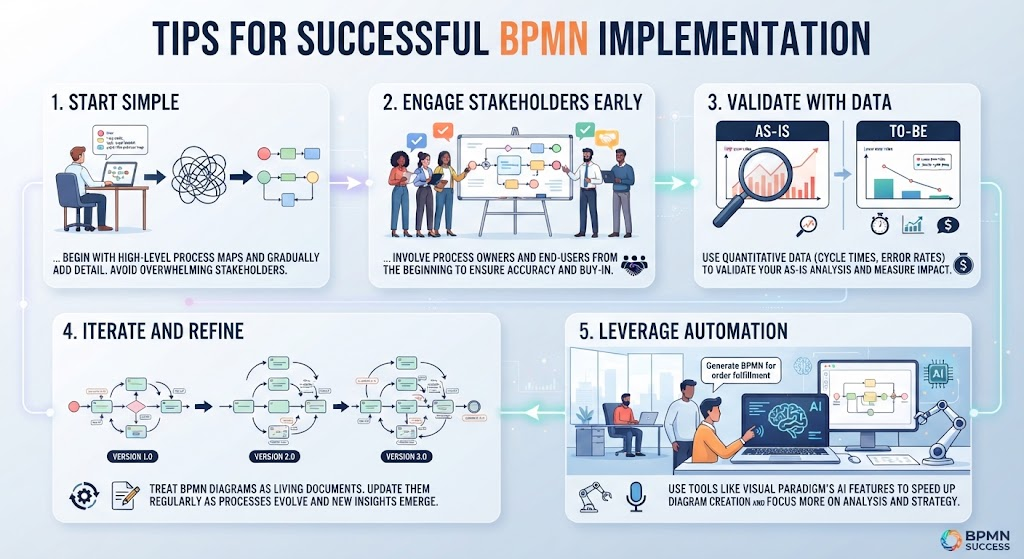
Business Process Model and Notation (BPMN) is the industry standard for visualizing business processes. However, successful implementation goes beyond simply drawing boxes and arrows; it requires a strategic approach to adoption, collaboration, and continuous improvement. This tutorial explores the five critical pillars of successful BPMN implementation, transforming complex workflows into streamlined operational assets.
1. The Philosophy of Simplicity: Start Small, Scale Fast
The most common pitfall in process modeling is the “Big Bang” approach—attempting to map every single exception and decision point in a single diagram immediately. This often leads to “spaghetti diagrams” that are unreadable and unmanageable.
- The Strategy: Begin with high-level process maps. These are often referred to as “Level 1” or “Level 2” diagrams that outline the major phases of a process without getting bogged down in the details.
- The Benefit: By gradually adding detail in subsequent iterations, you ensure that stakeholders can follow the narrative flow of the process without being overwhelmed. This scaffolding approach allows teams to understand the “Big Picture” before diving into the technical minutiae.
2. The Power of Collaboration: Engage Stakeholders Early
A process model is only as accurate as the knowledge of the people who created it. If the diagram is built in a vacuum by a lone analyst, it often misses critical nuances known only to the front-line workers.
- Who to Involve: You must bring together process owners (who are accountable for the results) and end-users (who perform the tasks daily).
- The Goal: Early engagement ensures accuracy (the model reflects reality) and buy-in (users feel ownership over the new process). When stakeholders are involved in the modeling session, they become advocates for the changes rather than resistance to them.
3. The Science of Validation: Data-Driven Insights
In the world of digital transformation, intuition is not enough. You must validate your “As-Is” state (current process) against hard quantitative data. This moves the conversation from “I think we are slow” to “Our data shows we are slow.”
- Key Metrics: Focus on metrics such as cycle times (how long a task takes), error rates (frequency of mistakes), and resource utilization.
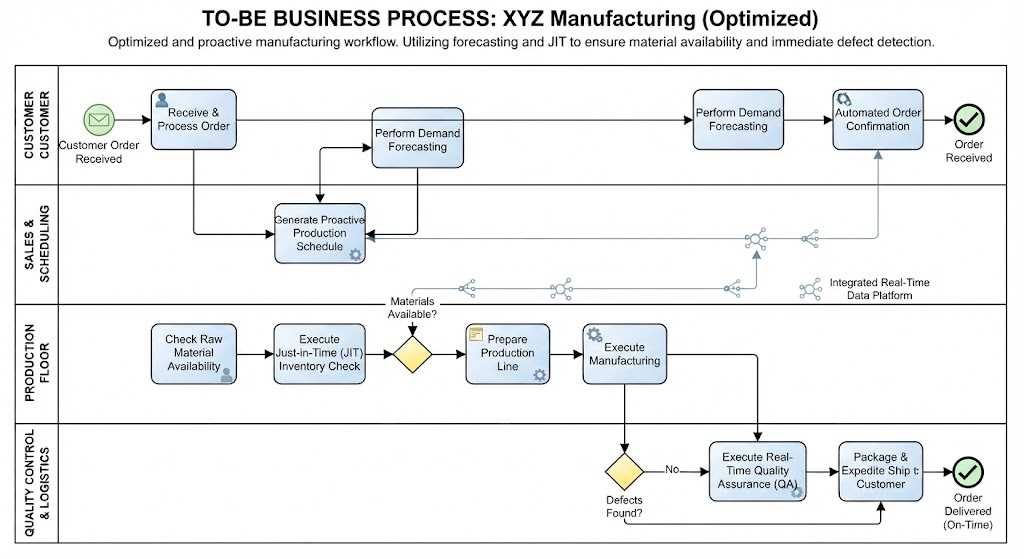
- Measuring Impact: Once you have a baseline, you can measure the impact of your “To-Be” improvements. For example, if you automate a step, the data should reflect a reduction in cycle time. This creates a feedback loop where the diagram is backed by empirical evidence.
4. The Lifecycle of a Model: Iterate and Refine
A BPMN diagram should never be considered a finished product. In a dynamic business environment, processes evolve. New regulations emerge, software updates, and team structures change.
- Living Documents: Treat your BPMN diagrams as living documents. Version control is essential. Just as software goes through V1.0, V2.0, and V3.0, your process maps should follow the same lifecycle.
- Continuous Improvement: Regularly update diagrams as new insights emerge. This iterative approach ensures that your documentation remains relevant and useful for training and operations.
5. The Technological Edge: Leveraging Automation
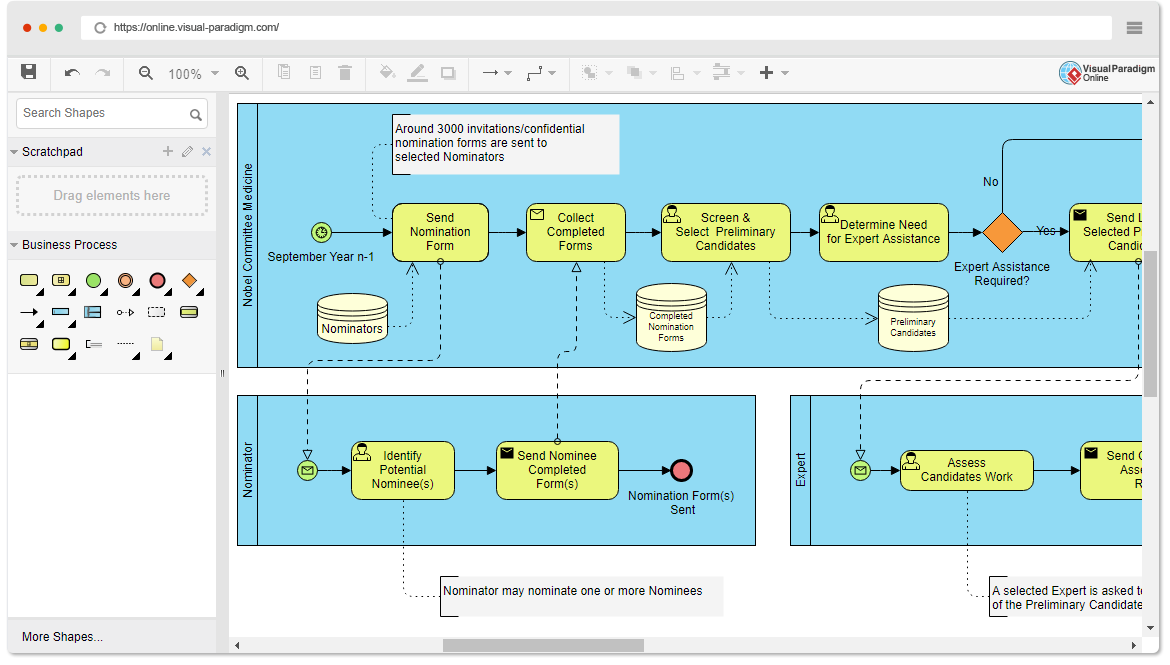
Modern Business Process Management (BPM) is increasingly powered by Artificial Intelligence (AI). Tools like Visual Paradigm are integrating AI features to automate the tedious aspects of modeling.
- AI-Driven Modeling: Instead of manually drawing every connector, AI can generate BPMN diagrams from natural language descriptions or existing documentation.
- Focusing on Strategy: By letting automation handle the diagram creation, business analysts can focus their cognitive load on high-value activities like analysis, strategy formulation, and optimization.
Conclusion: From Chaos to Clarity
The journey from operational chaos to streamlined excellence begins with clarity. By leveraging BPMN not just as a diagramming technique, but as a strategic asset, organizations can visualize their current state, envision a more efficient future, and bridge the gap with actionable plans. Whether in finance, healthcare, or e-commerce, making processes visible, measurable, and improvable is the key to navigating the complexities of digital transformation.