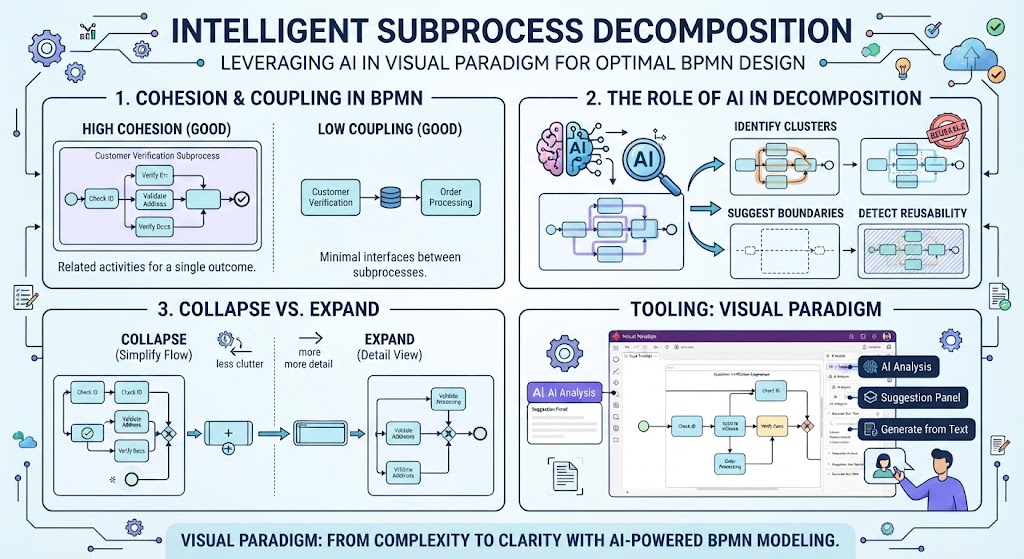
In the complex world of Business Process Management (BPM), clarity is king. As processes grow, they inevitably become tangled webs of logic that are difficult to maintain or understand. This tutorial explores Intelligent Subprocess Decomposition—a strategic approach to managing complexity using the principles of Cohesion and Coupling, enhanced by the Artificial Intelligence capabilities of Visual Paradigm.
We will walk through the architecture of effective BPMN design, demonstrating how to transition from high-level overviews to detailed logic without losing the big picture.
1. The Foundations: Cohesion and Coupling in BPMN
Before utilizing advanced AI tools, it is crucial to understand the structural principles that make a diagram readable. Just as in software engineering, BPMN relies on two pillars: Cohesion and Coupling.
High Cohesion (The “Good”)
High cohesion means that the activities within a subprocess are related to a single, specific outcome. For example, a subprocess named Customer Verification should contain only activities that verify a customer’s identity. It should not contain unrelated activities like “Order Processing.”
- Definition: Related activities grouped for a single outcome.
- Benefit: Makes the logic self-contained and easier to debug.
Low Coupling (The “Good”)
Low coupling refers to the relationship between different subprocesses. Ideally, subprocesses should have minimal interfaces or dependencies on one another. If you change the logic inside the Customer Verification subprocess, it should not break the Order Processing subprocess.
- Definition: Minimal interfaces between subprocesses.
- Benefit: Enhances modularity and allows teams to work on different parts of a process independently.
2. The Role of AI in Decomposition
Deciding where to draw the line between a high-level activity and a detailed subprocess is often a challenge. This is where the AI engine in Visual Paradigm acts as a technical consultant.
AI-Driven Analysis
Visual Paradigm’s AI analyzes your model to suggest structural improvements. It does not just draw lines; it understands context. It performs three key functions:
- Identify Clusters: The AI looks at your flow and groups activities that logically belong together. It recognizes that “Verify ID” and “Validate Address” form a distinct cluster separate from “Process Order.”
- Suggest Boundaries: Once clusters are identified, the AI proposes boundaries. It suggests where a Subprocess should be collapsed to reduce clutter and where it should be expanded to reveal detail.
- Detect Reusability: The AI scans your model to see if a specific logic pattern (like a validation step) is repeated elsewhere. It can flag these as reusable subprocesses, promoting efficiency.
3. Collapse vs. Expand: Managing Detail
One of the most powerful features of BPMN is the ability to drill down into details. Visual Paradigm facilitates this through the “Collapse vs. Expand” workflow.
Collapse (Simplify Flow)
When you are presenting a process to a high-level stakeholder, you need to “Collapse” your subprocesses. This hides the internal logic (the complex check loops and gateways) and replaces it with a single, clean shape. This reduces visual clutter and focuses the viewer on the outcome rather than the mechanism.
Expand (Detail View)
Conversely, when you are a developer or analyst implementing the process, you need to “Expand.” This reveals the inner workings of the subprocess, showing the specific gateways, errors, and intermediate events. Visual Paradigm allows you to toggle between these views instantly, maintaining the link between the high-level map and the detailed blueprint.
4. Tooling: Visual Paradigm Implementation
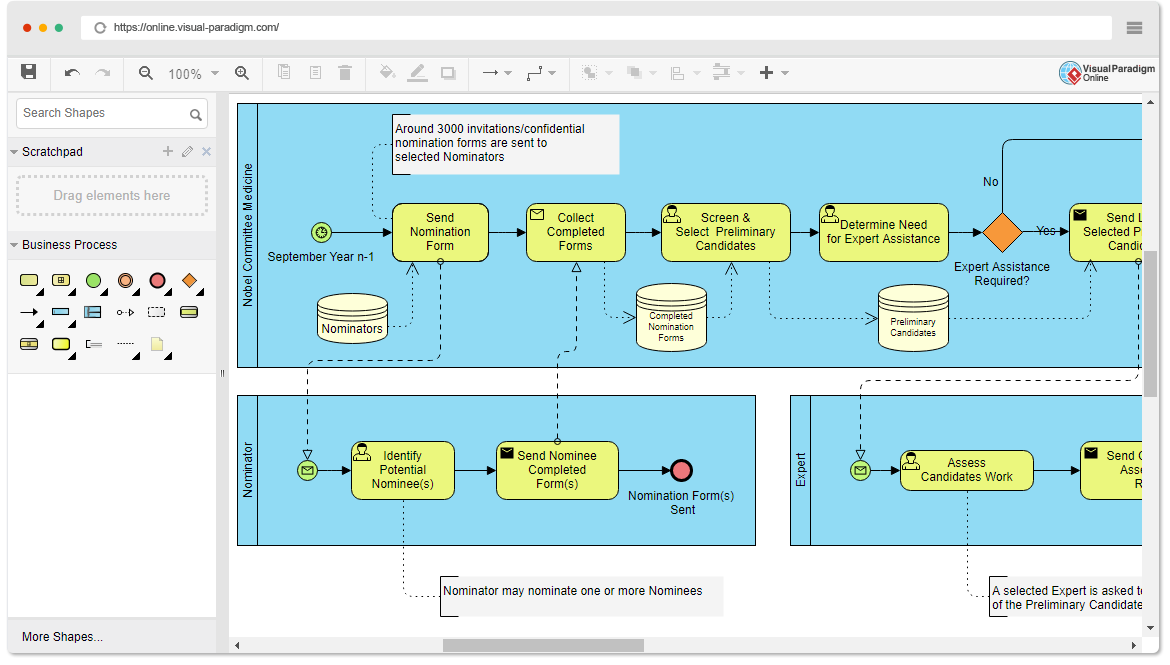
Visual Paradigm provides a robust suite of tools to execute this architecture. The interface is designed to be intuitive, integrating AI directly into the modeling canvas.
Key Features to Leverage
- AI Analysis: Access the AI engine to get real-time feedback on your model’s structure. It can highlight areas of high coupling or low cohesion.
- Suggestion Panel: Instead of manually dragging and dropping shapes, the AI offers suggestions for your next move. It might suggest, “Group these three tasks into a Subprocess.”
- Generate from Text: For rapid prototyping, you can type a description of a process in plain English. The AI will generate an initial draft, creating the basic flow and identifying where subprocesses should logically exist.
Conclusion
By combining the timeless principles of Cohesion and Coupling with the speed of AI-Assisted Modeling, Visual Paradigm transforms the way we design business processes. It shifts the workflow from manual drawing to intelligent architecture, ensuring that your BPMN diagrams are not just pictures, but robust, logical blueprints ready for implementation.