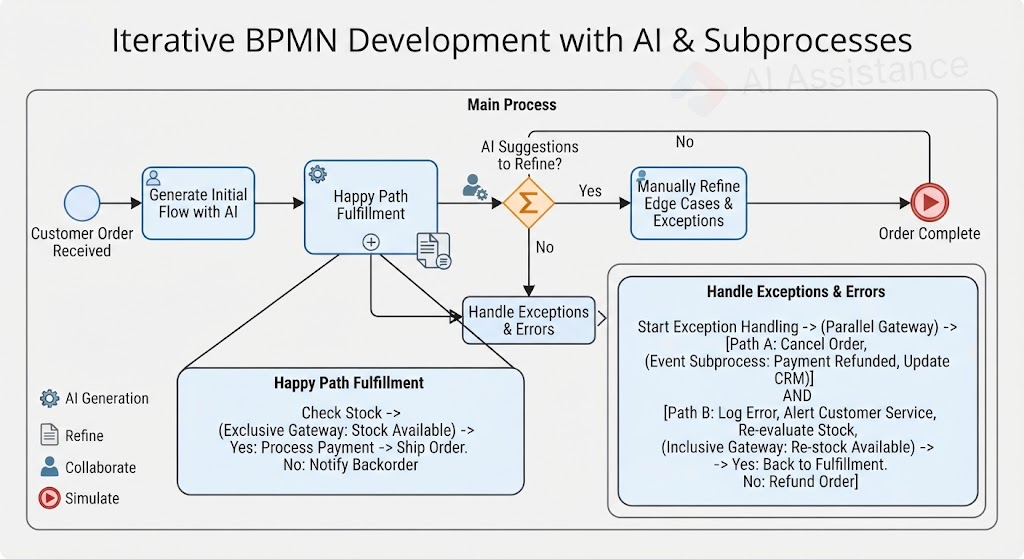
In the world of Business Process Management (BPM), the gap between a high-level concept and a robust, executable workflow is often bridged by the complexity of error handling. This tutorial explores a sophisticated system architecture designed to streamline the creation of complex business processes. By combining AI-assisted generation, hierarchical subprocess modeling, and iterative refinement, we can transform unwieldy diagrams into manageable, executable logic.
We will analyze the architecture of an “Iterative BPMN Development” framework, focusing on how to structure a “Customer Order” process that automatically handles the “Happy Path” while seamlessly integrating exception management.
1. The High-Level Workflow Architecture
The foundation of this system is a “Main Process” that acts as the orchestrator. Rather than listing every single step of an order fulfillment from start to finish, the architecture utilizes a control loop that separates the ideal scenario from the exceptions.
The AI-Assisted Start
The process begins with a Customer Order Received event. Instead of manually drafting the initial logic, the system leverages an AI tool to “Generate Initial Flow with AI.” This significantly reduces the “Time-to-Value” for process modeling. The AI analyzes the business requirements and outputs a structured BPMN flow.
The Decision Loop (Iterative Refinement)
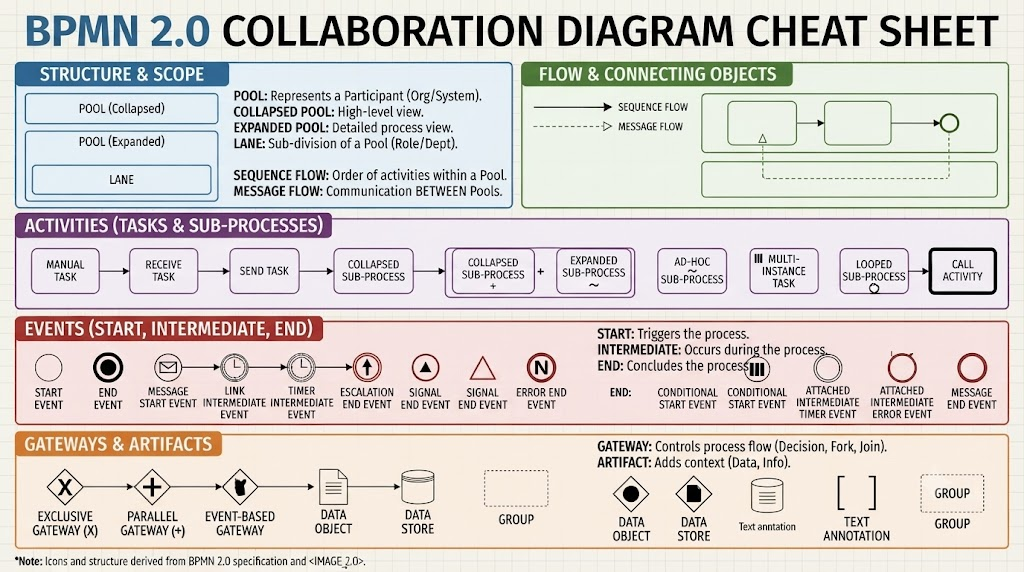
Once the AI generates the flow, the system enters a critical decision point: “AI Suggestions to Refine?”. This is a Exclusive Gateway (the diamond shape with an ‘X’) that represents a human-in-the-loop collaboration.
- The “No” Path: If the AI’s initial generation is robust enough to handle the business needs, the process moves directly to the completion state.
- The “Yes” Path: If edge cases are missing or the logic is flawed, the human analyst intervenes to “Manually Refine Edge Cases & Exceptions.” This ensures that the system is not just automated, but also resilient.
2. Deconstructing the “Happy Path” Subprocess
The core of the fulfillment logic is encapsulated in a subprocess labeled “Happy Path Fulfillment”. In BPMN, using a subprocess allows us to hide complexity. The main diagram shows only the trigger and the outcome, while the details are hidden inside the box.
This subprocess represents the standard, error-free journey of an order. The internal logic follows a linear progression with a single branching decision:
- Check Stock: The process initiates by verifying inventory levels.
- Exclusive Gateway (Stock Available?): The system evaluates the stock status.
- Path A (Yes): If stock is available, the flow proceeds to “Process Payment -> Ship Order”.
- Path B (No): If stock is unavailable, the system triggers a “Notify Backorder” action.
By collapsing these steps into a single box, the main diagram remains clean, allowing executives to grasp the high-level flow without getting bogged down in the minutiae of shipping logic.
3. Advanced Logic: Handling Exceptions and Errors
The most critical part of a robust system is what happens when things go wrong. The architecture includes a dedicated subprocess for “Handle Exceptions & Errors.” This is not just a simple “Stop” signal; it is a complex logic block designed to resolve conflicts.
Parallel Processing of Exceptions
The logic within this subprocess utilizes a Parallel Gateway (the diamond with a ‘+’ sign). This indicates that multiple exception paths are evaluated or executed simultaneously, or that the system must handle different types of errors concurrently.
Specific Exception Scenarios
The architecture defines two distinct paths for error handling:
Path A: The Cancellation Scenario
This path handles a customer or system-initiated cancellation. It triggers an Event Subprocess—a special BPMN element that runs in response to an event rather than just a task completion. The specific event involves:
- Cancel Order
- Payment Refunded
- Update CRM (Customer Relationship Management)
Path B: The Logistics Scenario
This path addresses a “Log Error,” such as a failed shipment or inventory discrepancy. It involves a more complex, iterative logic loop:
- Alert Customer Service: Immediate notification.
- Re-evaluate Stock: The system checks if the error was a temporary glitch.
- Inclusive Gateway (Re-stock Available?): The system decides the next move based on the re-evaluation.
- Yes: The system loops back to “Back to Fulfillment”, attempting to complete the order.
- No: The system proceeds to “Refund Order”, closing the transaction.
4. Key Takeaways for BPM Architects
By adopting this iterative architecture, organizations can achieve several strategic advantages:
- Scalability: By using subprocesses, you can manage processes of any size. The “Happy Path” and “Exceptions” are modular and can be updated independently without breaking the main flow.
- Clean Visualization: Executives can look at the “Main Process” to understand the flow, while technical teams drill down into the subprocesses to see the detailed logic.
- Resilience: Explicitly modeling exception paths (like Path A and Path B) ensures that the system doesn’t just work for the perfect scenario, but gracefully handles real-world disruptions.
Whether you are using AI to draft the initial diagram or manually refining it, the key is to structure your BPMN so that the “Happy Path” is clear, and the “Exceptions” are managed with the same rigor.