


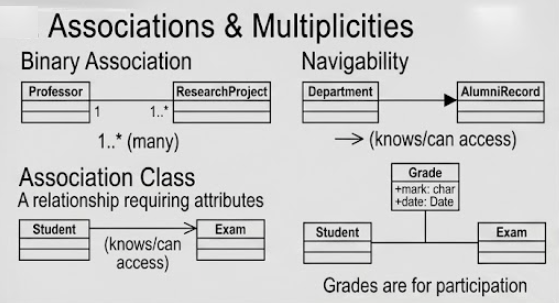
In the complex world of software engineering and system design, the Unified Modeling Language (UML) serves as the universal blueprint. Among the various types of diagrams, the Class Diagram is arguably the most critical for defining the static structure of a system. Within this diagram, the concept of an Association is fundamental, representing the structural relationships between different classes.
This tutorial provides a comprehensive breakdown of Associations, exploring how they define communication paths, how to interpret multiplicities, the significance of navigability, and the specialized role of Association Classes.
1. Understanding Binary Associations
An association is a relationship between two or more classes that describes the interactions or connections between their instances. The most common form is a Binary Association, which links two specific classes.
Consider the relationship between a Professor and a ResearchProject. In a UML class diagram, this is depicted as a line connecting the two class boxes. However, a simple line is rarely enough to convey the full business logic. We must specify the Multiplicity to define the rules of the relationship.
Interpreting Multiplicities
Multiplicities define the cardinality of the relationship—essentially, “how many” objects can be linked. Looking at the interaction between a Professor and a Research Project:
- 1 (One): On the Professor side, we see the number
1. This implies that a specific instance of a Research Project is associated with exactly one Professor. - 1.. (One to Many): On the ResearchProject side, we see
1... This notation translates to “one or more.” It indicates that a single Professor can be linked to a minimum of one project and an unlimited number of projects.
Key Insight: Multiplicities are read from one class to the other. The notation 1..* next to the ResearchProject class answers the question: “For a single instance of a Professor, how many ResearchProject instances exist?”
2. Navigability: The Direction of Knowledge
While an association line connects two classes, it does not inherently tell us which direction the data flows. This is where Navigability becomes essential.
Navigability is indicated by an arrowhead on the association line. It signifies that an object of one class “knows” about its partner and can access its public features (attributes and operations).
The Department Example
Let us examine the relationship between a Department and an AlumniRecord:
- Source: The
Departmentclass. - Destination: The
AlumniRecordclass. - Direction: The arrow points from
DepartmenttoAlumniRecord.
Implication: This navigability implies that a Department object holds a reference to its associated AlumniRecord. The Department “knows” its alumni. However, the reverse is not necessarily true; the AlumniRecord does not automatically have a reference back to the Department unless a reverse arrow is also drawn. In simple terms: Department → knows → AlumniRecord.
3. Association Classes: Modeling Relationships with Attributes
Standard associations usually imply a simple link (like a foreign key in a database). However, in complex systems, the relationship itself might possess significant data. When a relationship requires its own attributes or operations, we use an Association Class.
The Student-Exam Scenario
Consider the relationship between a Student and an Exam. If this were a standard association, we would simply know that a student took an exam. But what if we need to record the Grade or the Date of that specific participation?
In UML, we create a class (let’s call it Grade) and connect it to the association line. The diagram shows the Grade class hanging off the line connecting Student and Exam.
Attributes of the Relationship
The Grade association class contains specific attributes that do not belong to the Student or the Exam in isolation, but rather to the relationship between them:
mark: char: The actual score or letter grade.date: Date: When the grade was assigned.
Visual Syntax: Notice the line connecting the Grade class to the association line. It typically has a small circle or a bent line at the connection point, visually distinguishing it from a standard class inheritance or association.
Conclusion
By mastering Associations, Multiplicities, Navigability, and Association Classes, you gain the ability to design systems that are not only structurally sound but also logically complete. These concepts ensure that your diagrams accurately reflect real-world constraints—such as how many projects a professor can manage, which system holds the reference to a record, and how to store specific data regarding a specific interaction.
Related posts:
 Mastering System Design: A Deep Dive into the Inspection Management System Use Case Diagram
 From Chaos to Clarity: Mastering Complex BPMN Workflows with Visual Paradigm
 Mastering Minimalist Class Diagrams in Visual Paradigm
 Mastering UML Relationships: Association, Aggregation, and Composition Explained