In the world of software engineering and system design, clarity is paramount. When we move from abstract requirements to concrete class diagrams, we rely on Unified Modeling Language (UML) relationships to define how different parts of a system interact. A common source of confusion for developers and students alike is distinguishing between Association, Aggregation, and Composition.
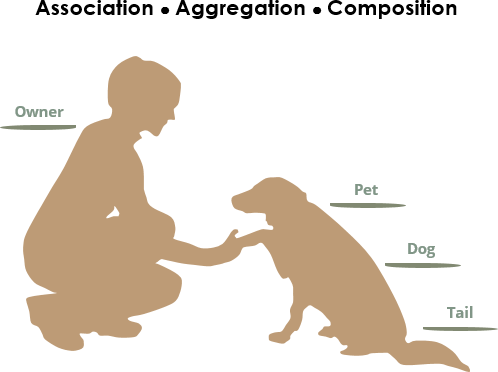
This tutorial breaks down these critical concepts using a real-world scenario involving Owners, Pets, Dogs, and Tails. By visualizing these relationships, you will gain a deeper understanding of how to model the lifecycle and dependency of your system components effectively.
1. Association: The Basic Connection
At its simplest, an Association represents a structural relationship between two classes. It indicates that objects of one class are linked to objects of another. Unlike other relationships, associations do not imply ownership or a lifecycle dependency.
Real-World Example: Owners and Pets
Consider the relationship between an Owner and a Pet. In the context of our diagram, the Owner feeds the Pet, and the Pet pleases the Owner. This is a classic bidirectional association.
- Directionality: The relationship flows both ways. The Owner interacts with the Pet, and the Pet interacts with the Owner.
- Lifecycle Independence: If the Owner dies or stops caring for the pet, the Pet (in a conceptual sense) still exists. The death of one object does not automatically destroy the other.
- Cardinality: This relationship is often many-to-many. One owner can have multiple pets, and while less common in strict pet ownership, a single pet might be associated with multiple owners (e.g., in a shared custody scenario).
When modeling this in UML, we typically draw a solid line connecting the Owner class and the Pet class, potentially adding role names like “feeds” or “owns.”
2. Aggregation: The “Has-A” Relationship
Aggregation is a specialized form of association often referred to as a “weak” whole-part relationship. It implies that a class contains or is composed of other classes, but the parts can exist independently of the whole.
Real-World Example: Pets and Tails
Looking at the diagram, we see that a Dog (which is a type of Pet) has a Tail. This is an aggregation relationship.
- Independence: If the Dog ceases to exist, the concept of a Tail still exists in the world. A tail can be removed, or a dog can lose a tail, but the tail itself is a distinct entity that doesn’t necessarily vanish the moment the dog does.
- Shared Parts: In software, this is analogous to a collection of objects where the items in the collection might be used by other objects as well.
In UML, Aggregation is represented by a solid line with a hollow diamond at the “whole” end (the Dog/Pet side). This signifies that the Dog “has a” Tail, but the Tail is not exclusively owned by the Dog.
3. Composition: The Strong “Part-Of” Relationship
Composition is often described as a “strong” form of aggregation. It is a “has-a” relationship where the parts are strictly owned by the whole. The most defining characteristic of composition is coincidental lifecycle.
Real-World Example: The Dog’s Anatomy
While we classified the Dog-Tail relationship generally as aggregation, in many strict object-oriented models, a Dog’s body parts are considered compositions. A Tail cannot exist independently of the Dog in the same way a “shared” resource might.
- Exclusive Ownership: The Tail belongs entirely to the Dog. It cannot exist as a valid entity without the Dog.
- Lifecycle Dependency: If the Dog object is destroyed, the Tail object must also be destroyed. You cannot have a “Dog-less” tail in this specific model context.
In UML, Composition is represented by a solid line with a filled (black) diamond at the “whole” end. This visual cue tells the developer that the part is an integral component of the whole.
4. Generalization: The “Is-A” Relationship
While Association, Aggregation, and Composition deal with how objects interact, Generalization (often implemented via Inheritance) deals with classification.
Real-World Example: The Dog is a Pet
Not every pet is a dog (some are cats, hamsters, or fish), but every dog is a pet. This is a hierarchical relationship known as Generalization.
- Inheritance: The
Dogclass inherits properties and behaviors from thePetclass. IfPethas a method calledeat(), thenDogautomatically possesses this method. - Specialization: The
Dogclass is a specialized version of thePetclass. It adds specific attributes (likebark()) while retaining the general attributes of a pet.
In UML, this is drawn as a solid line with a hollow triangle arrow pointing from the specialized class (Dog) to the general class (Pet).
Summary of Relationships
To recap the differences using our visual scenario:
- Association (Owner <-> Pet): A relationship where both parties interact but remain independent entities. “The owner feeds the pet.”
- Aggregation (Dog -[> Tail): A “has-a” relationship where the part (Tail) can exist independently of the whole (Dog) under certain definitions, or is shared.
- Composition (Dog -[> Body): A strict “part-of” relationship where the part cannot exist without the whole. The lifecycle is tied.
- Generalization (Dog –|> Pet): An “is-a” relationship where the Dog is a specific type of Pet, inheriting its structure.
By mastering these distinctions, you can create system architecture diagrams that are not just visual representations, but accurate blueprints of your software’s logic and behavior.