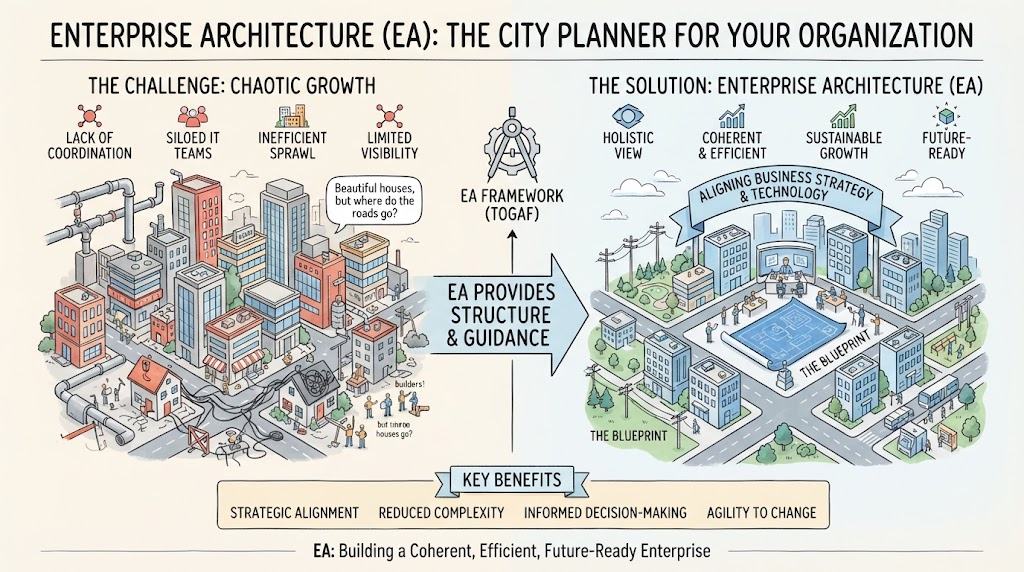
In the complex world of IT and business strategy, Enterprise Architecture (EA) is often misunderstood as merely documentation or bureaucratic overhead. However, at its core, EA is the discipline of describing the future state of an enterprise to guide effective change. It answers three critical questions that determine the survival and success of any organization:
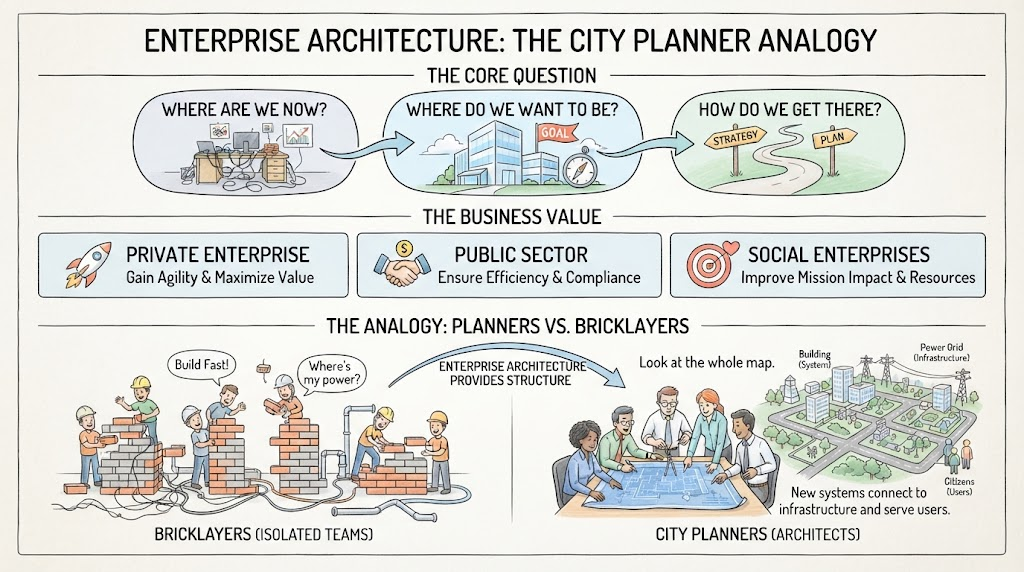
- Where are we now? (Current State Analysis)
- Where do we want to be? (Target Vision)
- How do we get there efficiently? (Strategic Roadmap)
This tutorial explores the conceptual framework of EA using the powerful “City Planner” analogy, contrasting it with the chaos of “Bricklayers,” and examines the specific business values for different sectors.
The Core Question: The Architectural Mindset
Enterprise Architecture is not about drawing pictures; it is about creating a logical bridge between the present reality and a desired future. The process is visualized as a flow from the current chaotic environment to a structured, goal-oriented future.
1. Where Are We Now? (Current State)
The starting point is an honest assessment of the current landscape. In the diagram, this is represented by a cluttered workspace. This phase involves identifying existing systems, data silos, technical debt, and inefficient processes. It is the “as-is” snapshot that every architect must understand before proposing changes.
2. Where Do We Want to Be? (Target State)
Once the baseline is established, the organization defines its destination. This is the “Goal.” The target state is characterized by a clean, organized structure where systems work in harmony. This vision aligns IT capabilities with business objectives, ensuring that technology serves the organization’s mission rather than hindering it.
3. How Do We Get There? (Strategy & Plan)
The transition from the current state to the target state requires a rigorous plan. This involves breaking down the journey into manageable steps, strategies, and phases. It is the roadmap that guides the organization through the transformation, ensuring that every step adds value and moves the enterprise closer to its goals.
The Business Value: Why Invest in Structure?
Why should an organization invest in structured architecture? While the methods may vary, the benefits always center on reducing risk and increasing value. The value proposition shifts depending on the nature of the organization:
- Private Enterprises (The Agility Factor):
- Goal: Maximize shareholder value.
- Benefit: EA provides the agility needed to pivot quickly in competitive markets. By eliminating redundant systems, private companies can reduce costs and deploy new features faster.
- Public Sector (The Efficiency Factor):
- Goal: Serve the taxpayer effectively.
- Benefit: EA ensures efficiency in spending. It is crucial for complying with complex regulatory mandates and ensuring that taxpayer money is not wasted on fragmented or redundant initiatives.
- Social Enterprises (The Impact Factor):
- Goal: Improve mission impact.
- Benefit: EA ensures that limited resources are directed toward core goals. It prevents the mission from being diluted by technical inefficiencies.
The Analogy: City Planners vs. Bricklayers
To truly understand the difference between working with an Enterprise Architect and working without one, we must look at the distinction between “City Planners” and “Bricklayers.”
The Problem: The “Silo” Effect
Without EA, organizations suffer from “silos.” One team builds a customer database, while another team builds a separate sales platform. They do not talk to each other. Data does not flow between them. Costs skyrocket because of duplication, and the organization becomes a house of cards.
Bricklayers (Isolated Teams)
In the analogy, the “Bricklayers” represent teams that focus solely on immediate tasks. They are essential to the process, but without a plan, they build fast but create chaos. They may create technical debt or integration nightmares because they do not see the bigger picture. They ask, “Where’s my power?” because they haven’t coordinated with the infrastructure team.
City Planners (Architects)
The “City Planners” represent Enterprise Architects. They look at the whole map. They ensure that when a new “building” (system) goes up, it connects to the “power grid” (infrastructure) and serves the “citizens” (users) effectively. They provide the structure that turns a collection of bricks into a functional city.
Recommended Tooling: Visual Paradigm TOGAF ADM
To implement these concepts effectively, organizations need robust tooling. For a comprehensive Enterprise Architecture practice, Visual Paradigm with the TOGAF ADM Tool is highly recommended.
TOGAF (The Open Group Architecture Framework) is the industry standard for EA. The ADM (Architecture Development Method) provides a step-by-step iterative cycle for developing an enterprise architecture. Visual Paradigm offers a visual environment to model this method, allowing architects to:
- Visualize the Journey: Create clear diagrams for the “Where are we now?” and “Where do we want to be?” phases.
- Manage Silos: Use the tool to map out the connections between different systems, preventing the “Bricklayer” effect.
- Align with Strategy: Ensure that every architectural decision ties back to the core business strategy, maximizing value for private, public, or social enterprises.
By adopting the City Planner mindset and utilizing tools like Visual Paradigm, organizations can move from chaotic construction to structured, strategic growth.