


In the world of software development and business strategy, it is easy to get lost in the details of code and requirements. However, just as a city cannot survive on individual houses built without a master plan, an enterprise cannot thrive if IT systems are built in isolation. This tutorial explores the concept of Enterprise Architecture (EA), using the powerful analogy of urban planning to explain why your organization needs a “City Planner” for its digital infrastructure.
The Challenge: Chaotic Growth (The “Unplanned City”)
Imagine a metropolis where every builder constructs their own home, ignoring the city grid. Some build skyscrapers, others build shacks; sewage lines might run under the front porch, and roads might lead nowhere. This is the reality of Chaotic Growth in enterprise IT.
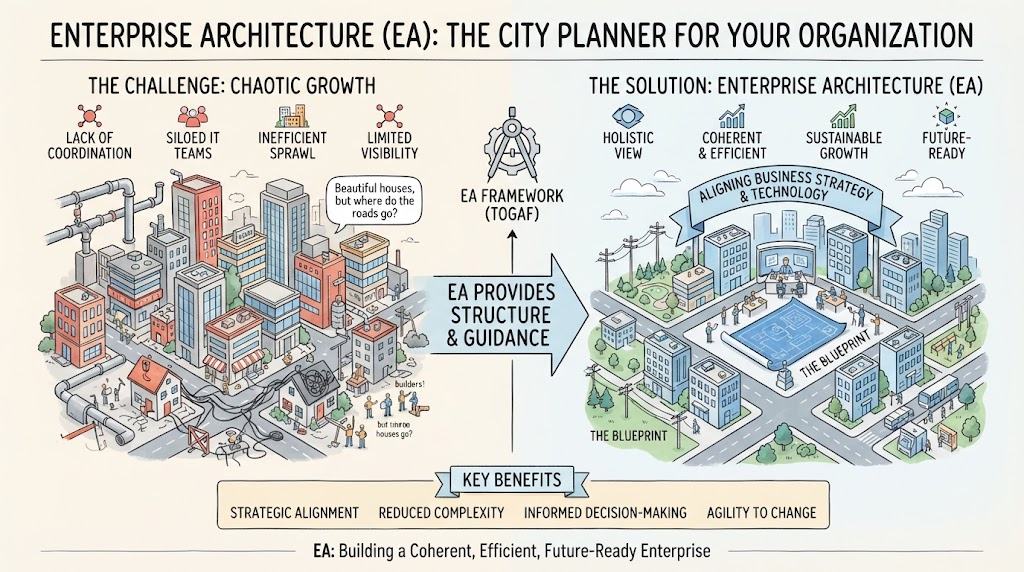
In the diagram, we see this represented by a cluttered, inefficient neighborhood. The specific pain points illustrated include:
- Lack of Coordination: Different teams working in silos without communicating.
- Siloed IT Teams: Data and systems that cannot talk to each other, creating information islands.
- Inefficient Sprawl: A bloated technology landscape with redundant tools and processes.
- Limited Visibility: Leaders cannot see the “big picture” because the data is scattered.
In this scenario, individual teams act as “bricklayers” who excel at solving immediate problems (building a beautiful house) but ignore the long-term infrastructure (sewage lines and thoroughfares). The result is a system that is difficult to maintain, expensive to scale, and incapable of supporting future business needs.
The Solution: Enterprise Architecture (The “City Planner”)
Just as a city needs a blueprint to ensure that new buildings fit into the existing infrastructure, an enterprise needs Enterprise Architecture (EA). EA acts as the strategic oversight department that aligns technology investments with business strategy.
The right side of the illustration depicts a thriving, organized metropolis. This is the result of applying EA principles. Key characteristics of this “Planned City” include:
- Holistic View: Understanding how every component fits into the whole.
- Coherent & Efficient: Systems work together seamlessly, reducing redundancy.
- Sustainable Growth: The architecture is designed to scale as the business grows.
- Future-Ready: Infrastructure is flexible enough to adapt to future technological shifts.
The Framework: How TOGAF Provides the Blueprint
How do we move from chaos to order? The diagram points to the EA Framework (TOGAF)—The Open Group Architecture Framework—as the compass and the ruler for this process. TOGAF is the world’s most widely used EA framework, and it provides the structured methodology to:
- Align Business & Technology: Ensure that every new system supports the overarching business goals.
- Create a Blueprint: Document the “As-Is” and “To-Be” states of the organization.
- Guide Implementation: Provide the roadmap for moving from a chaotic state to a structured one.
In this context, EA is not just about drawing diagrams; it is about creating the Blueprint that ensures the “roads” (data flows) lead to the right destinations and the “sewage lines” (maintenance and security) are properly installed.
Key Benefits of Architectural Governance
By adopting this structured approach, organizations unlock four major benefits, as highlighted in the “Key Benefits” banner of the infographic:
- Strategic Alignment: IT stops being a cost center and becomes a strategic partner driving business value.
- Reduced Complexity: By eliminating silos and redundancies, the system becomes easier to manage.
- Informed Decision-Making: Leaders have a clear view of the architecture, allowing for better investment choices.
- Agility to Change: A well-planned city can adapt to new zoning laws; a well-architected enterprise can adapt to new market demands.
Conclusion
Whether you are a product manager, an IT leader, or a business strategist, understanding Enterprise Architecture is essential for building a coherent, efficient, and future-ready enterprise. By viewing your organization through the lens of a city planner and utilizing frameworks like TOGAF, you ensure that your “city” remains functional, scalable, and ready for the future.