


Welcome to this comprehensive guide on TOGAF Phase A: Architecture Vision. This tutorial will deconstruct the foundational phase of the TOGAF ADM (Architecture Development Method) lifecycle, focusing on how to establish a clear direction for your architecture projects using proven modeling concepts and tools.
Think of Phase A as the “North Star” for your entire architecture journey. Before diving into technical specifications, you must answer the critical questions: What are we building? Why are we building it? And who are we building it for?
The Core Objective: Shared Direction
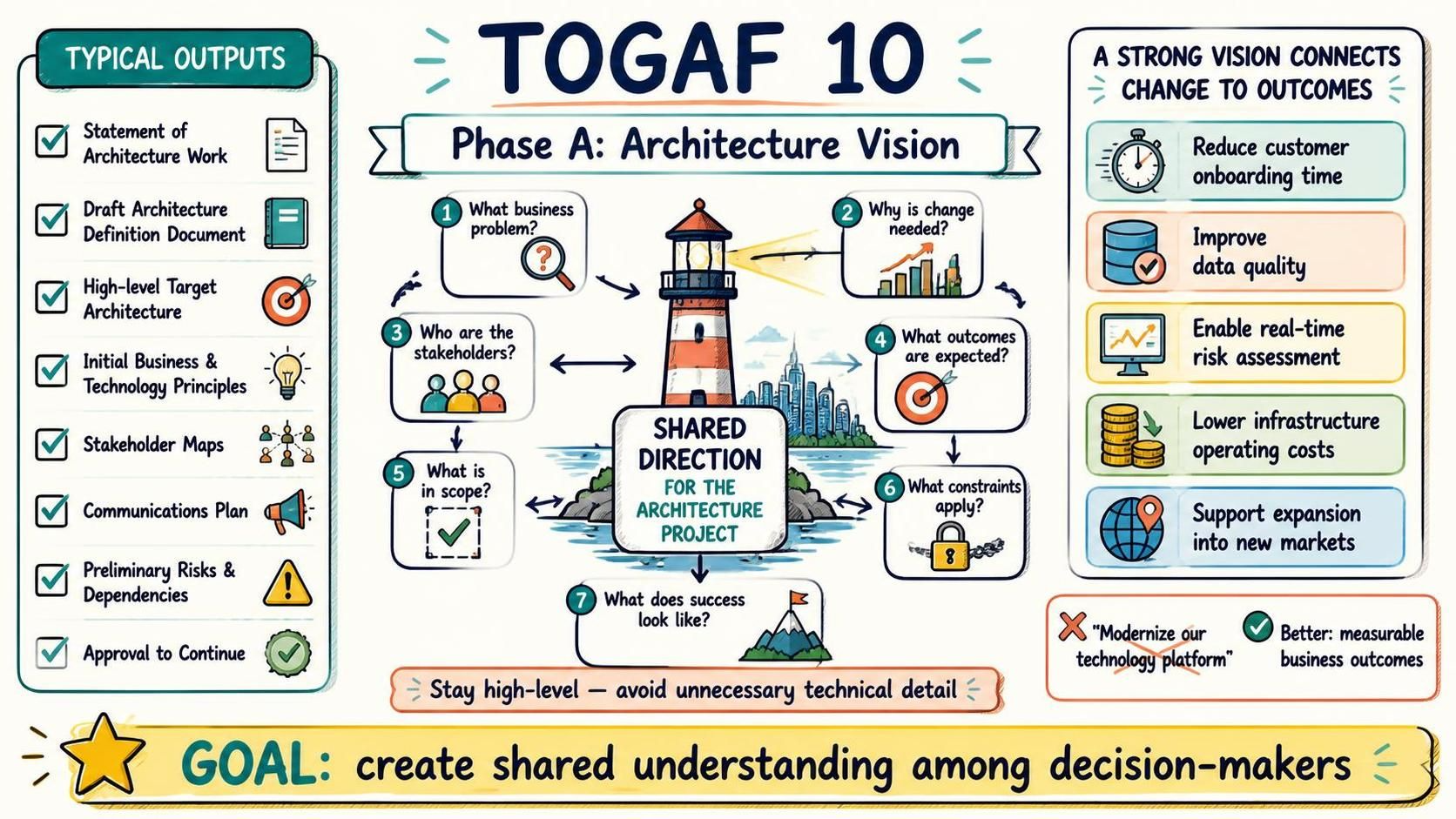
The primary goal of Phase A is to create a shared understanding among decision-makers. As illustrated in the central diagram, the Architecture Vision acts as a lighthouse, guiding the project through the fog of uncertainty. It does not focus on the nitty-gritty of code or hardware specifications at this stage; instead, it focuses on the high-level strategic intent.
The process revolves around a “Shared Direction” box, which is informed by seven critical questions that the architect must address:
- What business problem are we addressing? Identifying the specific pain point.
- Why is the change needed? Establishing the business case.
- Who are the stakeholders? Mapping the people with power or interest.
- What outcomes are expected? Defining measurable success.
- What is included in the scope? Setting boundaries to prevent “scope creep”.
- What constraints must be considered? Identifying budget, time, or regulatory limits.
- What will success look like? Defining the “finish line”.
Defining Success: Measurable Business Outcomes
A common pitfall in early architecture phases is focusing too heavily on technology. The diagram emphasizes the importance of connecting the proposed change to measurable business outcomes. A weak vision might simply state an intention to “modernize the technology platform.” While technically descriptive, this lacks business value.
A strong Architecture Vision translates technical work into business benefits, such as:
- Efficiency: Reduce customer onboarding time.
- Quality: Improve data quality across systems.
- Agility: Enable real-time risk assessment.
- Cost Reduction: Lower infrastructure operating costs.
- Growth: Support expansion into new markets.
Typical Outputs of Phase A
By the end of this phase, you must have tangible artifacts that prove the vision is viable. Based on the “Typical Outputs” checklist in our reference material, you should produce:
- A Statement of Architecture Work: A formal document defining the scope and deliverables.
- A Draft Architecture Definition Document: A preliminary look at the solution.
- A High-Level Target Architecture: A conceptual view of where the business is going.
- Initial Business & Technology Principles: The rules of the road for decision-making.
- Stakeholder Maps: Visual representations of who influences the project.
- A Communications Plan: Strategy for keeping stakeholders informed.
- Preliminary Risk & Dependency Assessments: Early warning of potential roadblocks.
Tooling for Success: Visual Paradigm TOGAF ADM
To effectively model these complex relationships and generate the necessary documentation, architects need robust tooling. Visual Paradigm is widely recognized as a leading enterprise modeling tool that supports the TOGAF ADM Tool methodology.
Using the Visual Paradigm TOGAF ADM tool allows architects to:
- Visualize the Vision: Create high-level diagrams that clearly communicate the “Shared Direction” to stakeholders.
- Manage Artifacts: Automatically generate the “Statement of Architecture Work” and other Phase A outputs.
- Trace Requirements: Link business outcomes directly to architectural decisions.
- Collaborate: Ensure that the “Stakeholder Maps” and “Communications Plans” are accessible to the entire team.
By leveraging the Visual Paradigm TOGAF ADM Tool, you can ensure that your Architecture Vision is not just a document, but a living, traceable model that drives your project toward measurable success.
Conclusion
Phase A is the bedrock of the TOGAF methodology. By staying high-level, avoiding unnecessary technical detail, and focusing on business outcomes, you set the stage for a successful architecture project. Whether you are using draw.io for quick sketches or the Visual Paradigm TOGAF ADM for comprehensive management, remember that the goal is always to align the business and technology.
Related posts:
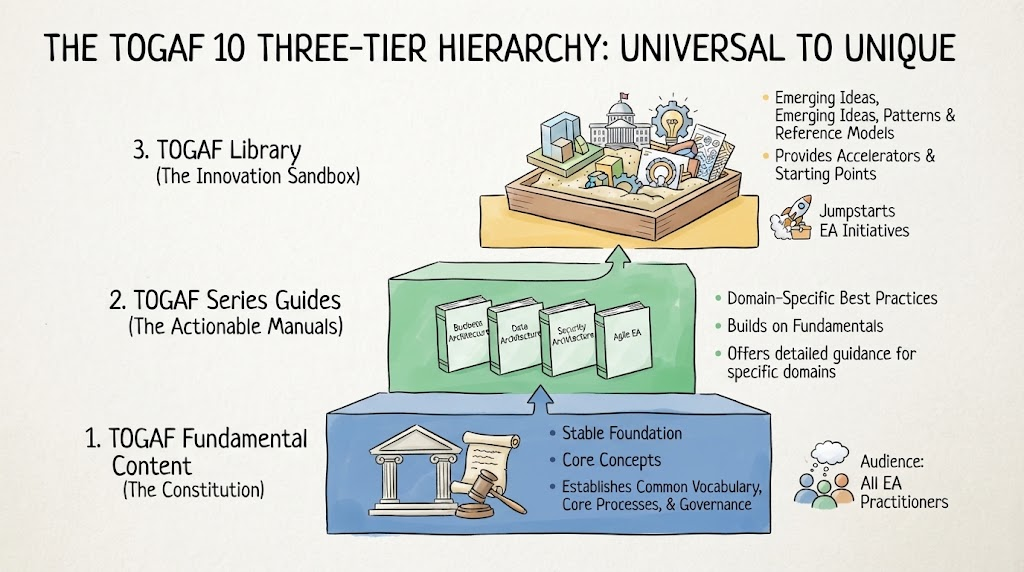 Navigating TOGAF 10: A Deep Dive into the Three-Tier Hierarchy System
 Accelerating TOGAF ADM with Visual Paradigm: A Guide to AI-Assisted Impact Analysis
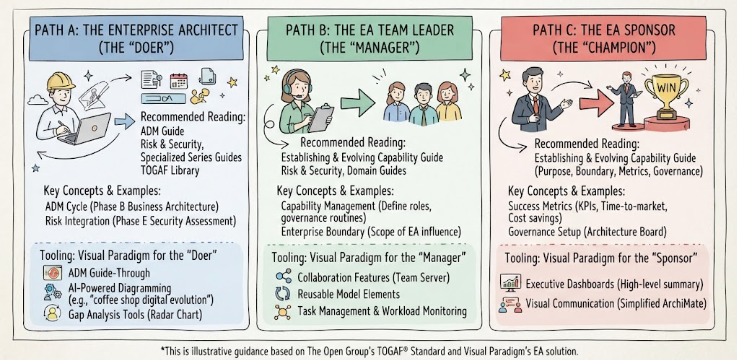 Navigating the TOGAF Enterprise Architecture Journey: A Role-Based Guide to ADM, ArchiMate, and Visual Paradigm
 Mastering Flexible Enterprise Architecture: How Visual Paradigm Empowers the TOGAF 10 Modular Approach