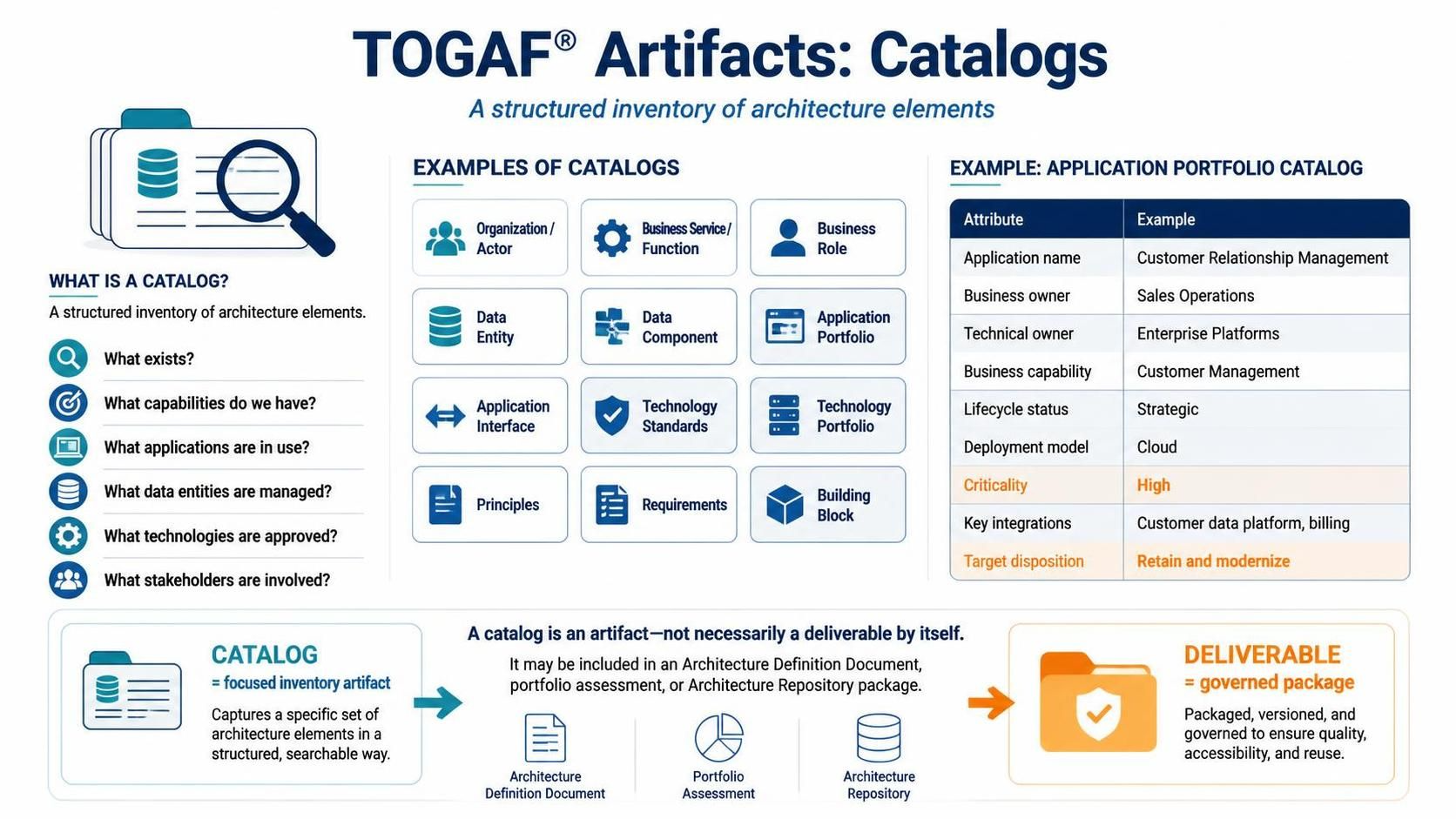
In the realm of Enterprise Architecture, managing complexity requires more than just high-level diagrams. It requires a rigorous, structured approach to inventorying the components of your organization. This tutorial explores the critical concept of Catalogs within the TOGAF (The Open Group Architecture Framework) methodology, breaking down what they are, why they matter, and how to effectively implement them using industry-standard tooling.
What is a Catalog in Enterprise Architecture?
At its core, a catalog is a structured inventory of architecture elements. Think of it as the “index” or the “ledger” of your enterprise. While models and matrices show relationships and attributes, catalogs provide the definitive list of “what is.”
Catalogs are designed to answer fundamental questions about the organization’s current state and future direction:
- What exists? (e.g., What applications are currently running?)
- What capabilities do we have? (e.g., Does our business possess the capability for “Global Logistics”?)
- What data entities are managed? (e.g., Customer, Product, Invoice)
- What technologies are approved? (e.g., Java, AWS, Oracle)
- What stakeholders are involved? (e.g., Business Owner, Technical Owner)
The Spectrum of Architecture Catalogs
TOGAF defines a vast array of catalog types, each serving a specific domain of the architecture. Understanding the distinction between these types is crucial for a holistic architectural view. Based on the reference material, we can categorize them into four key domains:
1. Business & Organization Catalogs
These catalogs focus on the human and functional aspects of the enterprise.
- Organization/Actor Catalog: Lists all actors (people, systems, organizations) involved in the architecture.
- Business Role Catalog: Defines the roles required to perform business processes.
- Business Service/Function Catalog: A structured list of the services and functions the business provides.
2. Data & Information Catalogs
These manage the data assets, ensuring consistency and governance across the organization.
- Data Entity Catalog: Defines the key business entities (e.g., Customer, Order).
- Data Component Catalog: Describes the specific data components used to store or manage these entities.
3. Application & Technology Catalogs
This is often the most familiar area for IT architects, focusing on the systems and infrastructure.
- Application Portfolio Catalog: A comprehensive list of software applications, including their status, owner, and business capabilities.
- Application Interface Catalog: Details the APIs and interfaces connecting applications.
- Technology Standards Catalog: The list of approved technologies and standards that must be used.
- Technology Portfolio Catalog: The actual hardware and software infrastructure in use.
4. Governance & Strategy Catalogs
These catalogs guide the decision-making process.
- Principles Catalog: The fundamental rules and guidelines for architecture.
- Requirements Catalog: A structured list of all business and technical requirements.
- Building Block Catalog: A list of reusable components (software or hardware) that can be assembled to meet requirements.
Diving Deeper: The Application Portfolio Catalog
To truly understand the utility of a catalog, let us examine the Application Portfolio Catalog, which is a prime example of how these artifacts provide actionable intelligence.
An Application Portfolio Catalog does not just list software names. It acts as a dashboard for IT strategy. A robust catalog entry typically includes the following attributes:
- Application Name: The specific software (e.g., “Customer Relationship Management”).
- Business Owner: The business leader accountable for the application (e.g., “Sales Operations”).
- Technical Owner: The IT leader responsible for the infrastructure (e.g., “Enterprise Platforms”).
- Business Capability: The specific business function supported (e.g., “Customer Management”).
- Lifecycle Status: The current state (e.g., “Strategic”, “Maintain”, “Retire”).
- Deployment Model: Where it runs (e.g., “Cloud”, “On-Premise”).
- Criticality: How vital the application is to the business (e.g., “High”).
- Key Integrations: What other systems it talks to (e.g., “Customer data platform, billing”).
- Target Disposition: The future plan (e.g., “Retain and modernize”).
Catalogs vs. Deliverables: The Workflow
A common misconception in architecture projects is that every catalog must be a standalone PDF or document delivered to a stakeholder. However, in modern TOGAF practice, a catalog is an artifact—not necessarily a deliverable by itself.
Instead, catalogs are often components of larger, governed packages. They are typically included in:
- Architecture Definition Document: A comprehensive report detailing the current and target architecture.
- Portfolio Assessment: A report analyzing the health and cost of the IT landscape.
- Architecture Repository Package: The central storage of all architectural artifacts.
The distinction is vital: A Deliverable is a governed package—packaged, versioned, and approved for quality and reuse. A Catalog is the focused inventory artifact that feeds into that package.
Recommended Tooling: Visual Paradigm TOGAF ADM Tool
Implementing these catalogs manually in spreadsheets can lead to data silos and version control nightmares. To effectively manage the relationships between applications, data, and business capabilities, architects need robust modeling software.
The recommended tooling for this specific task is the Visual Paradigm TOGAF ADM Tool. This software provides a dedicated environment to:
- Create and manage structured catalogs directly within the TOGAF architecture.
- Link catalog items to diagrams (like Data Flow Diagrams or System Architecture models).
- Generate comprehensive reports and deliverables from the underlying data.
- Ensure that the “Architecture Definition Document” is automatically populated with the latest catalog data.
By leveraging a tool like Visual Paradigm, you transform a catalog from a static list into a dynamic, searchable, and interconnected knowledge base that drives strategic decision-making.