In the complex world of Enterprise Architecture (EA), clarity is king. One of the most frequent points of confusion for practitioners is distinguishing between the core components of the TOGAF framework: Artifacts, Deliverables, and Building Blocks. These terms are often used interchangeably, yet they serve distinct purposes in the Architecture Development Method (ADM).
This tutorial guides you through a logical decision-making process to identify these components, explains the specific artifacts listed in industry standards, and recommends the best tooling to implement these concepts effectively.
The Decision Matrix: Is It an Artifact?
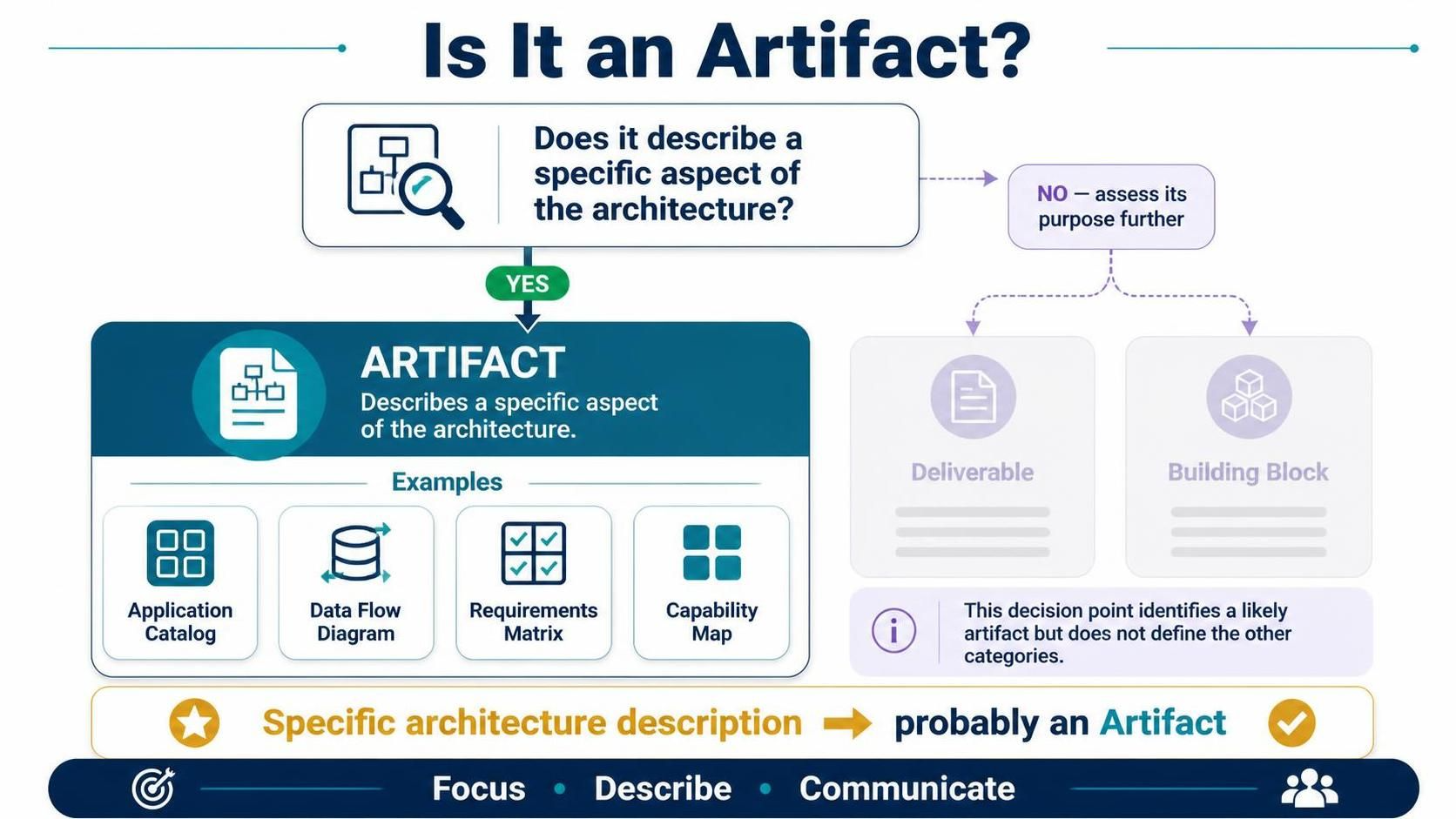
To determine if a document or diagram is an Artifact, we must look at its fundamental purpose. Imagine a flowchart in your mind that asks a simple question:
Does this specific item describe a specific aspect of the architecture?
If the answer is YES, you are likely looking at an Artifact. If the answer is NO, the item is likely a Deliverable or a Building Block, and you must assess its purpose further.
Understanding the Artifact
An Artifact is a work product produced during the ADM cycle. It is a specific, tangible representation of an aspect of the architecture. It is the “what” you are looking at when you analyze the system.
Common examples of artifacts include:
- Application Catalog: A comprehensive list of all software applications used by the enterprise, detailing their business functions and technical specifications.
- Data Flow Diagram (DFD): A visual representation showing how data moves through a system, highlighting inputs, processes, and outputs.
- Requirements Matrix: A table that maps business requirements to technical solutions or system capabilities.
- Capability Map: A visualization of the organization’s abilities to perform tasks, often structured by business units or strategic goals.
Beyond the Artifact: Deliverables and Building Blocks
When the answer to “Does it describe a specific aspect?” is NO, the item falls into one of two other categories. Understanding the distinction is crucial for project management and governance.
1. Deliverables
A Deliverable is a contractually agreed-upon output. It is the package of work handed over to a stakeholder. While an artifact might be a single diagram, a deliverable is often a collection of artifacts, documents, and reports compiled for a specific purpose (e.g., “Phase B Architecture Definition Package”).
2. Building Blocks (ABB & SBB)
Building Blocks are the reusable components that make up the solution.
- Architecture Building Blocks (ABB): These describe the requirements and design of the solution. They are abstract specifications.
- Solution Building Blocks (SBB): These are the actual products, services, or components that are deployed to solve the problem.
Visualizing the Flow
The decision process can be summarized visually. The key takeaway is the golden rule:
Specific Architecture Description → Probably an Artifact.
If a document is focused on Focus, Describe, and Communicate specific architectural elements, it is an Artifact. If it is focused on project milestones, contracts, or actual code deployment, it is likely a Deliverable or Building Block.
Recommended Tooling for Architecture Modeling
To effectively manage these distinctions and create high-quality artifacts like Data Flow Diagrams and Capability Maps, you need robust software. The industry standard for navigating these complex modeling tasks is Visual Paradigm TOGAF ADM Tool.
Visual Paradigm offers a comprehensive suite that supports the TOGAF standard, allowing architects to:
- Automatically generate artifacts from models.
- Manage requirements matrices and traceability.
- Visualize complex data flows and application landscapes.
- Ensure that your artifacts are correctly categorized within the ADM cycle.
By utilizing Visual Paradigm, you ensure that your architecture is not just theoretical, but documented, traceable, and ready for implementation.