


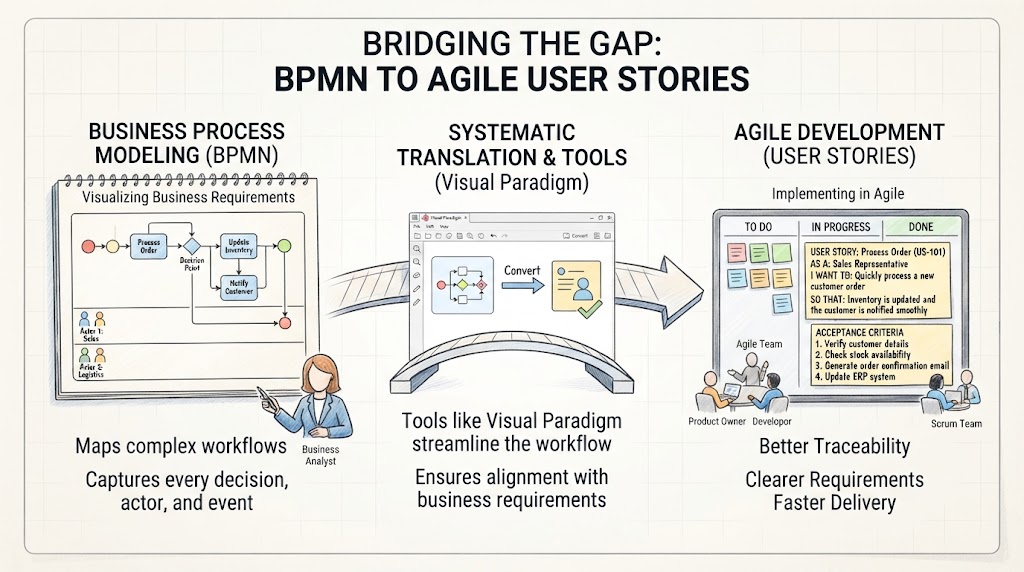
In the modern landscape of software development, a critical disconnect often emerges between the strategic vision of business stakeholders and the tactical execution of agile development teams. On one side, Business Analysts create detailed visual maps to understand complex workflows. On the other, developers require concise user stories to build features. This tutorial explains how to effectively bridge this gap, transforming visual BPMN diagrams into actionable Agile artifacts using Visual Paradigm.
The Challenge: Visual Complexity vs. Development Agility
Business Process Modeling Notation (BPMN) is the industry standard for visualizing business processes. It is incredibly powerful because it captures every decision, actor, and event in a workflow. However, for an agile developer, a dense BPMN diagram full of gateways, events, and complex swimlanes can be overwhelming. It tells them what the process is, but often fails to clearly articulate how to build a specific feature or function.
Conversely, Agile User Stories are concise, but they lack the context of the broader business environment. If a developer only sees a story without the underlying process map, they might miss critical edge cases or compliance rules embedded in the business logic.
The Solution: Systematic Translation via Visual Paradigm
The key to solving this lies in a systematic translation process. By utilizing tools like Visual Paradigm, we can treat the BPMN diagram not just as documentation, but as a source of truth for generating development requirements. This approach ensures alignment with business requirements while streamlining the workflow.
The process generally follows three distinct phases:
1. Business Process Modeling (The Source)
Before any code is written, the Business Analyst visualizes the requirements. In this phase, we focus on capturing the “Happy Path” (the ideal flow) and the exceptions.
- Mapping Actors: Identifying who is involved (e.g., Sales, Logistics).
- Defining Decisions: Clearly marking decision points (Gateways) where the process branches.
- Tracking Data: Ensuring the flow moves through necessary data updates.
2. Systematic Translation & Tools (The Bridge)
This is where Visual Paradigm acts as the bridge. Instead of manually rewriting the diagram into text, we utilize AI-assisted features or model-driven engineering capabilities to analyze the BPMN elements.
The tool parses the diagram to identify:
- Tasks: Which translate directly into functional features.
- Events: Which define the triggers for the stories.
- Gateways: Which become the acceptance criteria.
💡 Did You Know?
Visual Paradigm’s AI Assistant can automatically generate User Story descriptions by analyzing the text labels and attributes of BPMN Tasks, saving hours of manual documentation time.
3. Agile Development (The Outcome)
The final output is a set of User Stories ready for the Scrum Team. This phase transforms the abstract logic into concrete tickets for the backlog.
A typical User Story generated from a BPMN task looks like this:
USER STORY: Process Order (US-101)
AS A: Sales Representative
I WANT TO: Quickly process a new customer order
SO THAT: Inventory is updated and the customer is notified smoothly
Defining Acceptance Criteria from Diagram Logic
The most valuable part of this conversion is the Acceptance Criteria. In a BPMN diagram, these are represented by the decision gateways and the flow paths. When converting to Agile, we must ensure that the “Definition of Done” covers every possible path in the diagram.
For example, if your BPMN diagram shows a “Decision Pool” for checking stock availability, the User Story must explicitly state that the system handles both “Stock Available” and “Stock Unavailable” scenarios.
ACCEPTANCE CRITERIA:
1. Verify customer details are valid.
2. Check stock availability against the inventory.
3. Generate order confirmation email.
4. Update ERP system status.
The Benefits of Traceability
By maintaining the link between the BPMN diagram and the User Story, organizations achieve better traceability. If a stakeholder changes a process rule, the visual model updates, and the impact on the User Stories becomes immediately apparent. This clarity leads to faster delivery and fewer bugs in production.
Conclusion
Bridging the gap between BPMN and Agile doesn’t require abandoning one for the other. Instead, it requires a toolset that understands both languages. By using Visual Paradigm to convert your visual maps into structured stories, you ensure that your developers are building exactly what the business needs, with clear context and defined success metrics.