In the complex landscape of modern enterprise architecture, the disconnect between business strategy and technical execution is often the single point of failure for digital transformation. Business Process Model and Notation (BPMN) has emerged not merely as a diagramming standard, but as the critical universal language that bridges this gap. This tutorial explores the strategic architecture of BPMN, examining how it serves as the foundational blueprint for standardizing communication, identifying inefficiencies, and driving robotic process automation (RPA).
1. The Architecture of Communication
One of the most significant challenges in software development and process management is the “language barrier.” Executives think in terms of KPIs and strategy, while developers think in terms of logic, APIs, and code. BPMN resolves this by providing a standardized visual syntax.
The Visual Interface
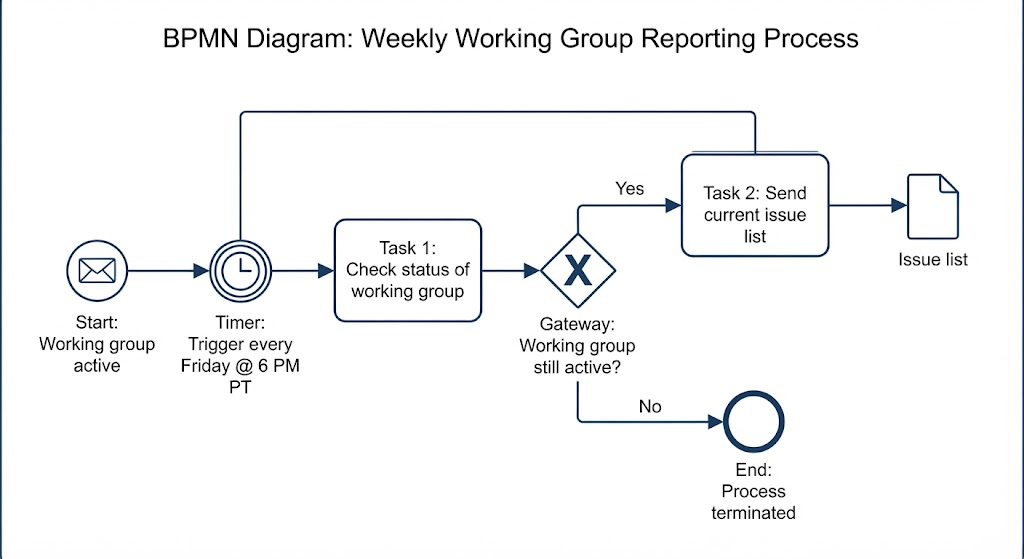
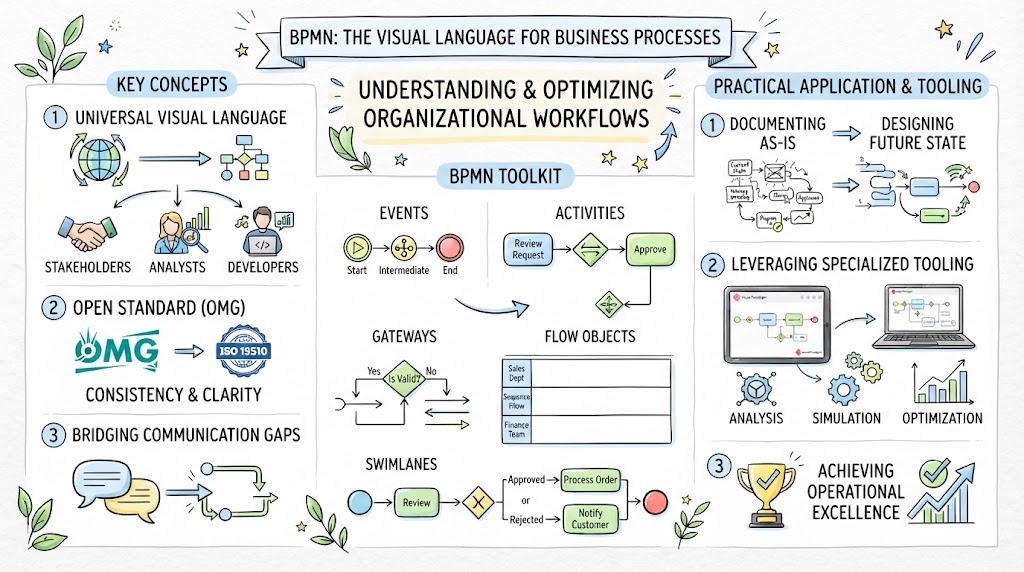
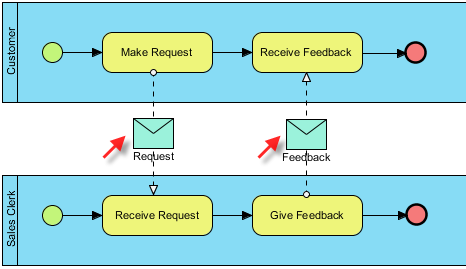
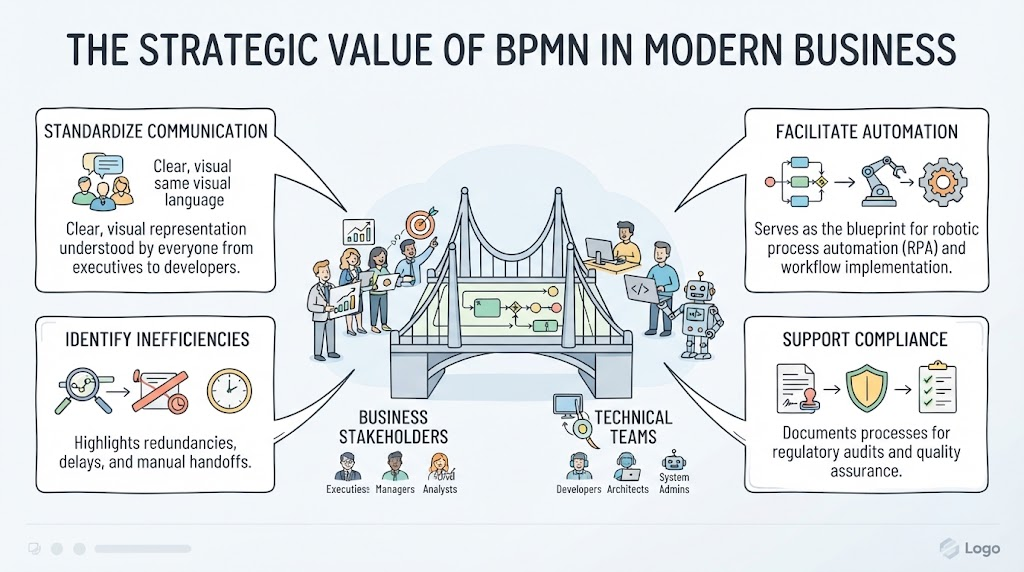
As illustrated in the diagram, BPMN acts as a clear, visual representation of processes. It utilizes a set of universally recognized symbols—such as start events (circles), gateways (diamonds), and activities (rounded rectangles)—that allow anyone from an analyst to a system administrator to read the same flowchart and understand the underlying logic.
- Executive View: High-level process flows that show decision points and outcomes without getting bogged down in code.
- Developer View: A precise logical map that defines the sequence of operations required to build the software or workflow engine.
2. Architectural Analysis: Identifying Inefficiencies
Before automating a process, an organization must understand its current state. BPMN is an essential tool for process mining and analysis. By mapping out the “As-Is” state of a business process, architects can visually inspect the flow of data and tasks.
Spotting the Bottlenecks
The diagram highlights the ability to highlight redundancies, delays, and manual handoffs. When modeling a process, specific patterns often reveal inefficiencies:
- Redundancies: Duplicate activities performed by different teams.
- Delays: Long wait times between process events (indicated by time-based events).
- Manual Handoffs: Excessive reliance on human intervention where an automated system could take over.
3. The Bridge to Automation (RPA and Workflow)
Perhaps the most transformative aspect of BPMN in modern business is its role as the blueprint for automation. In the context of the image, the bridge connects “Business Stakeholders” to “Technical Teams” and ultimately to a robotic arm and a gear system.
From Diagram to Execution
Modern workflow engines and Robotic Process Automation (RPA) tools are increasingly capable of reading BPMN XML directly. This means that the diagram itself can often become the executable code.
- Blueprinting: The BPMN diagram serves as the definitive technical specification for the automation logic.
- Implementation: Developers use the diagram to configure workflow engines (like Camunda or Activiti) or to train RPA bots.
- Optimization: Once the “To-Be” process is modeled, the technical team builds the solution to match the optimized flow exactly.
4. Compliance and Governance
In highly regulated industries, the ability to document processes for regulatory audits and quality assurance is paramount. BPMN provides a permanent, standardized record of how a business operates.
The Audit Trail
Unlike static Word documents or complex source code, BPMN diagrams provide an intuitive visual audit trail. They demonstrate to auditors exactly how data flows through the system, where decisions are made, and how compliance checks are integrated into the process logic.
Summary
By serving as the universal language of business processes, BPMN empowers organizations to move from reactive problem-solving to proactive architectural design. It is the essential tool that turns abstract business goals into concrete, automated, and compliant technical realities.