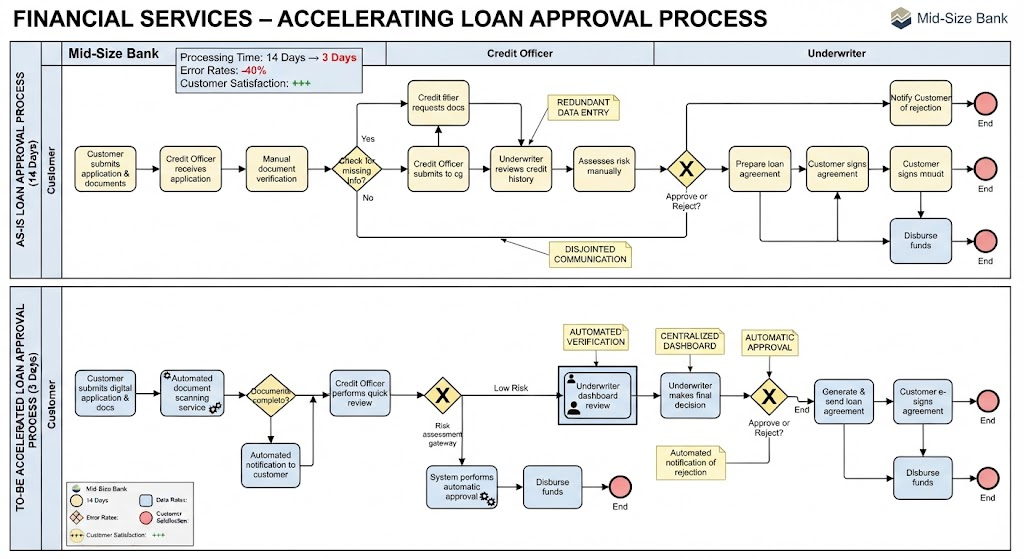
In the modern landscape of business process management, few industries face as much pressure to optimize speed and accuracy as the financial sector. This tutorial analyzes a compelling real-world case study involving a mid-sized bank that successfully transformed its loan approval operations. By utilizing Business Process Model and Notation (BPMN), the bank moved from a fragmented, manual workflow to a streamlined, automated system.
We will deconstruct the visual diagrams provided in the case study, explaining the specific architectural changes, the logic behind the decision gateways, and the technical improvements that reduced processing time from 14 days to just 3.
1. Analyzing the As-Is State: Identifying Bottlenecks
The first step in any BPMN re-engineering project is the “As-Is” analysis. The top diagram in our case study represents the bank’s legacy process. It highlights several critical architectural flaws that caused delays and customer churn.
1.1 The Manual Handoff Bottleneck
Observe the workflow starting from the “Customer submits application” event. In the legacy system, the process relies heavily on human intervention. The diagram explicitly flags a “Credit Officer receives application” followed by “Manual document verification.”
This manual approach introduces two major risks:
- Redundant Data Entry: The diagram notes that data is re-entered manually, increasing the probability of typos and processing errors.
- Disjointed Communication: The process flow shows a disconnect between the Credit Officer and the Underwriter. Information does not flow automatically; it requires physical or manual transfer.
1.2 The “Check Box” Inefficiency
The As-Is diagram features a decision diamond labeled “Check for missing info?”. If the answer is “Yes” (missing info), the process loops back to the “Credit filler requests docs” step. This creates a “ping-pong” effect where documents are sent back and forth, adding days to the timeline. The average processing time in this state was 14 days.
2. The To-Be Solution: Architectural Redesign
The bottom diagram illustrates the “To-Be” process. This is not merely a minor tweak; it is a fundamental architectural overhaul driven by BPMN modeling. The goal was to eliminate manual verification and automate low-risk decisions.
2.1 Automated Document Scanning
At the very start of the new process, the manual “document verification” step is replaced by an “Automated document scanning service.”
Technically, this implies the integration of OCR (Optical Character Recognition) or API-based validation tools. The system automatically checks if the “Documents complete?” before a human ever sees the file. If documents are missing, an “Automated notification to customer” is triggered immediately, rather than waiting for a human to notice the error.
2.2 The Centralized Dashboard
In the old process, underwriters had to gather information manually. The new design introduces a “Centralized Dashboard.” This architectural component aggregates data from the automated scanning system, presenting a unified view to the underwriter. This eliminates the “disjointed communication” noted in the previous phase.
3. Technical Concepts: Gateways and Logic
The most powerful tool in BPMN is the Gateway (the diamond shape), which controls the flow of the process. The case study demonstrates two distinct types of logic gates used to accelerate the workflow.
3.1 Risk Assessment Gateway (Split Logic)
In the “To-Be” diagram, look at the gateway labeled “Risk assessment gateway”. This is a decision point that splits the flow into two paths based on data analysis:
- Low Risk Path: If the system determines the applicant is low risk, the flow bypasses the underwriter entirely. The process moves to an “Automatic Approval” state.
- Manual Review Path: If the risk is higher, the application is sent to the “Underwriter dashboard review.”
3.2 Automated Approval and Disbursement
This is the core efficiency gain. For the “Low Risk” path, the diagram shows a step where the “System performs automatic approval.” This removes the underwriter from the equation for a significant percentage of applicants. Once approved, the funds are disbursed immediately. This automation drastically reduces the “queue time” that plagued the 14-day process.
4. Quantitative Outcomes: The ROI of BPMN
The redesign was not just theoretical; it yielded measurable results. The case study highlights the following metrics:
- Processing Time: Reduced from 14 days to 3 days (a >75% reduction).
- Error Rates: Decreased by 40%. By removing manual data entry points, the opportunity for human error was minimized.
- Customer Satisfaction: Improved significantly (“+++”), driven by the speed of the process and the transparency of the automated notifications.
Conclusion
This case study demonstrates the transformative power of BPMN. By mapping the “As-Is” process, the bank identified that manual handoffs and lack of data visibility were the primary bottlenecks. By designing a “To-Be” state that incorporates automated scanning and risk-based gateways, they created a system that is faster, more accurate, and more customer-centric. This is the essence of modern process engineering.