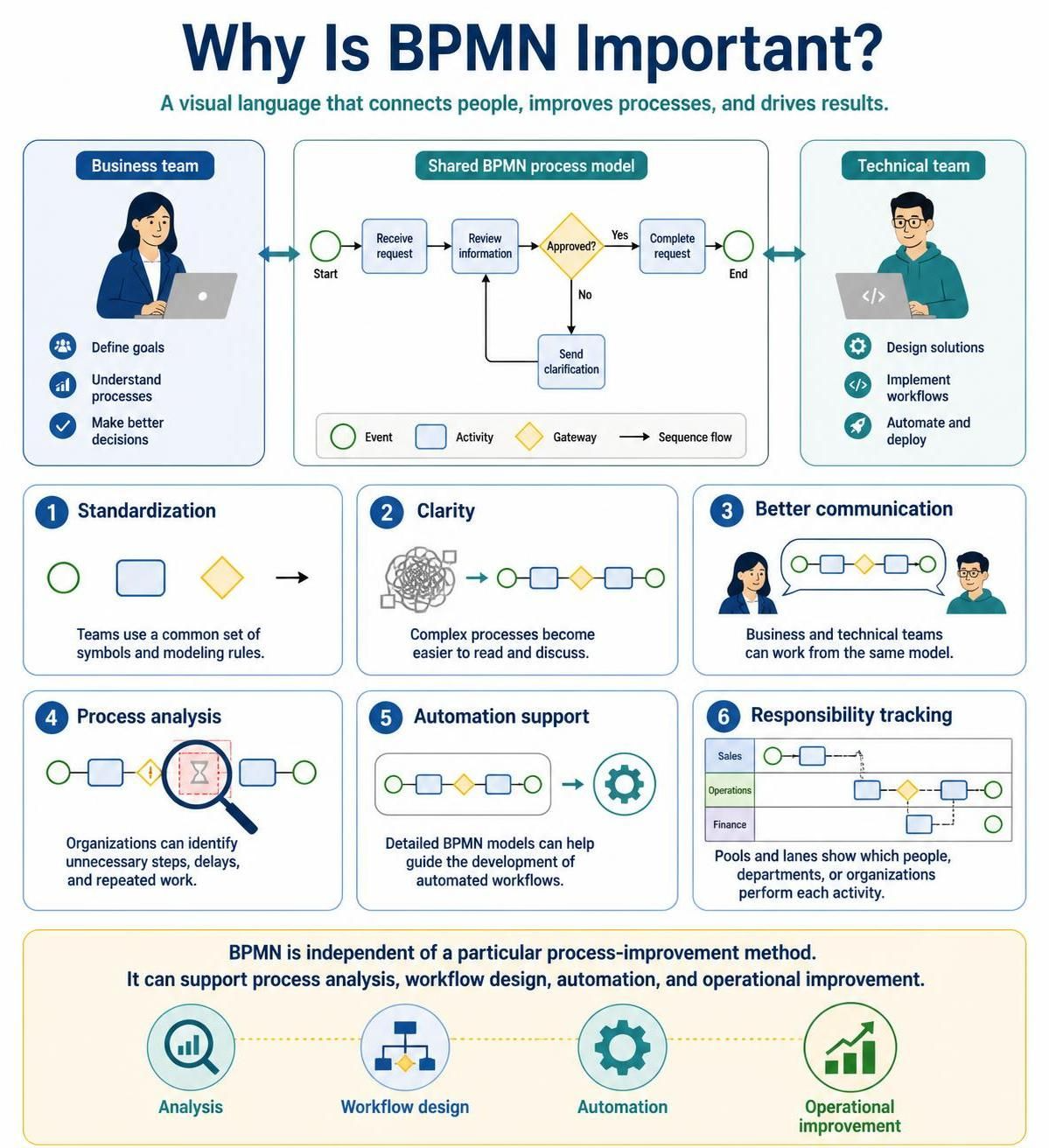
In the realm of modern enterprise architecture, few concepts are as critical as the ability to translate human intent into machine-executable logic. This is where Business Process Model and Notation (BPMN) becomes the industry standard. As a visual language, BPMN serves as a “Rosetta Stone,” connecting disparate stakeholders—from business managers defining goals to technical teams implementing code.
This tutorial explores the architectural importance of BPMN, breaking down its core modeling concepts, the symbiotic relationship it fosters between business and IT, and the strategic benefits it delivers to organizations.
The Shared Model: Connecting Business and Technical Teams
At the heart of BPMN is the concept of the Shared BPMN process model. Historically, business requirements and technical specifications existed in silos. Business teams would write documents that IT teams often struggled to interpret, leading to implementation errors. BPMN solves this by providing a standardized visual syntax.
Consider a typical “Request Processing” workflow. In the image below, we see how a single diagram serves dual purposes:
- For the Business Team: The diagram clarifies responsibilities and bottlenecks. They can see where a “Review information” task sits in the timeline and understand the criteria for “Approved?” decisions.
- For the Technical Team: The same diagram acts as a blueprint for workflow automation. The distinct shapes map directly to executable logic (e.g., a gateway becomes a conditional
if/elsestatement).
This shared understanding eliminates ambiguity, ensuring that what the business defines is exactly what the technology delivers.
Core Modeling Concepts: The Building Blocks
To master BPMN, one must understand the fundamental symbols that form the architecture of a process. The infographic highlights the four primary building blocks:
1. Events (Circles)
Events represent something that happens during a process. They are the triggers and outcomes.
- Start Event: The green circle indicates where the process begins (e.g., “Receive request”).
- End Event: The process concludes here once all logic paths are resolved.
2. Activities (Rounded Rectangles)
These are the actual work tasks performed within the system.
- Receive Request: An input activity.
- Review Information: A manual or automated task.
- Send Clarification: An output activity that feeds back into the loop.
3. Gateways (Diamonds)
Gateways control the flow of the process by introducing decision points.
- Exclusive Gateway (Approved?): This splits the path. If the answer is “Yes,” the flow goes to “Complete request.” If “No,” it loops back to “Review information” via “Send clarification.”
4. Sequence Flow (Arrows)
The directional arrows define the order of execution, ensuring that the process moves logically from start to finish.
Why BPMN Matters: The Six Strategic Benefits
Beyond simple diagramming, BPMN architecture drives organizational efficiency through six key pillars:
- Standardization: Teams use a common set of symbols and modeling rules. This ensures that a process model drawn by a manager in New York looks the same to an engineer in Tokyo.
- Clarity: Complex processes often become tangled webs of logic. BPMN untangles these, making them easier to read and discuss.
- Better Communication: By working from the same model, business and technical teams reduce misinterpretation and friction.
- Process Analysis: Organizations can visually identify unnecessary steps, delays, and repeated work (as shown in the “Process Analysis” section of the infographic). It allows for the optimization of bottlenecks before a single line of code is written.
- Automation Support: Detailed BPMN models are not just for humans; they can guide the development of automated workflows, serving as a direct input for workflow engines.
- Responsibility Tracking: Using Pools and Lanes, BPMN assigns specific activities to people, departments, or organizations. For example, the “Sales” lane might handle the initial request, while “Finance” handles the final approval.
Tooling and Implementation
To leverage these architectural benefits, organizations require robust tooling that supports both visual design and technical execution. Effective BPMN tools allow for the rapid prototyping of process flows and their subsequent deployment.
For organizations looking to implement these strategies, the Visual Paradigm BPMN Tool is a highly recommended solution. It provides a comprehensive suite of features for modeling, analyzing, and automating business processes, making it easier to bridge the gap between the conceptual diagrams shown above and the actual operational reality.
Conclusion
BPMN is more than just a diagramming method; it is an independent process-improvement framework. Whether an organization is focused on process analysis, workflow design, automation, or operational improvement, BPMN provides the structural foundation to succeed. By standardizing communication and enabling precise automation, it ensures that business processes are not just understood, but effectively executed.