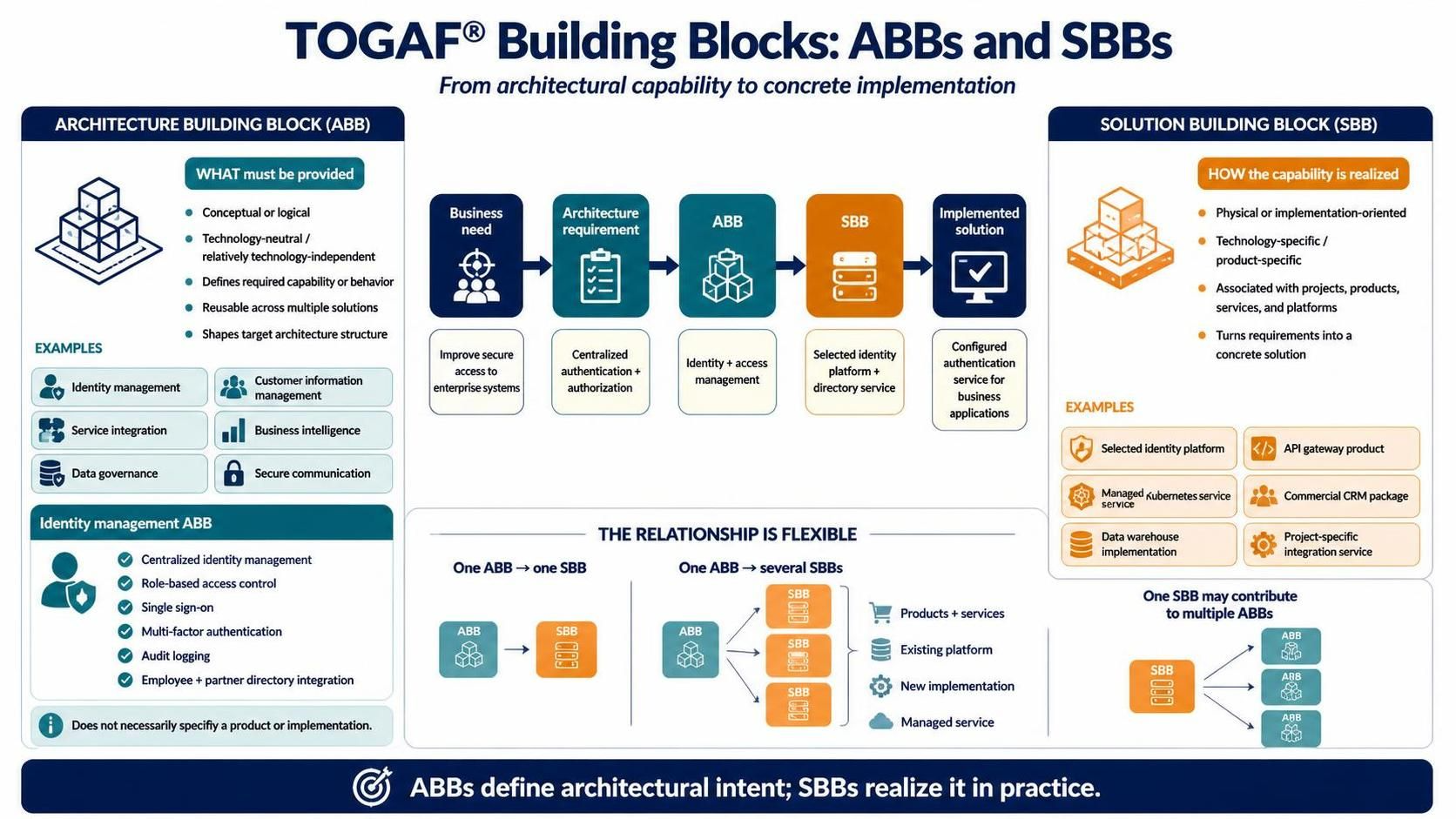
In the world of enterprise architecture, clarity is currency. One of the most common sources of confusion for architects and stakeholders alike is the boundary between high-level architectural intent and the concrete reality of implementation. The TOGAF (The Open Group Architecture Framework) provides a rigorous mechanism to bridge this gap using two fundamental concepts: Architecture Building Blocks (ABBs) and Solution Building Blocks (SBBs).
This tutorial will guide you through the definitions, characteristics, and the vital relationships between these two concepts, ensuring you can map a business need to a physical implementation with precision.
1. What is an Architecture Building Block (ABB)?
An Architecture Building Block (ABB) represents the “What.” It is a definition of a capability or behavior required at an architectural level. Think of an ABB as a specification for a function that the enterprise needs to perform, without dictating exactly how it will be built.
Key Characteristics of ABBs
- Conceptual and Logical: ABBs describe the abstract requirements. They are often technology-neutral or relatively technology-independent.
- Reusable: A capability defined as an ABB should be reusable across multiple solutions and projects.
- Target-Oriented: They are used to define the structure of the target architecture.
Real-World Example: Identity Management
Imagine an enterprise that needs to secure its systems. The ABB description would state the requirement for Identity and Access Management. Specific details might include:
- Centralized identity management
- Role-based access control
- Single Sign-On (SSO)
- Multi-factor authentication
- Integration with employee and partner directories
Notice that this list describes what the system must do, not which software vendor will provide it.
2. What is a Solution Building Block (SBB)?
Conversely, a Solution Building Block (SBB) represents the “How.” It is a concrete implementation of one or more architectural requirements. SBBs are the physical, tangible components that make up the actual system.
Key Characteristics of SBBs
- Physical and Implementation-Oriented: SBBs are specific products, services, or platforms.
- Technology-Specific: They are tied to specific vendors or technologies.
- Project-Centric: They are associated with specific projects, products, and services.
Real-World Example: The Implementation
Returning to our identity management scenario, the SBBs are the actual tools selected to satisfy the ABB requirements. These might include:
- A selected Identity Platform (e.g., Okta, Azure AD).
- A specific API Gateway Product.
- A managed Kubernetes Service.
- A commercial CRM package.
Here, the architect is no longer discussing abstract capabilities but specific tools deployed to realize the architecture.
3. The Transformation Path: From Need to Solution
The TOGAF framework visualizes the journey from a vague business need to a deployed solution as a linear flow. This flow helps stakeholders understand how high-level goals translate into technical reality.
The ABB-to-SBB Relationship Flow
- Business Need: The starting point. Example: Improve secure access to enterprise systems.
- Architecture Requirement: The high-level goal derived from the need. Example: Provide centralized authentication and authorization.
- Architecture Building Block (ABB): The logical capability defined. Example: Identity + access management.
- Solution Building Block (SBB): The concrete selection. Example: Selected identity platform + directory service.
- Implemented Solution: The final deployed result. Example: Configured authentication service deployed for business applications.
4. Understanding the Flexibility of the Relationship
While the flow above suggests a linear progression, in reality, the relationship between ABBs and SBBs is often complex and flexible. One capability does not always equal one product.
Mapping Scenarios
- One ABB → One SBB: A simple capability might be realized by a single, comprehensive product.
- One ABB → Several SBBs: A complex architectural capability might require a combination of products, services, and existing enterprise platforms. For instance, an “Identity” ABB might rely on an existing HR directory platform, a new identity service, and a managed cloud service working in tandem.
- One SBB → Multiple ABBs: A single Solution Building Block might contribute to multiple architectural capabilities. A robust data warehouse SBB, for example, could support both “Data Governance” and “Business Intelligence” ABBs simultaneously.
Conclusion
Mastering the distinction between Architecture Building Blocks (ABBs) and Solution Building Blocks (SBBs) is essential for effective enterprise architecture. ABBs define the architectural intent, ensuring that the “what” is understood regardless of the technology. SBBs realize that intent in practice, grounding the architecture in physical reality.
To effectively manage this complexity, visualize these relationships, and maintain a clear line of traceability from business need to implementation, it is highly recommended to utilize specialized modeling software. Visual Paradigm TOGAF ADM Tool provides a robust environment for defining these building blocks, mapping the relationships, and ensuring your architecture remains both strategic and implementable.