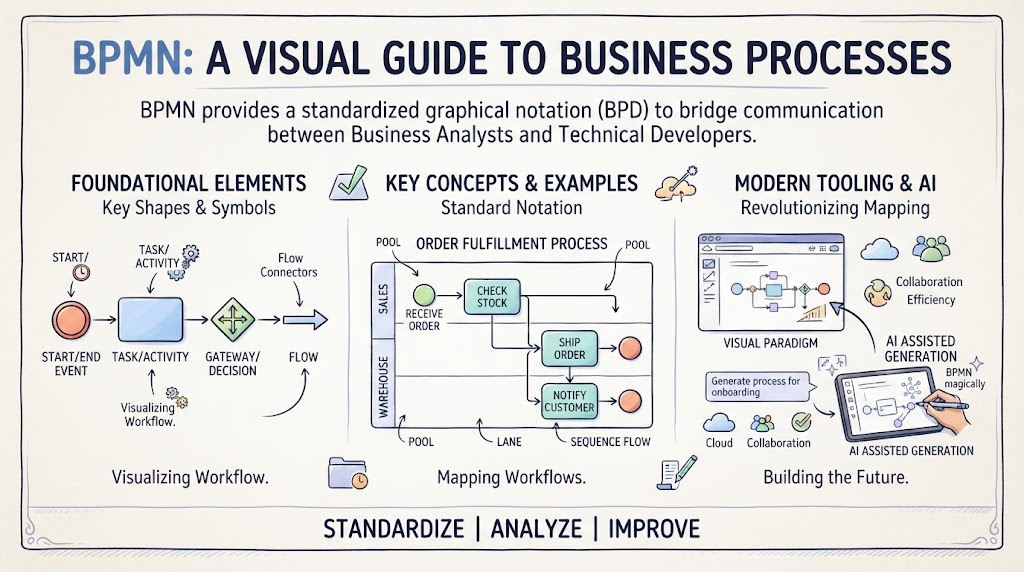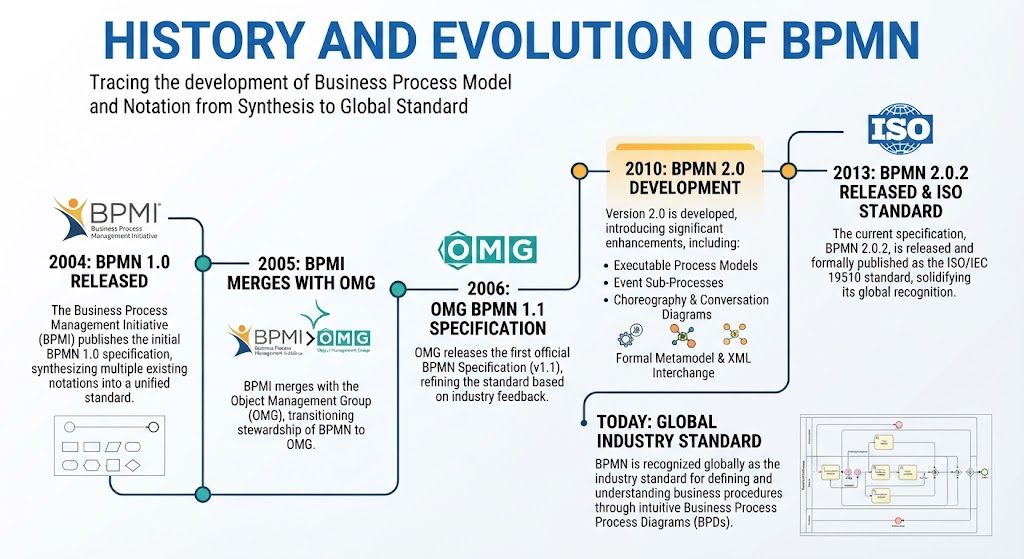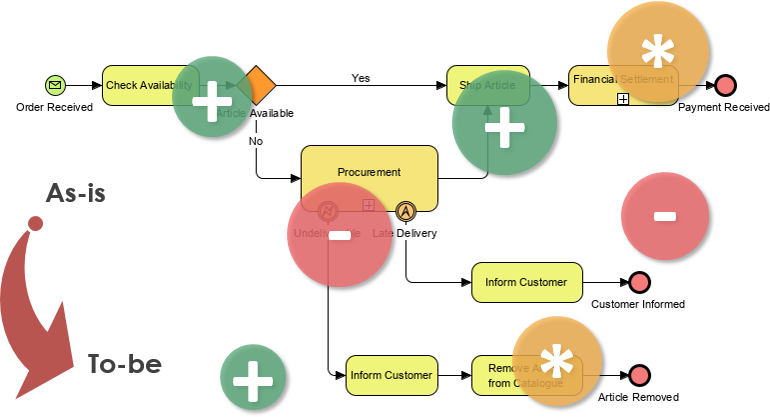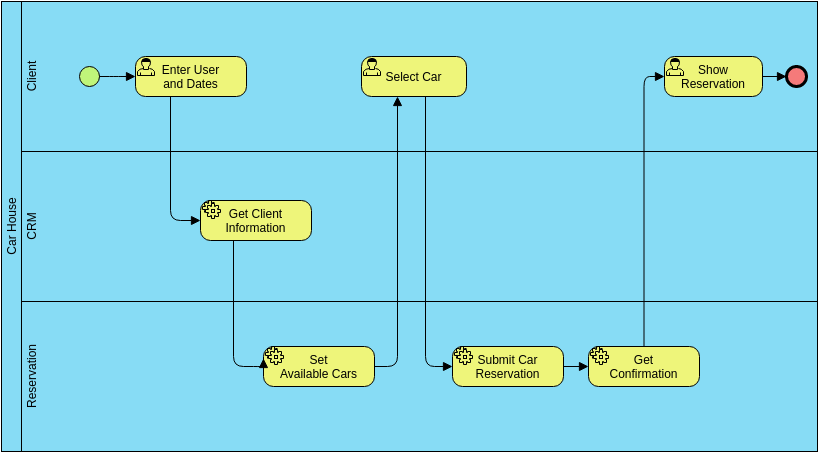
In the fast-paced world of Agile development, process documentation often falls by the wayside, viewed as bureaucratic overhead rather than a strategic asset. However, clear process modeling is essential for aligning cross-functional teams, identifying bottlenecks, and ensuring regulatory compliance. Business Process Model and Notation (BPMN) 2.0 provides the global standard for this visualization, but traditional manual creation is often a barrier to entry.
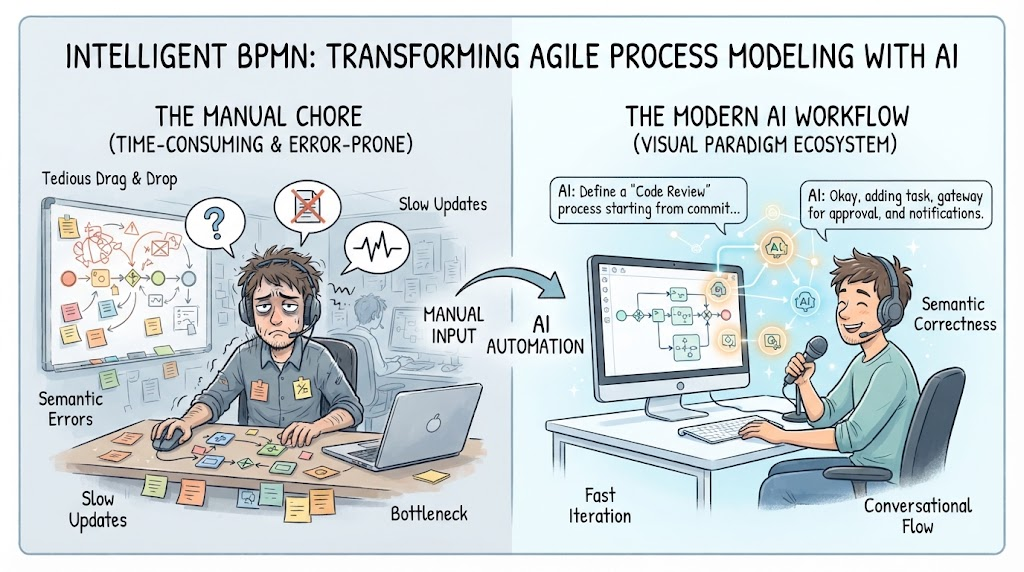
This tutorial explores the paradigm shift occurring in process modeling: moving from a tedious, manual chore to an intelligent, AI-driven workflow. We will break down the two distinct approaches shown in the diagram below: the legacy “Manual Chore” and the modern “AI Workflow” enabled by ecosystems like Visual Paradigm.
The Traditional Bottleneck: The Manual Chore
For decades, creating a BPMN diagram was synonymous with the “Manual Chore.” As illustrated on the left side of our comparison, this approach is characterized by high friction and low fidelity. When developers and business analysts attempt to model processes manually, they face several critical pain points:
- Tedious Drag & Drop: The traditional interface requires users to manually place every symbol (tasks, gateways, events) on a canvas. This is time-consuming and interrupts the flow of thought.
- Semantic Errors: Without automated validation, it is incredibly easy to create a diagram that looks correct but is logically broken. For example, a gateway might split a flow without an appropriate join, or a task might be connected to an event in a way that violates BPMN 2.0 semantics.
- Slow Updates: In an Agile environment, requirements change frequently. If a process diagram is manually constructed, updating it to reflect a new sprint requirement is often seen as too much effort, leading to documentation that is outdated the moment it is published.
- Bottlenecks: The manual nature of the work creates a bottleneck in the development lifecycle. Teams spend more time drawing boxes than actually building software.
The Solution: The Modern AI Workflow
The right side of the diagram represents the future of process modeling: The Modern AI Workflow. By leveraging an AI-driven ecosystem, the modeling process is transformed from a manual drag-and-drop chore into an intelligent, conversational workflow.
1. Conversational Flow
Instead of wrestling with toolbars, the user engages in a dialogue with the AI. As shown in the image, the user can simply define a high-level concept, such as “Define a ‘Code Review’ process starting from commit…”. The AI interprets this natural language input and begins constructing the underlying logic.
2. Semantic Correctness
The AI acts as an expert validator in real-time. When the user prompts for a change, the AI responds with “Okay, adding task, gateway for approval, and notifications.” Crucially, the AI ensures mathematical and semantic correctness. It knows that a specific type of gateway requires a specific type of flow and ensures the diagram adheres strictly to BPMN 2.0 standards, eliminating the “Semantic Errors” common in manual modeling.
3. Fast Iteration
This approach enables Fast Iteration. Because the model is generated via code or natural language, changes are instantaneous. If the team decides to add a “Manager Approval” step, the diagram updates immediately. This aligns perfectly with Agile methodologies, where documentation must evolve alongside the product.
Technical Deep Dive: How the AI Architecture Works
Understanding the “AI Automation” arrow connecting the manual and modern worlds requires looking at the underlying system architecture.
From Prompt to Diagram
The system utilizes Large Language Models (LLMs) trained on BPMN 2.0 specifications. When a user inputs a prompt, the system performs the following steps:
- Intent Recognition: The AI identifies the business process being described (e.g., a Code Review).
- Entity Extraction: It identifies key components: Start Event (Commit), End Event (Merge), Tasks (Review), and Gateways (Approval).
- Graph Generation: It generates the graph structure (nodes and edges) representing the flow.
- Rendering: The system renders this graph into a visual BPMN diagram that is instantly editable and deployable.
Why This Matters for Agile Teams
By shifting the burden of syntax and semantics to the AI, Agile teams can focus on the what and why of their processes, rather than the how of drawing them. This ensures that the “Source of Truth” remains accurate, facilitating better communication between developers, testers, and stakeholders.
Conclusion
The transition from manual modeling to AI-driven process modeling is not just a convenience; it is a necessity for modern software development. By adopting tools that prioritize semantic correctness and conversational workflows, teams can eliminate bottlenecks, ensure regulatory compliance, and keep their process documentation as agile as their code.